
Rates by paint grade
| Grade | ₹ / sq ft of surface | Coats needed | Realistic life indoors |
|---|---|---|---|
| Acrylic distemper | ₹16 | 2 | 2 – 3 years |
| Economy emulsion | ₹23 | 2 | 3 – 4 years |
| Premium emulsion | ₹32 | 2 | 5 – 6 years, wipeable |
| Luxury emulsion, Royale class | ₹43 | 2 | 7 – 8 years, washable |
| Texture and designer finish | ₹170 – 260 | 1 base plus finish | Feature walls only |
| Wall putty, single coat | ₹12 | — | Levels minor marks before painting |
| Wall putty, two coats | ₹20 | — | Required over fresh plaster for a flat finish |
| Primer | Included in the above | 1 | Never skip it over putty or fresh plaster |
Ex-GST. Per square foot of paintable surface area, not floor area. These are the same rates used by the painting cost calculator.
Measuring paintable surface
- Walls: perimeter × height. Measure the perimeter of each room and multiply by the wall height. For a 700 sq ft flat this typically comes to 2,100–2,300 sq ft.
- Ceilings: add the floor area where ceilings are being painted. That is another 700 sq ft in the example, taking the total to roughly 2,900.
- The rule of thumb is 4 to 4.5 times the carpet area for a flat with ceilings included, and 3 to 3.5 times for walls only.
- Deduct openings over 20 sq ft only. Windows and doors below that are conventionally not deducted, because cutting in around them takes as long as painting the area would have.
- Add wardrobe backs, niches and reveals where they are being painted; they are surface too.
- Ask the painter for the measured figure in writing before accepting a lump sum. A quote that does not state the surface area cannot be compared with another quote.
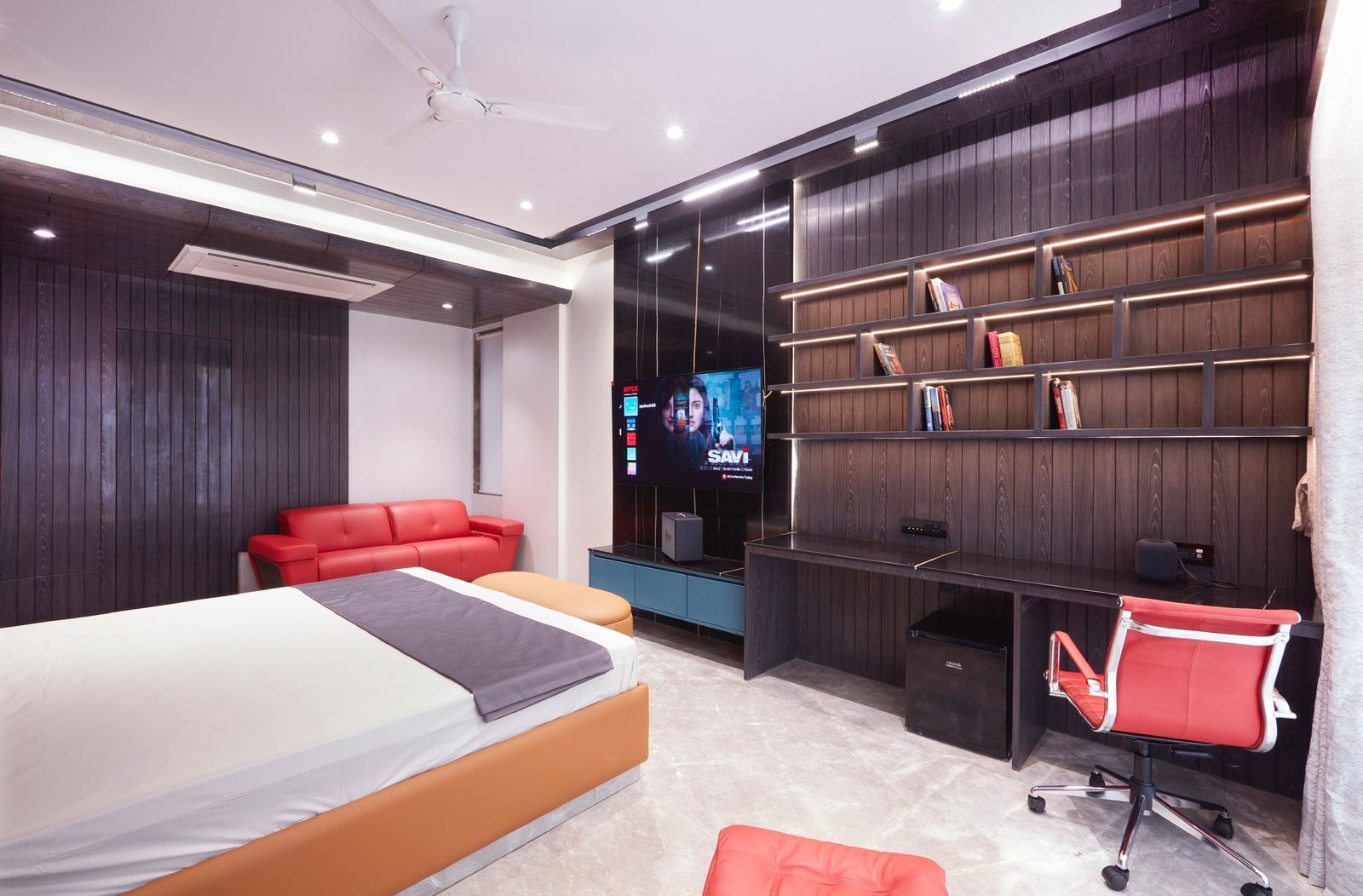
Priced on surface area, not on floor area
Surface condition, which changes everything
| Starting condition | What it needs | Composite ₹ / sq ft | Result |
|---|---|---|---|
| Two-year-old paint, sound film | Light sanding plus two coats | ₹32 | Looks new; no putty needed |
| Five-year-old paint, minor marks | Spot putty, primer, two coats | ₹44 | The usual job on a lived-in flat |
| Chalky old distemper | Scrape back, full putty, primer, two coats | ₹52 | Effectively a fresh wall |
| Peeling with damp patches | Trace the leak, treat, re-plaster, then paint | ₹78+ | Only durable if the source is fixed first |
| Fresh plaster, new flat | Two coats putty, primer, two coats | ₹52 | The best surface you will ever paint |
Composite rate includes preparation, material and labour at premium emulsion grade. Ex-GST.
A worked total: 700 sq ft flat
A two-bedroom flat with ceilings included, premium emulsion, one coat of putty, on sound five-year-old paint.
- Wall area = perimeter of all rooms × 10 ft height = 2,240 sq ft.
- Ceilings = 700 sq ft. Total paintable surface = 2,940 sq ft.
- Composite rate = ₹32 premium emulsion (two coats) + ₹12 single-coat putty = ₹44 per sq ft.
- 2,940 × ₹44 = ₹1,29,360.
- Add 6% for sound existing paint requiring spot repair = ₹1,37,122.
- Ex-GST total: ₹1.29–1.37 lakh. With 18% GST, ₹1.53–1.62 lakh.
Totals by home size
| Home | Paintable surface | Economy | Premium | Luxury |
|---|---|---|---|---|
| 1BHK, 450 sq ft carpet | 1,900 sq ft | ₹51,000 – 62,000 | ₹70,000 – 84,000 | ₹94,000 – 1,12,000 |
| 2BHK, 700 sq ft carpet | 2,940 sq ft | ₹79,000 – 96,000 | ₹1.08 – 1.29 L | ₹1.45 – 1.73 L |
| 3BHK, 1,050 sq ft carpet | 4,400 sq ft | ₹1.18 – 1.44 L | ₹1.62 – 1.94 L | ₹2.17 – 2.59 L |
| 4BHK, 1,700 sq ft carpet | 7,100 sq ft | ₹1.91 – 2.32 L | ₹2.61 – 3.12 L | ₹3.50 – 4.18 L |
| Villa, 3,200 sq ft carpet | 13,400 sq ft | ₹3.60 – 4.38 L | ₹4.93 – 5.90 L | ₹6.60 – 7.89 L |
Surface area at roughly 4.2× carpet area including ceilings. Ranges cover one to two coats of putty. Ex-GST.
Two painters quote a flat, one says eighty thousand and one says one twenty. Nine times out of ten they are quoting the same paint on different putty and different surface measurements, and neither has written either number down.
Greenbox principal designer
How to compare two painting quotes
- Get the surface area in square feet, in writing. Without it, two lump sums are not comparable and never will be.
- Establish the putty coats. One or two, and over what — the whole surface or spot repair only. This is the single largest difference between a cheap and an expensive quote.
- Confirm the primer. It should be named and it should be from the same manufacturer as the topcoat, because warranty claims depend on the system.
- Count the topcoats. Two, always. A single topcoat over putty gives patchy coverage that shows in raking light within a month.
- Name the product, not the brand. Every manufacturer sells at four price points, and ‘Asian Paints’ describes a ₹16 product and a ₹43 one equally well.
- Ask who does the making good. Nail holes, minor plaster damage, masking, furniture moving and cleaning up are either in the quote or they are an argument later.
- Check the ceiling is included. It is a quarter of the surface area and it is quietly excluded surprisingly often.
What this excludes
- 18% GST on the contract value.
- Damp treatment. Painting over a damp wall wastes the paint. Tracing and treating the source is separate work and it comes first.
- Plaster repair beyond spot filling — ₹45–₹120 per sq ft where a wall needs re-plastering.
- Enamel or PU on joinery, doors and grilles, which is priced separately per square foot of that surface.
- External painting, which uses different products and needs access equipment.
- Wallpaper and specialist wall finishes, which are a different trade entirely.
Where the saving actually is
On a painting job the paint itself is a third of the cost and the labour is two thirds, which is why the obvious savings rarely work and the useful ones are less obvious.
- Do not drop the grade to save money. Going from premium at ₹32 to economy at ₹23 saves 28% of the paint line and costs you two years of life. On a 2BHK that is roughly ₹26,000 saved against repainting two years earlier.
- Do drop the ceiling grade. Ceilings are a quarter of the surface, they are never touched and they are barely looked at. Economy emulsion on the ceiling and premium on the walls is a genuine saving with no visible consequence.
- Paint fewer walls better. Repainting only the rooms that need it, properly, beats repainting the whole flat thinly. Paint batches vary, so if you do this, keep the leftover for touch-ups.
- Skip the texture. At ₹120 per sq ft a single 80 sq ft feature wall is ₹9,600, which is a fifth of the cost of painting a whole 1BHK.
- Do not skip the primer. It is included in the rates above and it is the layer that makes the topcoat adhere. Removing it saves almost nothing and voids every manufacturer warranty.
- Buy the paint yourself only if you know the product code. Self-supply saves the contractor’s margin on a third of the job and loses it again if you buy the wrong sheen or run short mid-wall.
Local rates and tools
Mumbai runs about 15% above these figures — see house painting cost in Mumbai. To price your own flat, use the painting cost calculator, and for how much paint to buy, the paint quantity calculator. For choosing the colours, see how to choose paint colours.
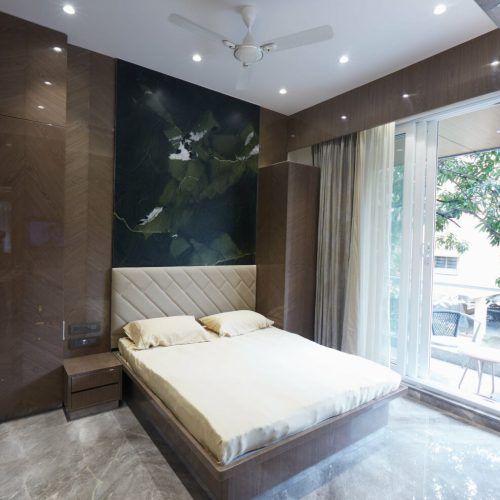
Selected work by Greenbox Design Studio. Tap any image to enlarge.
Frequently asked questions
How is house painting priced in India?+
Per square foot of paintable surface — walls plus ceilings — not per square foot of floor. Surface area is roughly 4 to 4.5 times the carpet area with ceilings included. Rates run ₹16 per sq ft for acrylic distemper, ₹23 economy emulsion, ₹32 premium emulsion and ₹43 for luxury emulsion, with putty at ₹12 or ₹20 for one or two coats.
What does it cost to paint a 2BHK?+
A 700 sq ft carpet 2BHK has about 2,940 sq ft of paintable surface. At premium emulsion with one coat of putty, that is a composite ₹44 per sq ft, or ₹1.29 lakh, rising to about ₹1.37 lakh with spot repair on five-year-old paint. Economy emulsion brings it to ₹79,000–₹96,000; luxury washable emulsion takes it to ₹1.45–₹1.73 lakh. Ex-GST.
How do I calculate paintable area?+
Measure the perimeter of each room and multiply by the wall height for the wall area, then add the floor area for the ceilings. Deduct only openings larger than 20 sq ft, because cutting in around a window takes as long as painting it would have. The result is typically 4 to 4.5 times the carpet area.
Is putty always necessary?+
Over fresh plaster, yes — two coats, or the finish will never be flat. Over sound existing paint, spot putty on marks is enough. Over chalky old distemper you scrape back and putty fully. Putty is the single largest difference between a cheap and an expensive quote, so establish how many coats and over what area before comparing prices.
Why do two painters quote such different prices?+
Because they are quoting different products at the same brand name, different putty coats, and frequently different measured surface areas — and usually none of the three is written down. Ask every painter for the surface area in square feet, the exact product, the number of putty coats and the number of topcoats, and the quotes become comparable.
How long does interior paint last?+
Two to three years for acrylic distemper, three to four for economy emulsion, five to six for premium and seven to eight for a washable luxury emulsion — assuming the surface was prepared properly. On a poorly prepared wall the best paint on the market will fail within two years, which is why preparation is where the money should go.