
Budget and cost
The first five questions are about money, and they are the ones people are most reluctant to ask directly. Detailed rates by home size sit on the Mumbai cost page; these answers cover the shape of the budget rather than the rate card.
What does a full home interior cost in Mumbai?+
₹1,760–₹3,890 per sq ft of carpet area, ex-GST, covering joinery, kitchen, false ceiling, electrical, painting and flooring where required. A 720 sq ft 2BHK therefore lands between ₹10.5 and ₹23 lakh. Below about ₹1,200 per sq ft, something is being left out of the scope rather than delivered more cheaply — usually carcass grade or hardware. See the Mumbai interior cost page for the full breakdown by home size.
How is the price actually built up?+
Joinery is 45–55% of a residential budget and is priced per square foot of shutter or per running foot of unit. Kitchen is 15–20%, false ceiling and lighting 8–12%, electrical and plumbing 6–10%, painting 6–9%. A BOQ that does not separate these is not comparable to another quotation. Contingency of 10% and GST of 18% sit on top, not inside.
Why do two quotations for the same flat differ by 40%?+
Almost always specification rather than margin. MR board instead of BWP, 0.8 mm laminate instead of 1 mm, unbranded hinges instead of Hettich or Hafele, two coats of paint instead of four, and no allowance for electrical relocation. Put the two BOQs side by side line for line and the gap usually explains itself within twenty minutes.
How much should I keep as contingency?+
Ten per cent of project value, held separately. It gets consumed by site discoveries in older flats — old wiring, uneven walls, concealed damp — and by the small upgrades almost every client makes once the space starts taking shape. A project that finishes without touching it is unusual.
Can I do the work in phases?+
Yes, and it costs 15–20% more overall because mobilisation, site protection and supervision are repeated. If you do phase, complete all the wet and dusty work in the first phase regardless of which rooms it affects.
Timelines and living through it
| Home | Design and approvals | Site work | Total |
|---|---|---|---|
| 1BHK | 3–4 weeks | 7–10 weeks | 10–14 weeks |
| 2BHK | 3–5 weeks | 10–16 weeks | 13–21 weeks |
| 3BHK | 4–6 weeks | 14–20 weeks | 18–26 weeks |
| 4BHK / duplex | 6–8 weeks | 20–30 weeks | 26–38 weeks |
| Kitchen only | 2–3 weeks | 4–6 weeks | 6–9 weeks |
Society working hours of 10 am to 6 pm and monsoon delays are already reflected. Add 2–3 weeks if the family remains in occupation.
Can I live in the flat during the work?+
For a single-room project, yes. For a full home interior, it adds two to three weeks and makes the experience considerably worse — dust reaches everywhere despite sheeting, the kitchen and one bathroom will be out of use for extended periods, and the site works around your routine rather than its own sequence. Most clients who try it move out by week three.
What causes most delays on Mumbai projects?+
In order: society permission and paperwork, late client decisions on finishes and appliances, long-lead imported items, and monsoon disruption between June and September. Actual trade productivity is rarely the problem. A decision calendar agreed at the start — who decides what, by when — removes the largest of these.
When should I order appliances?+
Before joinery fabrication begins, and the actual models, not the category. Hob, oven, chimney, dishwasher, washing machine and refrigerator all have specific cut-out and clearance dimensions, and a carcass built to a generic size has to be cut or rebuilt when the real appliance arrives. This is the single commonest source of avoidable rework.
Design and build under one accountable roof
Materials and specification
BWP or MR plywood — where does each belong?+
BWP (IS:710) in kitchens, utility areas, bathroom vanities and anywhere at skirting level where mopping water reaches. BWR or good commercial ply (IS:303) is defensible in dry bedroom wardrobes above skirting. The BWP premium is ₹38–₹52 per sq ft, roughly ₹18,000 on a 2BHK, and it is the line least worth saving on. Our plywood quality guide covers how to verify what arrives.
Which hardware brands are worth the money?+
Hettich, Hafele and Blum for hinges and channels, with Blum at the top of the range. The difference from unbranded hardware is cycle life and the availability of replacement parts in five years. Budget ₹340–₹900 per soft-close hinge and ₹1,200–₹4,500 per drawer set. Hardware is touched every day and fails first; it is the wrong place to economise.
Laminate, acrylic or veneer?+
Matte laminate at ₹1,450–₹1,900 per sq ft of shutter is the best value and hides wear well. Acrylic at ₹2,200–₹3,100 gives a high-gloss finish that shows every fingerprint and every scratch. Veneer at ₹2,400–₹3,600 is the only one that reads as real wood and needs polishing. See choosing a furniture finish.
Does the flooring need replacing?+
Usually not. Replacing sound flooring is the most common budget waste in Mumbai interiors — it costs ₹1.5–₹4 lakh on a 2BHK, adds three weeks, and requires all joinery to be installed afterwards. Replace it when it is genuinely damaged, when levels need correcting, or when you are changing the flat's character fundamentally.
What should I specify near the sea?+
SS 304 hardware as a minimum within two kilometres of the coast and SS 316 for balcony-adjacent or open positions. Mild steel with zinc plating blooms rust through the coating within eighteen months in Bandra, Worli or Juhu, and the stains run down shutter faces. The same applies to window hardware and curtain tracks.
Society, permissions and site conduct
What permission does my society need to give?+
Almost every Mumbai cooperative society requires a written application, an undertaking that no structural element will be altered, a refundable deposit of ₹10,000–₹1,00,000, and a workman list with ID copies. Work is normally restricted to 10 am–6 pm on weekdays, with no work on Sundays and during specified festivals. See society rules for renovation.
When is BMC permission actually required?+
For any structural change — removing or adding a wall that carries load, altering the facade, changing the position of a toilet or a shaft, or enclosing a balcony. Pure interior work with no structural alteration does not require BMC permission. The distinction matters because unauthorised structural work surfaces at resale and during redevelopment surveys.
Who is liable if a workman is injured?+
The contractor, and you should confirm they carry workmen's compensation insurance before work starts. Many societies now ask for a copy as a condition of permission. 'The society covers it' is not correct — the society's policy covers common areas and its own employees, not a contractor's workforce inside your flat.
Payments, contract and warranty
What payment schedule is reasonable?+
Ten to fifteen per cent on signing, 30–35% as a material advance, 25–30% on delivery to site, 15–20% on installation, and 5–10% retained until 30–45 days after handover. Anything above 40% before material lands on site shifts the risk onto you.
What should the contract contain?+
Six things: a line-item BOQ with brands and grades, a dated timeline with milestones, the payment schedule tied to those milestones, a written exclusions list, a variation procedure with rates, and the warranty terms. The exclusions list is the one most often missing and the one that causes most disputes.
What does the warranty actually cover?+
Typically one year comprehensive on workmanship and installation, with manufacturer-backed cover of five to ten years on hardware and boards where applicable. It does not cover misuse, water ingress from a source outside your flat, or normal seasonal adjustment. Read our warranty page for what we cover specifically.
Do you handle everything, or do I coordinate trades?+
We work design-and-build: one contract, one BOQ, one site team and one warranty holder. The alternative — appointing a designer and separately engaging a contractor — can be cheaper on paper and puts coordination and risk on you. Our comparison tool prices both routes.
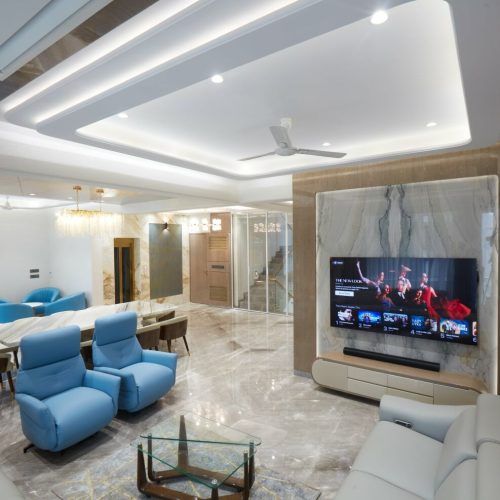
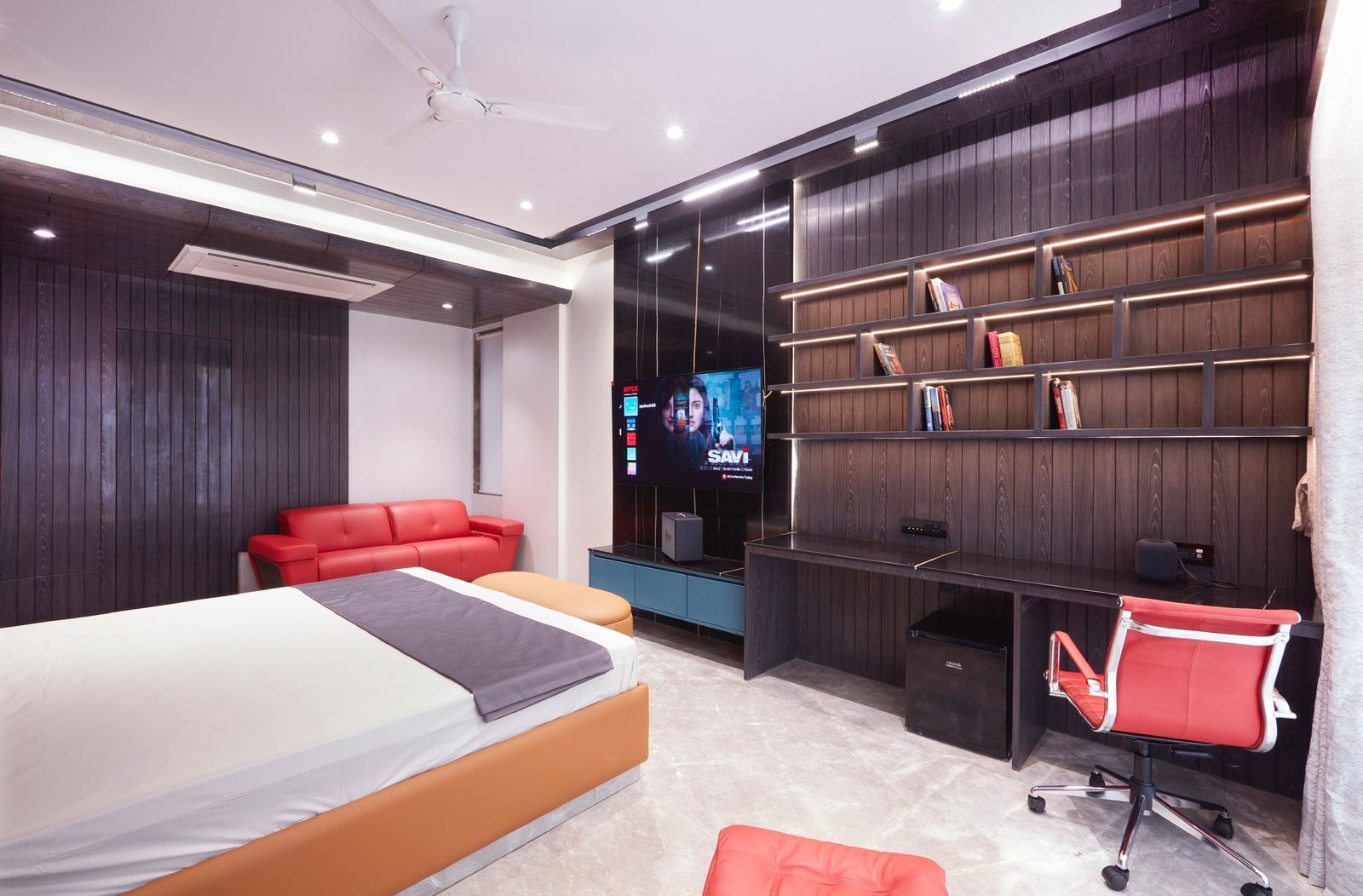
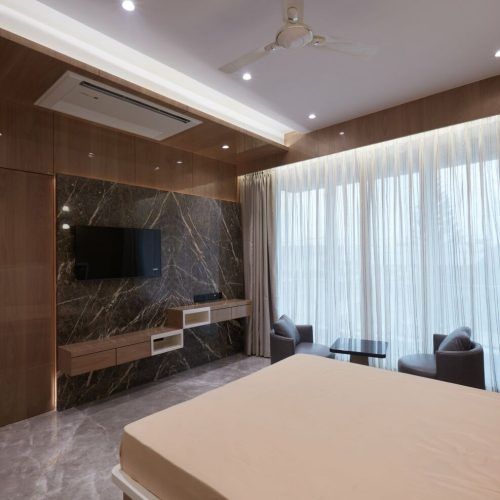
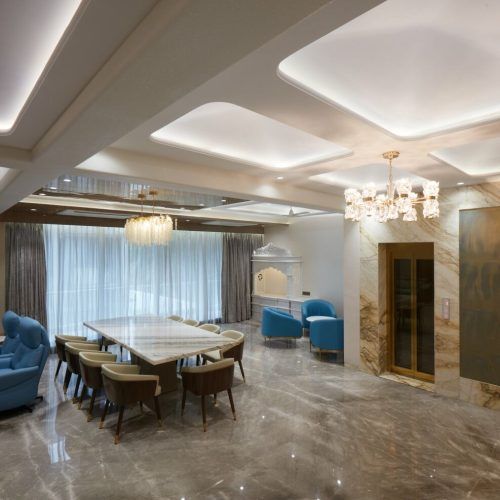
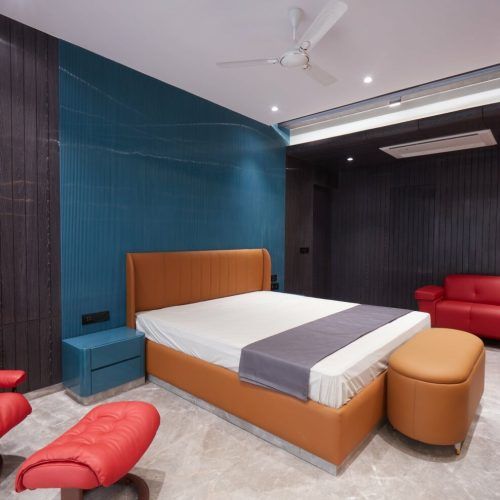
Selected work by Greenbox Design Studio. Tap any image to enlarge.
Frequently asked questions
What does a 2BHK interior cost in Mumbai?+
₹12.7–₹28 lakh ex-GST for a 720 sq ft carpet-area flat at ₹1,760–₹3,890 per sq ft, covering joinery, kitchen, ceiling, electrical and painting. The spread is driven by carcass grade, hardware brand and finish, not by how the space is planned.
How long does a 2BHK interior take?+
Thirteen to twenty-one weeks in total: three to five weeks of design, drawings and society approval, then ten to sixteen weeks on site under Mumbai's 10 am to 6 pm society working hours. Add two to three weeks if the family remains in occupation throughout.
Is GST included in interior quotations?+
Rarely. Almost every Indian interior quotation is ex-GST, with 18% applying on the service component. Confirm it in writing, because on a ₹15 lakh project the difference is ₹2.7 lakh and it is the commonest cause of a shock at the final invoice.
Should I choose a designer or a contractor?+
A design-and-build studio gives you one contract, one BOQ and one warranty holder, which matters when something fails in month fourteen. Appointing a designer and a contractor separately can cost less and places coordination risk on you. The right answer depends on how much of that coordination you want to own.
What is the single most important specification line?+
Carcass grade. It is invisible in a finished flat, it cannot be upgraded later without dismantling the joinery, and it determines whether a kitchen lasts eight years or twenty. BWP IS:710 in every wet area is the line to hold, whatever else is negotiated.
Do you work outside Mumbai?+
Yes — across the Mumbai Metropolitan Region including Thane, Navi Mumbai, Kalyan, Panvel and Palghar, and on selected projects further afield. Travel and logistics affect the rate on distant sites and we say so at quotation stage rather than absorbing it invisibly.