

Frame specification, by distance from the water
| Location | Frame | Board | Fixings | ₹ per sq ft |
|---|---|---|---|---|
| Within 1 km of Marve or Madh creek | Galvanised throughout | Moisture-resistant on external runs | SS 316 at wall junctions | ₹135 – 182 |
| 1 – 3 km inland — Link Road, Evershine | Galvanised, standard grade | Standard board | Zinc-plated | ₹120 – 165 |
| Malad East — Pushpa Park, Dindoshi | Painted MS acceptable | Standard board | Zinc-plated | ₹108 – 150 |
| Hill lanes — Kurar, Appapada | Painted MS acceptable | Standard board | Zinc-plated | ₹112 – 155 |
| Bathroom and utility, anywhere | Galvanised | Moisture-resistant | Zinc-plated | Add ₹15 – 25 |
Ex-GST, per square foot of ceiling area. Hill-lane rates include hand-carry of board from the lane head.
Why the frame is the thing that fails
When a ceiling goes wrong in a coastal flat, it is almost never the board. It is the suspension: the wall angle where the frame meets the external masonry, the hanger fixings closest to the window, and the screws holding the board to the section. Salt-laden air reaches those through the void, and painted mild steel in that position shows rust bleed through the board within three to five years — a brown line along the perimeter that cannot be painted out because it comes from behind. Galvanised sections and stainless fixings at the junctions add ₹12 to ₹18 per square foot and remove the failure entirely. Two kilometres inland it is money spent on nothing, and we would rather say so than apply a blanket coastal premium across a suburb that does not need one.

It is never the board that fails
Worked example: 470 sq ft of ceiling in a 980 sq ft flat
An Evershine Nagar flat, 2.85 metre slab, about two kilometres from the creek. Full ceiling in the living and dining area with a step over the dining table, cove in the master bedroom, plain ceiling in the passage.
| Scope | ₹ lakh | Note |
|---|---|---|
| Frame and suspension | 0.18 | Galvanised sections at 600 mm centres, zinc-plated fixings |
| Board and finishing | 0.23 | Standard board; moisture-resistant in the bathroom run |
| Cove and step detail | 0.13 | Step over the dining table; continuous cove in the master |
| Grille integration | 0.06 | Split unit drains routed with a designed fall; grilles set flush |
| Access panels | 0.02 | At both indoor units |
| Painting | 0.09 | Two coats over primer |
| Total, ex-GST | 0.71 | ₹151 per sq ft of ceiling |
Add 18% GST. Excludes light fittings. A flat the same size within a kilometre of the creek would add about ₹7,500 for stainless fixings and moisture-resistant board on the external runs.
Two more Malad-specific points
- Hand-carry in the hill lanes. In Kurar and Appapada, board comes from the lane head on shoulders. A 12 mm board is 1.2 by 2.4 metres and awkward rather than heavy, and a half-landing turn in those buildings is slow. We allow a day for delivery and handling rather than absorbing it, and we order in one load rather than two.
- Ducted cooling in the Link Road towers. Several of those buildings provide for concealed units, which need a 250 to 300 millimetre pocket. Put the pocket over the passage and the dining zone and step up over the seating area. A flat ceiling dropped to the depth of the duct across the whole room turns a 2.9 metre flat into a 2.6 metre one for no benefit.
What a coastal ceiling needs afterwards
A ceiling is not a maintenance-free element near the water, and the handover file should say so. Twice a year, the access panels come off and the fan coil filters and drain pans are cleaned — a blocked drain pan is the commonest cause of a stained ceiling in a flat with concealed cooling. Once a year, the cove is wiped out, because salt-laden dust settles on the upstand and dulls the light output noticeably within two seasons. Every three to four years the ceiling wants repainting, sooner on a west elevation. And any hairline crack at a board joint should be raked, filled and repainted rather than painted over, because painting over a moving joint simply hides it until it is wider. None of that is onerous; all of it is worth writing down at handover, which is what we do.
For the suburb as a whole, see interior designers in Malad. For board systems, materials and city-wide rates, see false ceiling designers in Mumbai.

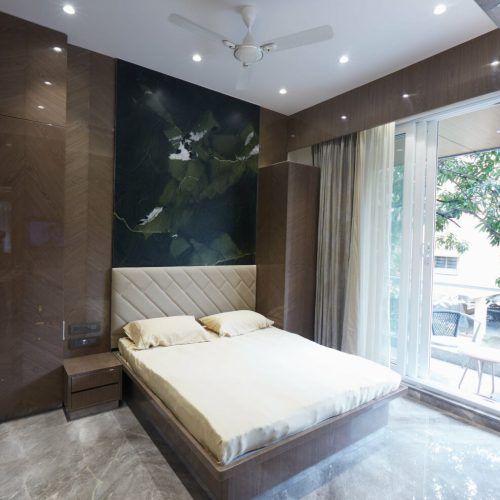

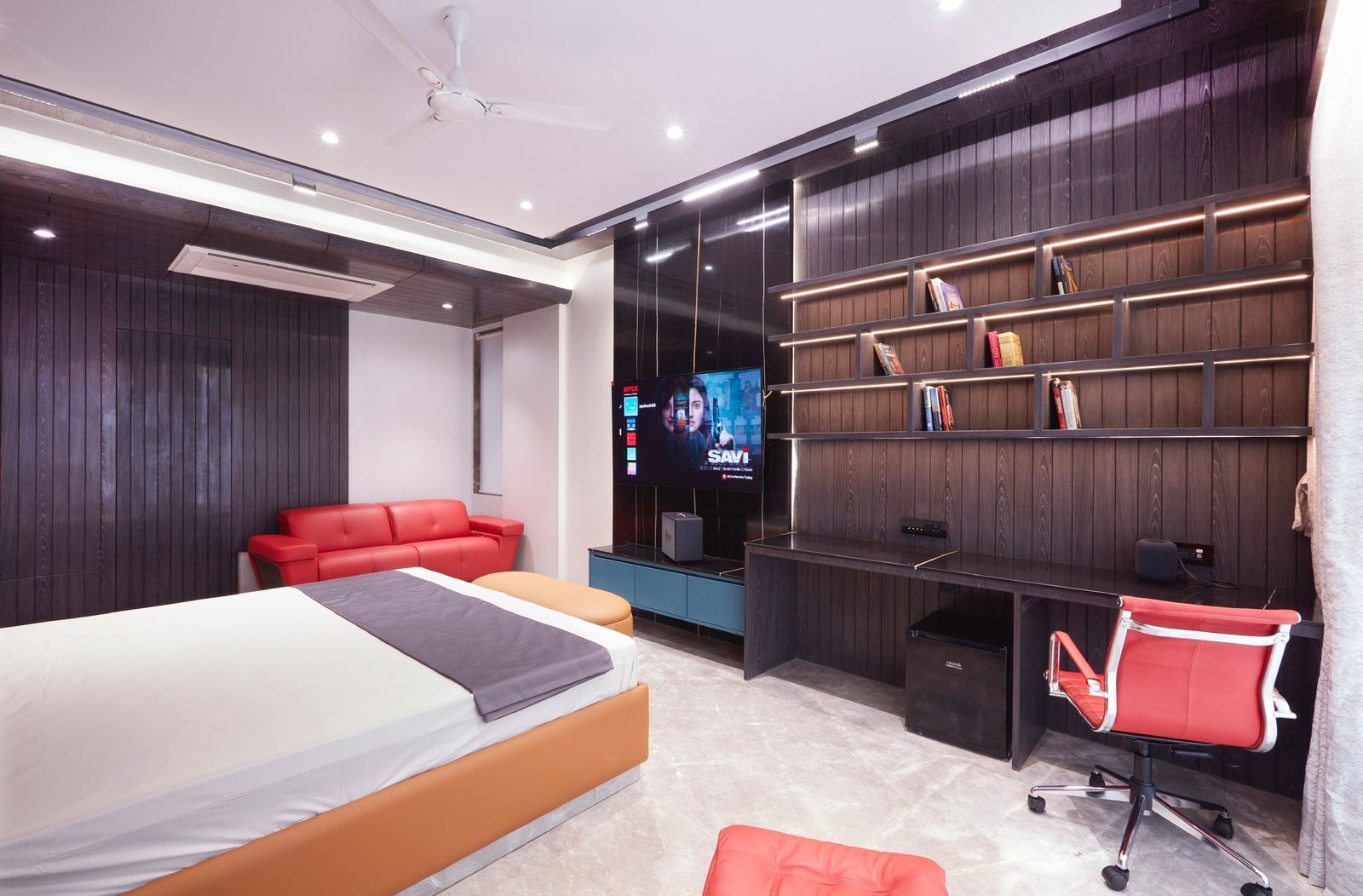

Ceiling and lighting work by Greenbox Design Studio.
Frequently asked questions
What actually fails in a coastal ceiling?+
The frame, not the board. The wall angle at the external masonry, the hangers nearest the window and the screws into the sections. Painted mild steel in that position bleeds rust through the board within three to five years, and it cannot be painted out because it comes from behind. Galvanised sections and stainless fixings remove it.
How far from the creek does this apply?+
About a kilometre, on our own repair experience in this suburb. Within it, galvanised frame and stainless fixings at the junctions. Beyond it, standard specification is sound and paying for the coastal version is money you will not see back. We mark the basis in the quotation.
Can we have ducted cooling in a Link Road tower?+
Where the building provides for it, yes, and the pocket is 250–300 mm. Put it over the passage and the dining zone and step the ceiling up over the seating. Dropping the whole ceiling to duct depth turns a 2.9 metre flat into a 2.6 metre one and nobody gains anything.
Does the hill-lane location add to a ceiling cost?+
A day for delivery and handling, and it is in the programme rather than hidden. Board is 1.2 by 2.4 metres and awkward on a stair with a half-landing turn. We order the whole ceiling in one load because a second delivery means a second early morning at the lane head.
Should the bathroom have a false ceiling?+
Only where there is something to conceal, such as an exhaust duct or a concealed cistern service run. If so, moisture-resistant board on a galvanised frame with an access panel, and an extract that actually vents outside rather than into the void. A sealed ceiling over a bathroom with no ventilation is a mould problem waiting to happen.