
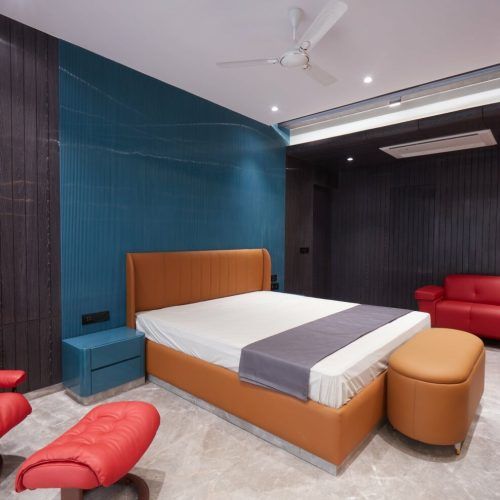
The six patterns, ranked for an Indian flat
The research literature lists fourteen patterns of biophilic design. In a Mumbai flat, most of them are either impossible or trivial, and it is worth being honest about which are which. Ranked by the difference they actually make in a 700–1,200 sq ft apartment:
| Pattern | Impact in a flat | Cost | How to do it here |
|---|---|---|---|
| Daylight access | Highest | Low to medium | Remove heavy pelmets, use sheer layers, keep tall furniture off window walls |
| Natural materials | High | Medium | Real wood, stone, cane, cotton and wool on 30%+ of visible surface |
| Planting | High | Low | 6–10 plants per room matched to the actual lux |
| Visual connection to nature | Medium to high | Free if you have it | Plan seating towards the best window; do not block the view with a TV |
| Natural forms and pattern | Medium | Low | Curved edges, irregular grain, handmade texture, no perfect repeats |
| Water | Low in flats | Medium | Usually more maintenance than benefit; a small still bowl at most |
| Airflow variability | Medium | Low | Cross-ventilation through the flat, ceiling fans rather than constant AC |
| Prospect and refuge | Medium | Low | One seat with a long view, one enclosed seat with a low ceiling |
Daylight first
Daylight is the element with the strongest measured relationship to wellbeing, and in most Mumbai flats it is being actively wasted. The usual culprits are a deep pelmet box that eats 250 mm off the top of the window, heavy blackout curtains used as the only layer, a wardrobe placed on the window wall, and dark tinted film applied to reduce heat. Fixing those four costs very little and can raise the working daylight in a living room substantially.
- Lose the pelmet or make it shallow. A 100 mm recessed curtain track gains 150 mm of glass height across the full window width.
- Two curtain layers, not one. A sheer for the day and a heavier layer for night and privacy. A single heavy curtain is either open or the room is dark.
- Keep the window wall clear of tall joinery. A 2,100 mm wardrobe beside a window blocks the light that would otherwise reach the far wall.
- Use a heat-reflective, high-visible-transmission film rather than a dark tint if solar gain is the problem. You can reject 60% of heat while keeping 70% of the light.
- Pale, matte surfaces on the wall opposite the window bounce daylight deeper into the room than any fitting can.
- Mirror opposite or perpendicular to a window, not on the window wall, roughly doubles the apparent daylight in a small room.

Design and build under one accountable roof
Plants that actually survive an Indian flat
The most common biophilic failure is buying plants for the image and not for the light. Most indoor positions in a Mumbai flat receive 200–800 lux — a fraction of the 10,000 to 100,000 lux outdoors — and the plants sold as indoor plants vary enormously in what they tolerate. Measure with a phone app, then choose.
| Position | Typical lux | Plants that survive | Watering in Mumbai |
|---|---|---|---|
| Directly at a bright window | 2,000–8,000 | Areca palm, rubber plant, croton, jade | Weekly; less in monsoon |
| Within 2 m of a window | 600–2,000 | Monstera, philodendron, fiddle leaf, dracaena | Every 5–8 days |
| Mid-room, indirect | 250–600 | Snake plant, ZZ plant, pothos, aglaonema | Every 10–14 days |
| Bathroom, frosted glass | 150–400 | Fern, peace lily, pothos | Rarely; humidity does the work |
| Interior corridor, no window | Under 150 | None — rotate plants in and out, or use none | — |
Monsoon halves the water requirement of nearly every indoor plant. More Indian houseplants die of overwatering in July than of anything else.
Material honesty
Biophilic response is partly about material authenticity: real timber grain, real stone, cane, clay, linen and wool register differently from printed reproductions of them. This does not mean everything must be solid — a veneered panel is real wood on the surface and reads as such. It does mean that a laminate printed with a wood pattern, at a repeat of 1,220 mm, does not deliver the same effect, however good the print.
The practical threshold we work to is 30% of visible surface in genuine natural material. In a living room that might be a veneered TV wall, a cane-front console, a wool rug, a stone counter and cotton upholstery. Reaching 30% is achievable at almost any budget once you count textiles, which are the cheapest natural material in the room and the most frequently overlooked.
What it costs
| Intervention | Scope | Cost |
|---|---|---|
| Pelmet removal and recessed track | Two windows | ₹16,000–₹32,000 |
| Two-layer curtains, sheer plus heavy | Two windows | ₹24,000–₹68,000 |
| Heat-reflective high-VLT film | 80 sq ft of glass | ₹12,000–₹22,000 |
| Veneered feature wall | 70 sq ft | ₹38,000–₹62,000 |
| Planting: 8 plants, pots, stands | One living room | ₹14,000–₹38,000 |
| Grow lights for low-lux corners | 3 fittings | ₹9,000–₹18,000 |
| Natural textiles: rug, cushions, throw | One room | ₹22,000–₹70,000 |
Open the curtain properly before you buy the plants. Daylight is free and it is doing most of the work.
Greenbox principal designer
Prospect, refuge and where people actually sit
Two of the more useful biophilic ideas have nothing to do with plants. Prospect is the pleasure of a long view with an unobstructed sightline; refuge is the pleasure of a protected, enclosed spot with your back covered. Every room people describe as comfortable contains at least one of them, and the best rooms contain both in different places. In a flat this translates directly into furniture planning: one seat positioned to look out of the longest sightline in the home, usually towards the window or down the length of the living-dining space, and one seat tucked into a corner with a lower ceiling or a canopy above it.
Most Mumbai living rooms are planned around the television, which delivers neither. The sofa faces a wall, the best window is behind it or beside it, and there is no protected seat anywhere in the room. Rotating the layout so that one chair faces the window, and adding a single armchair in a corner under a lower section of ceiling or a pendant, costs nothing in construction and changes which seat people choose. Watch a family in a room for an evening and you will see them find the refuge seat without being told it exists.
- Give the best view to a seat, not to a cabinet. The most common planning error in Mumbai flats.
- Lower the ceiling over the refuge. A 150 mm drop or a canopy over one seating cluster makes it read as protected.
- Keep sightlines from the entry to a window. Walking into a flat and seeing daylight ahead is worth more than anything you can place in the hall.
- Curve one thing. A curved sofa, a rounded table edge or an arched niche breaks the orthogonal grid that a flat is otherwise entirely made of.

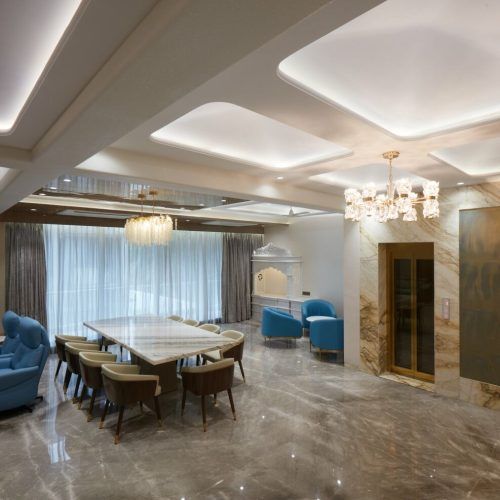
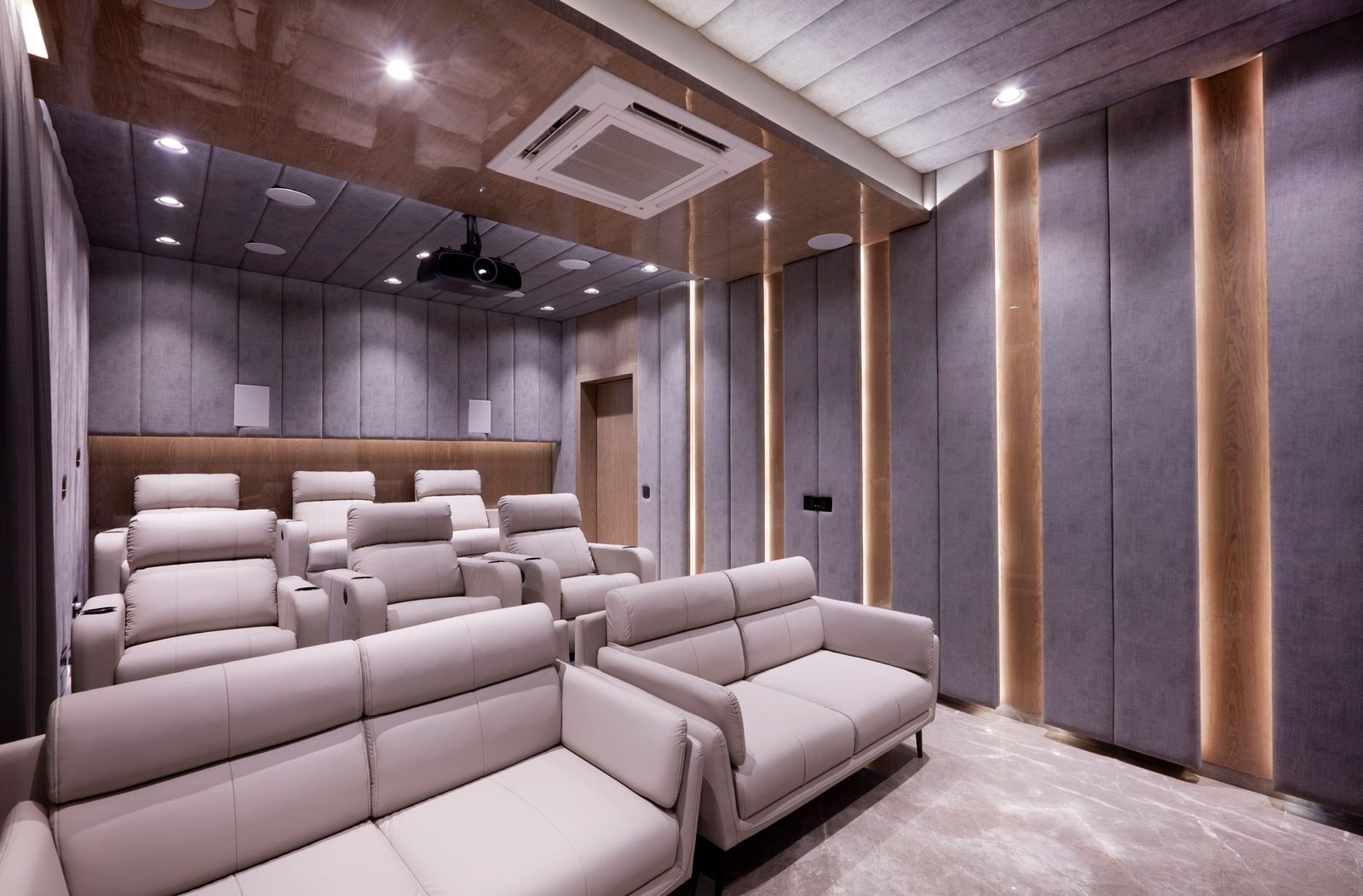
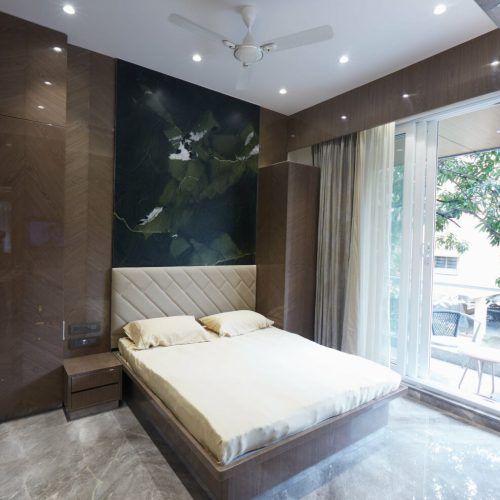
Selected work by Greenbox Design Studio. Tap any image to enlarge.
Frequently asked questions
Does biophilic design work without a garden?+
Yes — most of the effect comes from daylight, natural materials and a small number of well-placed plants rather than from a view of greenery. A flat with good daylight, 30% natural material and eight healthy plants delivers most of the measurable benefit without any outdoor space at all.
How many plants does a room need?+
Six to ten in a living room, three to five in a bedroom, grouped rather than distributed one per corner. Grouping matters: plants at three different heights in one cluster read as a planted area, while the same plants spread evenly around the room read as ornaments.
Which indoor plants survive Mumbai flats?+
Snake plant, ZZ plant, pothos and aglaonema tolerate the 250–600 lux of most mid-room positions. Monstera, philodendron and dracaena need to be within two metres of a window. Nothing survives a windowless corridor long term — rotate plants in and out, or leave the corridor to art instead.
Do artificial plants count?+
Not for the biophilic effect, which appears to depend on real material and real variation. They are a reasonable decorative choice in a dark corridor where nothing will live, and they should be dusted monthly or they look worse than an empty corner. Do not build a scheme around them.
Is a water feature a good idea in a flat?+
Rarely. Indoor water features in Mumbai's humidity mean algae, mosquito risk and constant maintenance, and the sound that is pleasant in a garden is repetitive in a 180 sq ft room. If you want water, a still bowl with a floating flower gives the reflective quality without the pump.
What does biophilic design cost?+
Between ₹45,000 and ₹1.8 lakh for a living room, depending on how much of it is daylight work and how much is new material. The daylight interventions — pelmet, curtain layering, film — are the cheapest and have the largest effect, which is the reverse of how most people spend on this.