
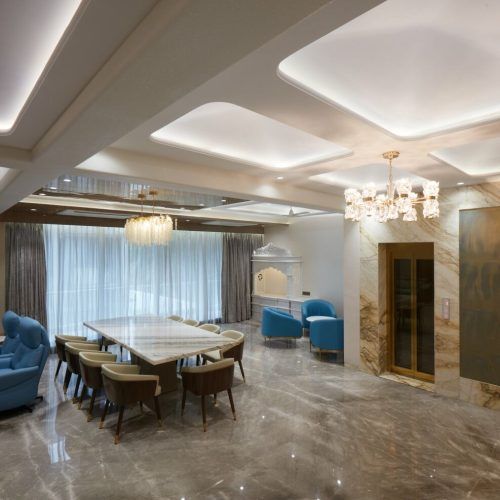
The placement rules, and the reality of a flat
A pooja space is the one element in an Indian home where traditional guidance and personal practice matter more than any design opinion we might have. Our job is to build it well to the family's requirement. The most consistent guidance places the space in the north-east of the home, with the person praying facing east or north; idols sit against the east or west wall, raised off the floor, with the north-east corner itself kept light and open rather than filled.
| Question | Traditional guidance | What works in a 2BHK | Why |
|---|---|---|---|
| Which part of the home? | North-east | North-east wall of the living room or the passage | The only north-east wall usually available |
| Facing which way? | Person faces east or north | Achievable in most flats | Free to honour if planned at layout stage |
| Idol height | Above waist, below eye level when seated | 600–750 mm above floor for a seated practice | Comfortable reach; keeps the flame below eye line |
| Under a staircase? | Avoided | Avoid; use the wall beside it instead | Also a soot and headroom problem |
| Shared wall with a bathroom? | Avoided | Avoid; a 150 mm service void solves it | Also a damp risk on that wall |
| In a bedroom? | Only if unavoidable | Use a shuttered unit that closes fully | Respects the guidance and the sleeper |
| Below a beam? | Avoided | Shift 300 mm or box the beam into the design | Costs nothing if caught on the ceiling plan |
Three formats, and who each one suits
Dedicated room, 25–40 sq ft
A door or a curtain, a raised platform, storage below for samagri, and a dedicated exhaust. Only viable in 3BHK and larger, or in a row house. Typically ₹1.8 L–₹4.5 L complete.
Niche unit, 900–1200 mm wide
Built into a wall or a wardrobe run, with shuttered storage below and an open or jaali-screened shrine above. This is what we build most often. ₹38,000–₹1.6 L.
Wall-hung mandir, 600–900 mm
A floating platform with a backing panel and concealed light. Suits studios and 1BHKs and rental fit-outs. ₹18,000–₹52,000.
Design and build under one accountable roof
Sizes that actually work
The commonest mistake is building the unit too shallow. A 250 mm-deep shelf cannot hold a thali, a kalash and two idols without everything touching, and things that touch get knocked over. These are the dimensions we use.
| Element | Dimension | Note |
|---|---|---|
| Shrine platform depth | 375–450 mm | 300 mm is the absolute floor; 450 mm is comfortable |
| Shrine platform width | 900 mm typical, 1200 mm generous | Below 750 mm the unit reads as an afterthought |
| Platform height above floor | 600–750 mm seated, 900–1050 mm standing | Decide by how the family actually prays |
| Clear height above platform | 600 mm minimum | Needed for a tall idol and for the lamp flame |
| Storage drawers below | 2 nos., 150 mm and 250 mm high | Samagri, wicks, oil, spare diyas |
| Jaali screen open area | 35–45% | Below 35% it blocks the view of the shrine |
| Aisle in front | 750 mm standing, 1200 mm if seating on the floor | Measure with a mat down |
Materials, soot and heat — the part most designs get wrong
A pooja space is the only place in a home where you deliberately light an open flame every day. Camphor and ghee lamps produce soot that will grey out a white laminate ceiling above the shrine within eighteen months, and a brass lamp base transfers enough heat to mark a veneer surface. Detail for this and the unit stays beautiful; ignore it and it looks tired in two years.
- Shrine surface in stone, not wood. A 20 mm Indian marble, Kota or granite top over the platform — ₹280–₹950 per sq ft in 2026 depending on stone — is heat-safe, wipes clean and costs very little because the area is small.
- Soot-tolerant surface directly above. Either a stone cladding strip, a powder-coated metal plate, or a washable matte enamel rather than acrylic emulsion. Never an open-pore veneer directly above a lamp.
- Ventilation. A dedicated 100 mm exhaust where the unit sits in a closed niche, or at minimum a 40 mm grille at the top of the back panel. A sealed pooja niche fills with smoke in about four minutes.
- Carcass in BWP IS:710. The unit often sits on an external or a bathroom-adjacent wall. Marine-grade carcass here is ₹180–₹240 per sq ft more than MR and worth every rupee.
- No fabric directly above the lamp. Torans and decorative cloth belong on the side returns, not the soffit.
Lighting
Three layers, all on separate switches. A concealed 2700 K warm strip washing the back panel so the idols are lit without a visible source; a single narrow-beam spot at about 15 degrees on the principal idol, around 350–450 lumens; and, if there is a jaali, a low-level backlight behind it so the screen reads as pattern rather than as a dark grid. Avoid cool white entirely here — 4000 K makes brass look green.
Every pooja unit we have had to rebuild was rebuilt for the same two reasons: it was too shallow, and there was nowhere for the smoke to go.
Greenbox principal designer
What it costs in 2026
| Build | Scope | Rate / total, ex-GST |
|---|---|---|
| Wall-hung mandir | 900 mm platform, backing panel, concealed light | ₹18,000–₹52,000 |
| Niche unit, laminate | 1200 mm, stone top, 2 drawers, jaali shutter, lighting | ₹38,000–₹72,000 |
| Niche unit, veneer / PU | 1200 mm, book-matched marble back, brass jaali | ₹95,000–₹1,60,000 |
| Dedicated room | 25–40 sq ft, platform, storage, exhaust, door | ₹1,80,000–₹4,50,000 |
| Marble / Kota shrine top | 20 mm, cut and polished | ₹280–₹950 per sq ft |
| CNC brass or MS jaali | Powder-coated or antique brass finish | ₹1,450–₹3,800 per sq ft |
Add 18% GST. Idols, loose brassware and the ghanti are the client's supply in every case.
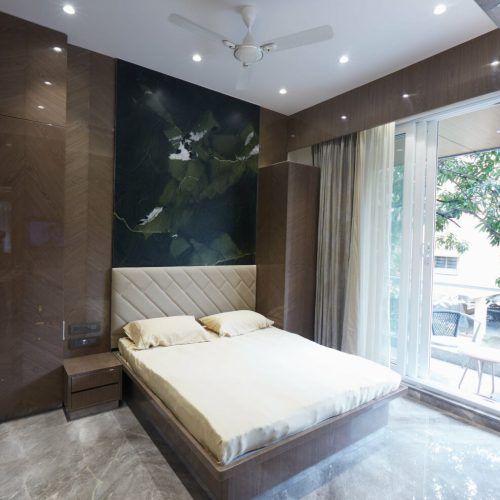
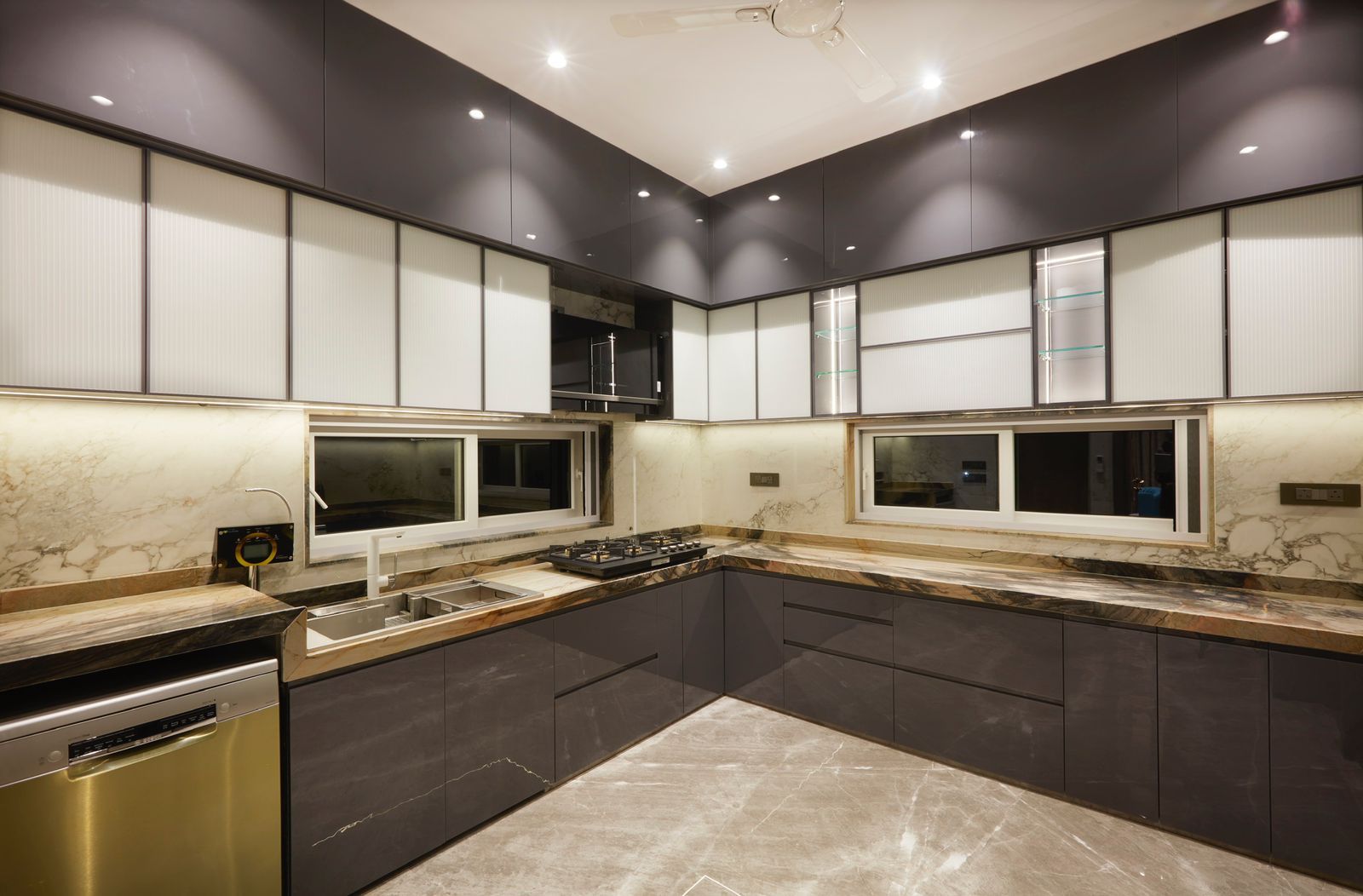
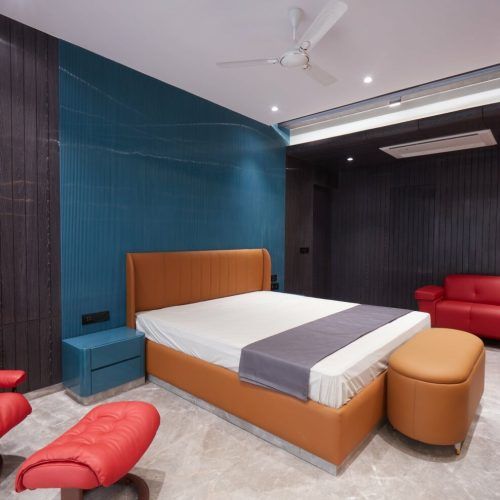
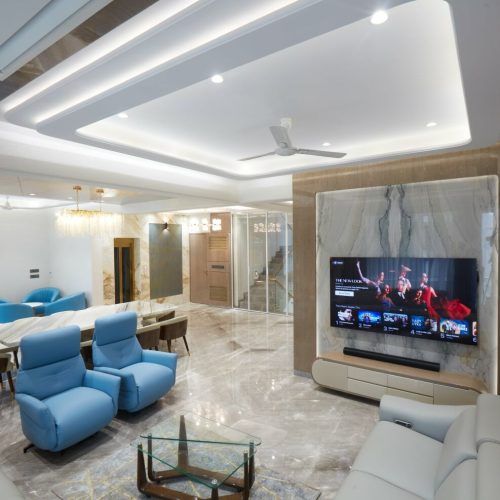
Selected work by Greenbox Design Studio. Tap any image to enlarge.
Frequently asked questions
Which direction should a pooja room face?+
The most widely followed guidance places the pooja space in the north-east of the home with the person praying facing east or north. Idols are usually set against the east or west wall rather than in the north-east corner itself, which is kept light and open. In a flat, the north-east wall of the living room or the entrance passage is the usual workable location.
Can a pooja room be in the bedroom?+
Traditional guidance prefers not, but in a 1BHK or a studio there is often no alternative. The accepted accommodation is a unit with full-height shutters that close completely when not in use, placed on the north-east wall of the room, and not directly facing the bed. Keep it off the wall shared with the attached bathroom.
What size should a pooja unit be?+
For a niche unit, 900 to 1200 mm wide and 375 to 450 mm deep, with the shrine platform 600 to 750 mm above the floor if the family prays seated and 900 to 1050 mm if standing. Allow at least 600 mm of clear height above the platform for a tall idol and the lamp flame.
How do you stop the ceiling above a mandir going black?+
Put a heat- and soot-tolerant surface directly above the lamp — a stone strip, a powder-coated metal plate or a washable matte enamel rather than acrylic emulsion or open-pore veneer — and give the niche a 100 mm exhaust or at minimum a 40 mm grille at the top of the back panel. A sealed niche fills with camphor smoke in about four minutes.
What does a built-in pooja unit cost in Mumbai in 2026?+
A wall-hung mandir runs ₹18,000 to ₹52,000. A 1200 mm built-in niche with a stone top, drawers, jaali shutter and lighting is ₹38,000 to ₹72,000 in laminate, or ₹95,000 to ₹1,60,000 in veneer or PU with a book-matched marble back and a brass jaali. All figures ex-GST; add 18%.
Is it acceptable to put a pooja unit under a staircase?+
Traditional guidance avoids it, and there is a practical objection too: headroom under a stair is poor, soot collects in the soffit, and the space is almost always a storage route as well. Where a duplex has no alternative north-east wall, we use the wall beside the stair rather than the volume beneath it.