
What credentials actually mean in India
Interior design is not a statutorily licensed profession in India the way architecture is under the Architects Act 1972. Anyone may call themselves an interior designer. That makes qualification claims weaker evidence than most clients assume, and makes documentary and reference checks proportionally more important.
| Credential | What it proves | What it does not prove | How to verify |
|---|---|---|---|
| GSTIN | A registered business with a filing trail | Quality or solvency | Free lookup on the GST portal, 30 seconds |
| IIID membership | Professional association, peer network | Any assessment of built work | Member directory on the IIID site |
| CoA registration | The person is a registered architect | That they run interiors well | Council of Architecture register |
| Degree / diploma | Training in design | Site or contract competence | Ask for the certificate; most will show it |
| Company registration | A legal entity you can contract with | That it holds assets | MCA master-data search by CIN |
| Contractor's licence | Only relevant for civil work | Interior fit-out capability | Ask for the municipal licence copy |
None of these substitute for a site visit and two reference calls.
The site visit is the real interview
Ask to see a project currently in execution, unannounced if the studio agrees to it. Twenty minutes on a live site answers questions a portfolio cannot. You are not judging mess — construction is messy — you are judging order within the mess.
- Is material stored off the floor, on battens, covered? Ply stacked flat on a wet slab tells you how the firm treats your money.
- Is there a printed drawing set on site? A site working from WhatsApp photographs will produce what WhatsApp photographs produce.
- Are cut edges sealed as the work progresses? Or piled up for later, which means never.
- Is there a site supervisor present, and does he know the drawing? Ask him one question about a dimension.
- Is the electrical marked on the wall before chasing? Chasing first and thinking second is the most expensive habit in the trade.
- What does the client say when you meet them? On a live site you often can. That conversation is worth the visit on its own.
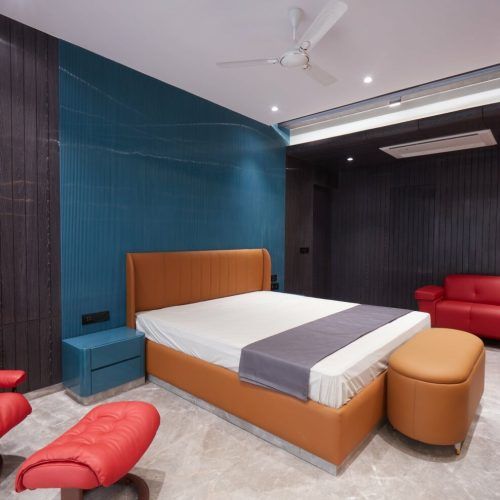
Design and build under one accountable roof
The reference call that tells you something
Ask for two clients whose projects completed between eighteen and twenty-four months ago. Recent clients are still in the glow; two-year clients have lived with the joinery through two monsoons and know whether the warranty was honoured. Four questions do most of the work.
- What was the final cost against the signed BOQ, in percentage terms? Under 8% variation is normal. Over 20% means either the BOQ was incomplete or the scope was not controlled.
- How many weeks late was handover, and what was the reason given? Everyone runs late in Mumbai; the useful signal is whether the reason was communicated before or after the date passed.
- What broke in the first year, and what happened when you called? This is the warranty question, and the answer is rarely rehearsed.
- Who was actually on site — the person you met, or someone else? Studios that sell with a principal and deliver with a junior are common.
- Would you use them again, and for what? The qualifier at the end of that answer is the honest part.
Six documents to ask for before any advance
| Document | Why it matters | Warning sign |
|---|---|---|
| GST registration certificate | Confirms the entity you are paying | Invoices from a different name |
| One complete past BOQ | Shows specification depth | Lump sums, no brands, no grades |
| Draft contract with exclusions | Exclusions are where disputes live | No exclusions list at all |
| Payment schedule tied to milestones | Protects you from front-loading | More than 40% before delivery |
| Written warranty terms | Defines coverage and duration | Verbal assurance only |
| Proof of workmen's insurance | Liability on your premises | 'The society covers it' — it does not |
Any studio that is uncomfortable being verified has told you what the verification would have found.
Greenbox principal designer
Reading a portfolio honestly
Portfolios are the least reliable document in the pack, and not because anyone is lying. They are photographed on handover day by a professional with lighting equipment, after a stylist has removed everything that belongs to a household. The correct way to read one is to ignore the atmosphere and look at three technical things instead.
First, look at the joinery joints — shadow gaps, panel alignment, where a run meets a wall that is not square. Mumbai walls are rarely square, and the scribe filler at that junction tells you whether the studio's workshop is precise. Second, look at the ceiling and the lighting: is the cove even, are the downlights aligned to a grid, do the sprinkler heads and AC grilles sit in a considered position or wherever the service contractor put them. Third, look for the same project photographed from more than one angle. Studios that only ever show one view of a project are often showing the only corner that worked.
| What you see in a portfolio | What to ask | What a weak answer sounds like |
|---|---|---|
| A beautiful kitchen | What was the per sq ft rate and what carcass grade? | 'Depends on the client's budget' |
| One view of each project | Can I see the whole flat from three angles? | 'The client did not allow more photographs' |
| Only new-build projects | Show me a renovation in an occupied flat | No example available |
| No Mumbai society projects | How do you handle 10am–6pm working hours? | Vague, non-specific answer |
| Projects all under two years old | Can I see something from 2021 today? | 'We do not stay in touch after handover' |
Budget ninety minutes for the whole exercise: thirty seconds on the GST portal, forty minutes on a live site, two reference calls of ten minutes each, and half an hour reading a past BOQ with a pen. Against a project that will cost between eight and forty lakh rupees and occupy your home for three to five months, that is the cheapest insurance available. The studios that pass it comfortably are not necessarily the cheapest quotation in your pile, and the correlation is worth noticing — the firms with nothing to hide tend to be the firms carrying the overheads of doing it properly, and those overheads appear in the price.
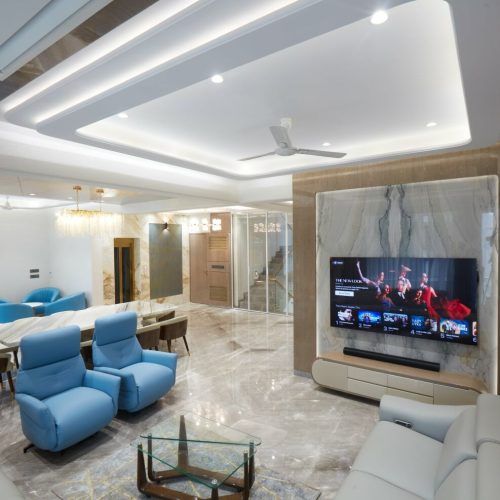
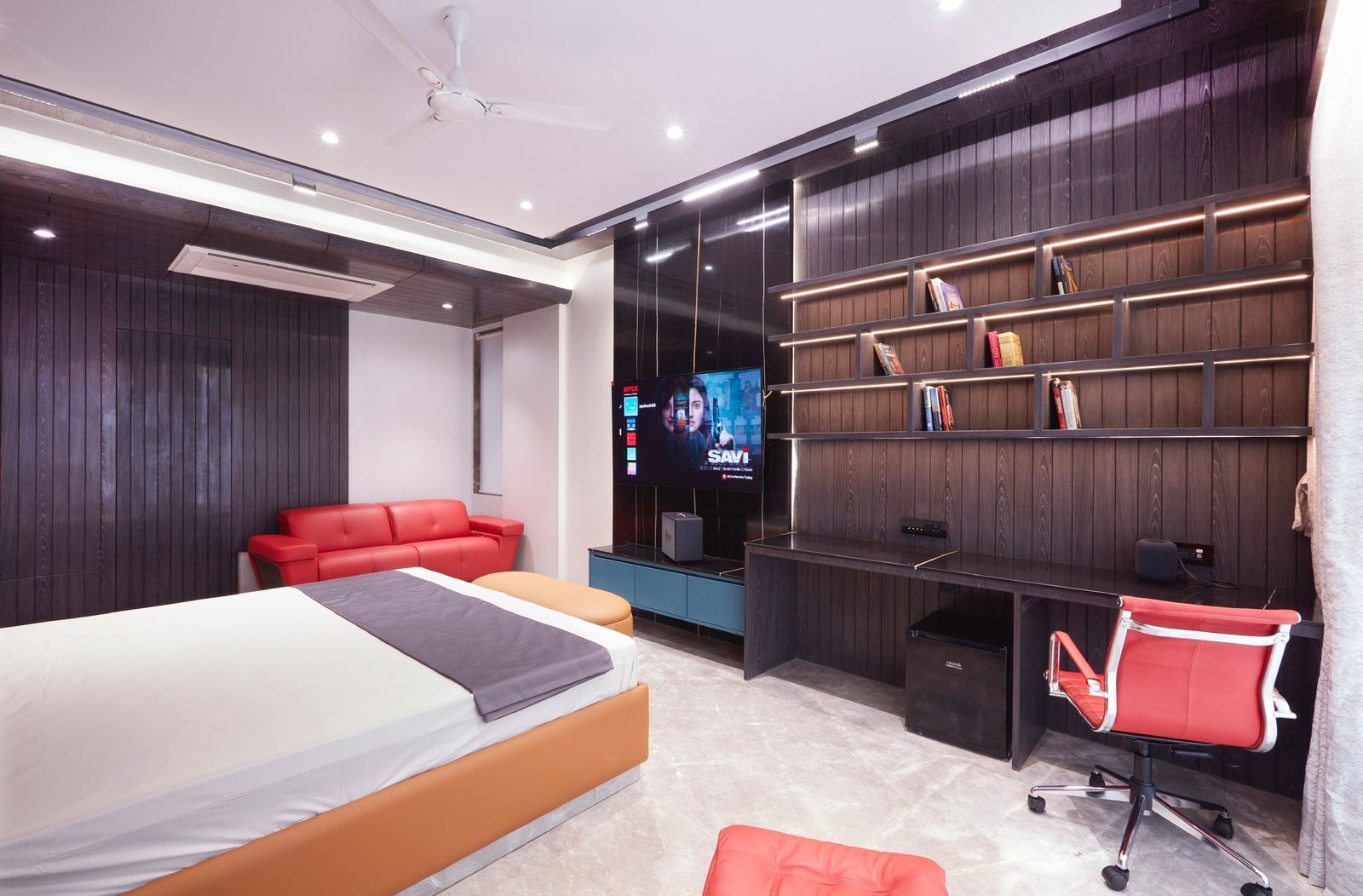
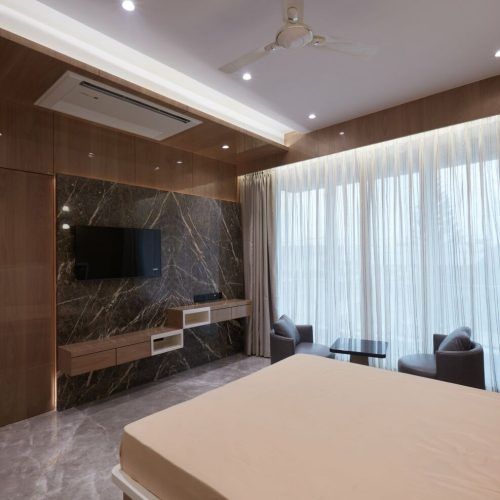
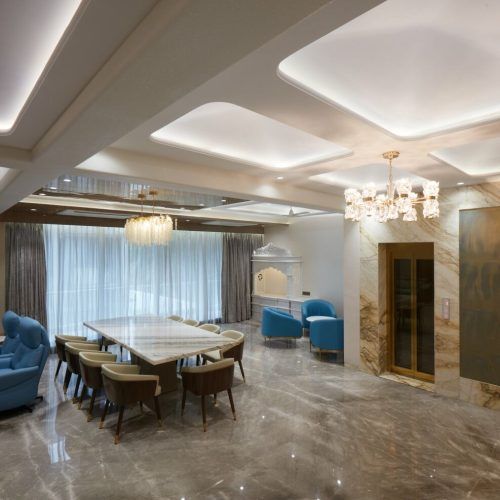
Selected work by Greenbox Design Studio. Tap any image to enlarge.
Frequently asked questions
Is interior design a licensed profession in India?+
No. Unlike architecture, which is regulated by the Council of Architecture under the Architects Act 1972, interior design has no statutory licensing in India. Professional bodies such as IIID offer membership, but it is voluntary. Documentary checks and references therefore carry more weight than titles.
How do I verify a GSTIN?+
Enter the 15-character number on the official GST portal's 'Search Taxpayer' page. It returns the legal name, registration date, status and jurisdiction free of charge. Confirm the returned legal name matches the name on the quotation and on the bank account you are asked to pay.
What advance is reasonable to pay?+
Ten to fifteen per cent as a design or booking advance, and a further 25–35% as a material advance released against a signed BOQ. Anything above 40% before material lands on site shifts the entire risk onto you and is worth negotiating hard.
Should I check reviews online?+
Read them, but weight them lightly. The volume is low for most studios and the incentives are obvious on both sides. A single unannounced site visit is worth more than fifty reviews. Where reviews are useful is in the pattern of the negative ones — three people describing the same failure is signal.
What if the designer is an individual, not a firm?+
That is common and can work well, but the contract structure matters more. Ask who executes — an individual designer usually works with contractors you should also meet. Insist the contract names the executing party and the warranty holder, or you will have nobody to call in month fourteen.