
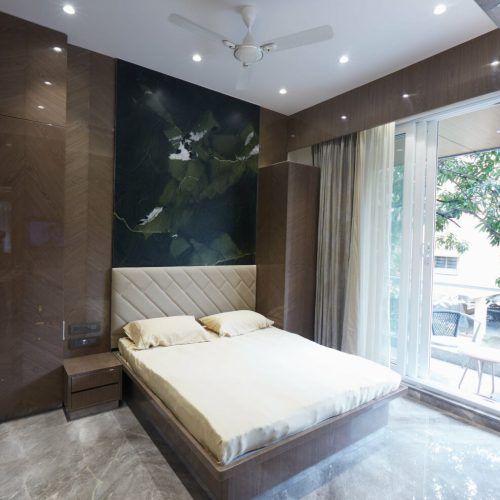
Start where the risk is
Retrofitting a whole home for accessibility at once is expensive and usually unnecessary. What matters is fixing the three places where a fall is both likely and consequential: the bathroom, the thresholds between rooms, and the route from the bed to the bathroom in the dark. These three account for the large majority of domestic falls among older adults, and all three can be addressed without touching the rest of the flat.
The other reason to sequence this way is acceptance. Older parents frequently resist an accessibility retrofit because it signals decline. A bathroom upgrade framed as a renovation, with the grab bars specified as matte black or brushed brass fittings that read as design rather than as hospital equipment, gets agreed. A whole-flat intervention with ramps and handrails often does not.
The bathroom, in detail
| Element | Specification | Why | 2026 cost |
|---|---|---|---|
| Floor tile | R11 or R12 anti-slip, small format with more grout lines | Grout gives grip; large polished tiles are the hazard | ₹140–₹320 / sq ft |
| Threshold | Zero step; fall the floor 10 mm over 1.2 m to the drain | A 40 mm kerb is the commonest trip point in a flat | ₹18,000–₹38,000 to rework |
| Grab bar at WC | 32 mm dia, 600 mm, at 750 mm AFL, into masonry | Supports sit-to-stand, the highest-load movement | ₹2,800–₹7,500 |
| Grab bar in shower | L-shaped, 750 x 750 mm, at 900 mm AFL | Entry and turning support | ₹4,200–₹11,000 |
| Shower seat | Folding, 400 mm deep, 450 mm AFL, 130 kg rated | Removes standing balance from washing | ₹6,500–₹18,000 |
| WC height | 460–480 mm to seat top (comfort height) | Standard 390–410 mm is too low to rise from | ₹9,000–₹26,000 |
| Taps | Single-lever or sensor; never two-handle screw-down | Grip strength and wrist rotation decline first | ₹3,500–₹14,000 |
| Door | Outward-opening or sliding, 800 mm clear | An inward door can be blocked by a fallen person | ₹14,000–₹36,000 |
Grab bars must be fixed into masonry or a plywood backing plate, never into a hollow partition or tile alone. A bar that pulls out is worse than no bar.
The grab bar fixing deserves emphasis because it is where retrofits fail. A 600 mm bar takes a sudden load of well over 100 kg when someone stumbles. Fixed into 8 mm tile with a plastic plug it will come away with the tile. The correct detail is a 12 mm ply or steel backing plate behind the tile, or chemical anchors into solid masonry, and it needs deciding before the tiling, which is why this is a renovation item and not an afternoon job.

Design and build under one accountable roof
Lighting for older eyes
A 70-year-old's retina receives roughly a third of the light a 20-year-old's does at the same illuminance, and the eye adapts to changes in brightness far more slowly. Both facts change the lighting specification. Corridors and stairs need 300–400 lux rather than the 100–150 lux typical of Indian passages, and the transition between a bright room and a dark corridor needs to be softened, because the ten or fifteen seconds of adaptation is exactly when a trip happens.
- Uniform light, no pools. Alternating bright and dark patches on a corridor floor read as steps to an ageing eye.
- No glare. Bare bulbs and specular reflections cause more disability glare with age. Use diffused fittings and matte floor finishes.
- Night lighting at 5–20 lux on the bed-to-bathroom route, motion-triggered, at skirting level so it does not wake anyone. This is a ₹4,000–₹9,000 intervention that removes the most common night-time fall.
- Two-way switching at both ends of any corridor and at the bedroom door and bedside. Nobody should have to cross a dark room to reach a switch.
- Contrast the edges. A dark strip at the nosing of any step, and a visible tonal difference between floor and wall, helps depth perception far more than brightness alone.
Heights, reaches and handles
Standard furniture and joinery dimensions assume a user who can squat, reach overhead and grip. Adjusting them is mostly free at the design stage.
- Seat heights 450–480 mm. Most sofas are 400–420 mm, which is comfortable to sit in and hard to rise from. Add firm cushions or specify a higher frame.
- Storage between 600 and 1,400 mm. Anything above shoulder height or below knee height should hold things used twice a year, not daily. Pull-down wardrobe rails cost ₹6,500–₹14,000 and return the top shelf to use.
- Lever handles everywhere. Door handles, taps, window catches. A knob requires grip plus rotation, which is the first combination arthritis removes.
- Deep drawers instead of low cupboards. A drawer brings its contents to you; a low cupboard requires kneeling and then standing up in a confined space.
- Rocker switches at 900–1,000 mm, large plate, ideally illuminated. The Indian standard of 1,200–1,300 mm is high for a seated or stooped user.
What to do in a rented or society-restricted flat
Many older people in Mumbai live in flats where structural changes are impractical — a rented unit, or a society that will not permit bathroom waterproofing to be redone. A useful amount can still be achieved without touching the structure: a freestanding shower seat, suction-free clamp-on grab bars rated and tested for load, an anti-slip treatment applied to existing tile at ₹90–₹180 per sq ft, a raised WC seat at ₹2,500, plug-in motion night lights, and replacing every knob in the flat with a lever at ₹900–₹2,400 per handle.
Avoid suction-cup grab bars marketed for the purpose. They are designed as balance aids, not fall arrest, and they release without warning under a shock load. If the wall cannot take a fixed bar, a floor-to-ceiling tension pole rated to 130 kg is the safer alternative at around ₹9,000.
The retrofit that matters is not the ramp at the front door. It is the light between the bed and the bathroom at two in the morning.
Greenbox principal designer
A word on sequencing when parents are moving into an existing family flat. Do the bathroom and the lighting before they arrive, not after. Retrofit work in an occupied flat with an older resident is disruptive in a way that is hard to overstate — dust, noise, a bathroom out of use for eight to twelve days, workmen present through the day. Where the full package cannot be done in advance, do the bathroom first as a single block of work and leave the lighting and handle changes for later, because those are quiet, two-day jobs that can happen around normal life.


Selected work by Greenbox Design Studio. Tap any image to enlarge.
Frequently asked questions
What is the most important elderly-safety upgrade?+
The bathroom. Wet, hard surfaces combined with the sit-to-stand and step-in movements make it the highest-risk room in any home. A zero-threshold entry, R11 flooring, two properly anchored grab bars and a comfort-height WC together cost ₹60,000–₹1.1 lakh and remove most of the risk.
How high should a grab bar be fixed?+
750 mm above finished floor level beside a WC, and 900 mm for an L-shaped bar in a shower. Use 32 mm-diameter bars — that is the diameter a hand closes around most securely — and fix into masonry or a backing plate, never into tile with plastic plugs.
Are anti-slip tiles necessary?+
In wet areas, yes. Look for an R-rating: R10 for a dry bathroom floor, R11 as the minimum for a shower area, R12 where water is constant. Smaller format tiles add grout lines, which add grip. A polished large-format tile in a wet bathroom is the single worst common specification.
Can I make a flat accessible without renovation?+
Partially. Anti-slip floor treatment, a freestanding shower seat, a raised WC seat, tension-pole grab rails, lever handle replacements and plug-in motion night lights together run ₹25,000–₹55,000 and require no permission. The zero-threshold shower and fixed grab bars do need work, and they are the ones that matter most.
What lighting level do older adults need?+
Roughly twice what a younger adult needs: 300–400 lux in corridors and on stairs, 500–750 lux for reading or kitchen work, and 5–20 lux of motion-triggered night lighting on the route to the bathroom. Uniformity matters as much as level — patchy light reads as uneven ground.
Does an elderly-friendly design look institutional?+
Only if it is specified from a medical catalogue. Grab bars are available in matte black, brushed brass and satin nickel and read as towel rails; comfort-height WCs are a standard product; anti-slip tiles come in every finish. Nothing on this list has to look clinical, and the ones that do get removed within a year.