
What Kelvin actually measures
Colour temperature describes the appearance of white light on a scale from warm and yellow to cool and blue, expressed in Kelvin. Confusingly, low numbers are warm and high numbers are cool — the opposite of the everyday association. A candle is about 1,800 K, an old incandescent bulb 2,700 K, midday daylight around 5,500 K, and an overcast sky 6,500 K or higher.
Indian homes drifted to 6500 K over the last two decades for a simple reason: cool white looks brighter for the same wattage, and when CFLs and early LEDs were expensive, brightness per rupee was what people bought. The habit persists, and it is the single most common reason a well-designed room photographs beautifully and feels clinical in person.
The temperatures, and where each belongs
| Temperature | Appearance | Use in | Avoid in |
|---|---|---|---|
| 2700 K | Very warm, lamp-like | Bedside, lounge lamps, restaurants | Kitchens, study |
| 3000 K | Warm white | Living, dining, bedrooms, corridors | Nowhere, really |
| 3500 K | Warm neutral | Kitchens in a warm-toned home | Bedrooms |
| 4000 K | Neutral white | Kitchen counter, bathroom mirror, study desk | Living rooms, bedrooms |
| 5000 K | Cool white | Utility, garage, workshop | All living spaces |
| 6500 K | Cool daylight | Industrial and inspection tasks | Every room in a home |
Design and build under one accountable roof
Why 3000 K is the default answer
Three reasons. It flatters Indian skin tones, which cooler light does not — 6500 K renders warm complexions grey. It works with the materials most Indian homes use: teak, walnut, beige stone, brass and warm laminates all look dull and slightly green under cool light and come alive at 3000 K. And it is close enough to the incandescent light people grew up with to read as domestic rather than commercial.
The exception is task light. At a kitchen counter or a study desk, 4000 K improves contrast and makes detail easier to see, and because task lighting is local and separately switched, the shift in temperature is experienced as purposeful rather than inconsistent. The rule is that a temperature change should coincide with a functional change, never with a room boundary in an open plan.
CRI: the number nobody prints on the box
Colour Rendering Index measures how accurately a light source shows colours against a reference, on a scale to 100. Cheap LEDs typically sit at CRI 70–80, which means colours are visibly flattened — reds go muddy, wood goes flat, skin looks tired. Good LEDs are CRI 90 or above. The difference between a CRI 80 and a CRI 95 fitting at the same 3000 K is far more visible than the difference between 3000 K and 3500 K, and it is the specification most often omitted.
| CRI | What it looks like | Typical products | Price impact |
|---|---|---|---|
| 70 – 80 | Colours flattened, wood dull, skin grey | Budget panel lights, generic strips | Baseline |
| 80 – 90 | Acceptable general lighting | Mainstream branded LED | +15 – 25% |
| 90 – 95 | Colours read correctly, materials look right | Specification-grade fittings | +40 – 70% |
| 95+ | Reference quality | Art and retail display fittings | +80 – 150% |
Tunable white: worth it or not?
Tunable fittings let you shift between roughly 2700 K and 6000 K on the same lamp, either by switch cycling or through an app. In principle it solves the argument: cool in the morning, warm in the evening. In practice we specify it sparingly, for three reasons. Switch-cycled tunable fittings change temperature every time the power is interrupted, so a power cut leaves half your ceiling at a different setting. App-controlled systems add a hub, a driver and a dependency on a manufacturer's server for something as basic as a light. And the colour quality at the extremes of the tuning range is usually worse than a fixed fitting at the same temperature, because the lamp is blending two LED chips rather than using one optimised phosphor.
Where it does earn its place is a study or a home office used at different times of day, and a child's room that has to serve homework at 6pm and sleep at 9pm. For those, a single good tunable fitting on its own circuit is a sensible ₹3,500–₹9,000. For a living room, three fixed-temperature circuits on dimmers give more control for less money and less to go wrong.
Mixing, and why it is so visible
- Within one open space, use one temperature for all ambient light. The eye adapts to a single white point; two white points in the same field of view are read instantly as one of them being wrong.
- Task light may differ, if it is clearly a task light. 4000 K under a kitchen wall unit, in a room otherwise at 3000 K, is legible as a different job.
- Check the strip and the downlight are the same bin. Two fittings both sold as 3000 K from different makers can differ by 200–300 K, which is visible on a white ceiling.
- Replace failed fittings with the same model. The commonest cause of a mixed ceiling is one lamp replaced four years later with whatever the shop had.
- Beware of tunable fittings on separate controls. If half the room can be set to 4000 K and the other half to 3000 K, somebody eventually will.
Clients argue about Kelvin and ignore CRI. Then they wonder why their walnut veneer looks like laminate.
Greenbox principal designer
How to choose without guessing
Buy one of each candidate fitting — it costs ₹1,500 to ₹4,000 and settles the argument permanently. Hold them up in the actual room, at night, against your actual wall colour and your actual joinery. Look at the back of your hand under each. Look at a piece of the veneer or laminate you have selected. Then decide. Showrooms are lit at 5000 K with high output to make everything look crisp, which is precisely the condition your home will never be in, and a sample board seen in a showroom tells you almost nothing about how it will read at 9pm in your living room.
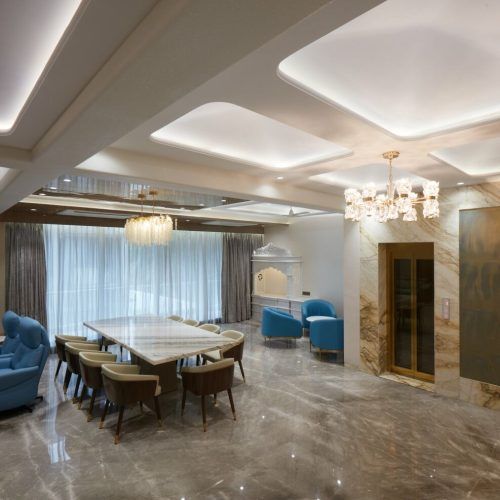
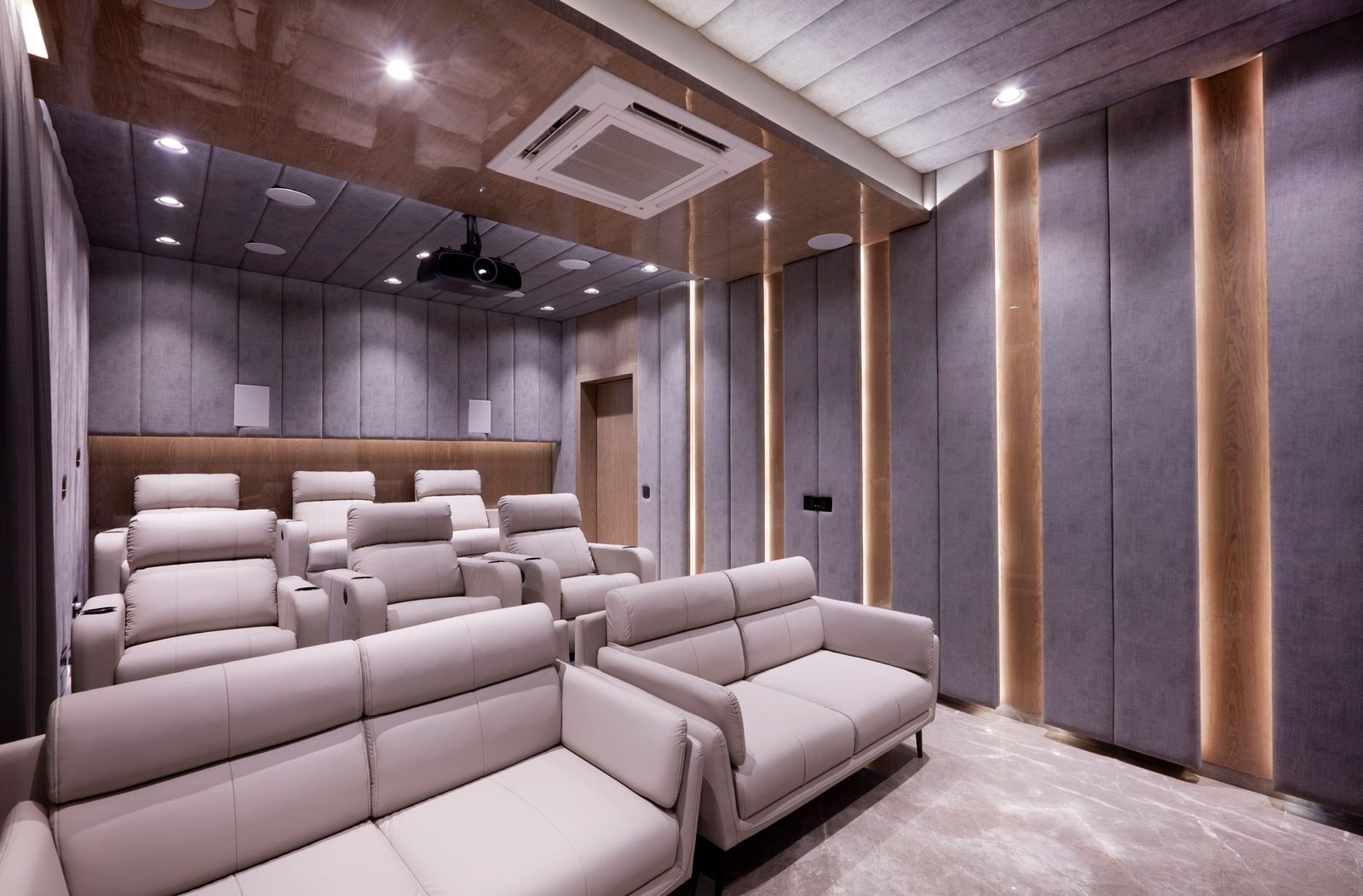
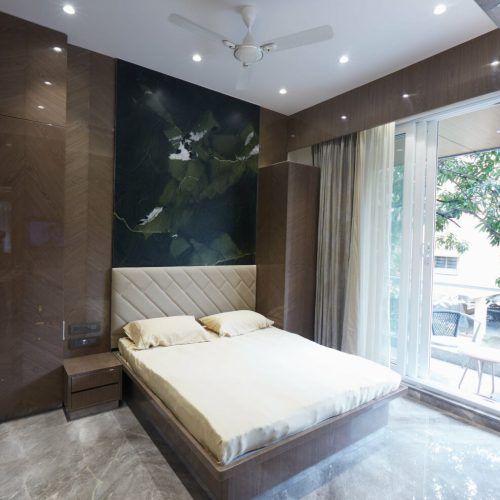
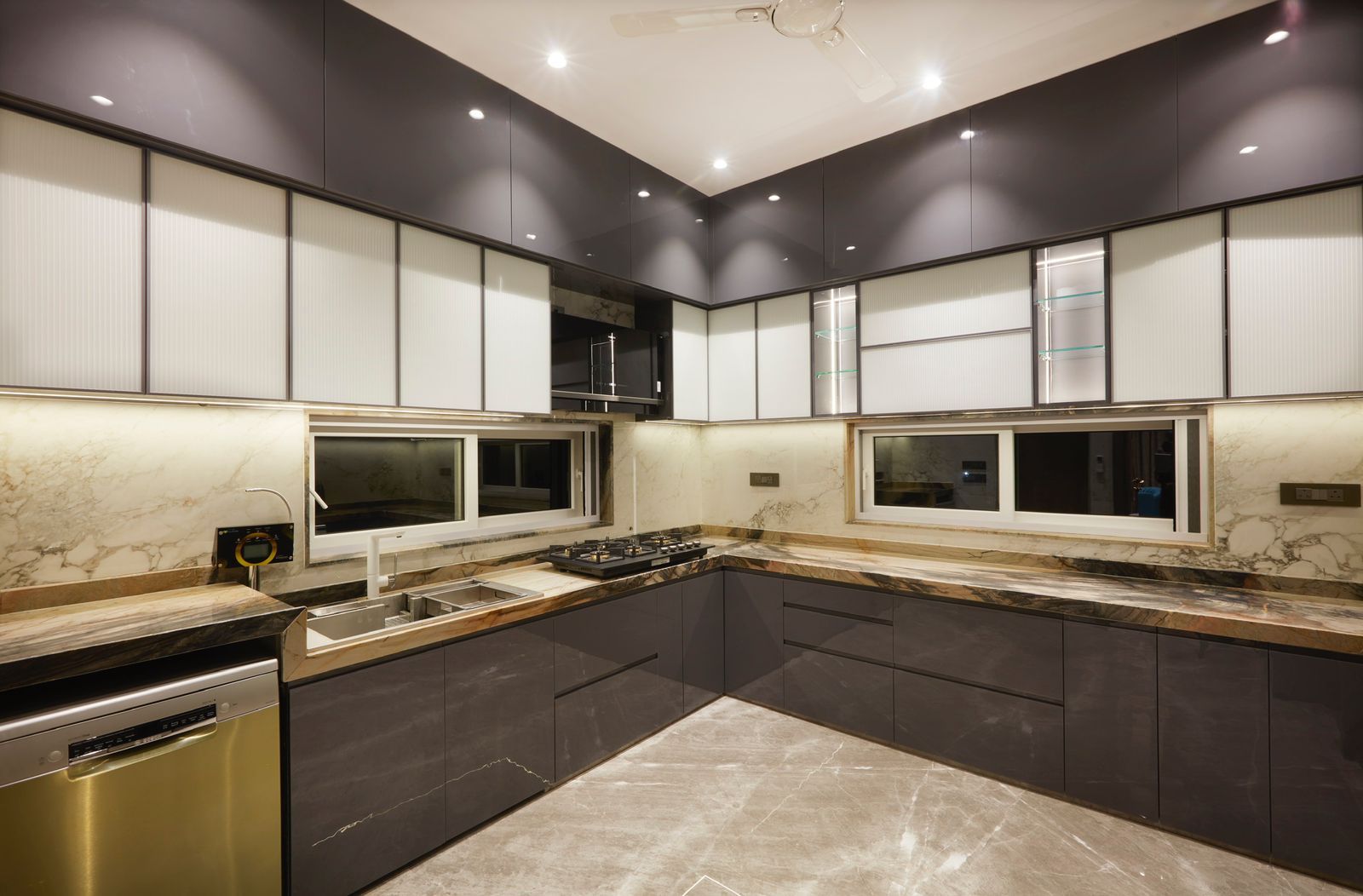
Selected work by Greenbox Design Studio. Tap any image to enlarge.
Frequently asked questions
Should I use warm white or cool white at home?+
Warm white at 3000 K for living rooms, bedrooms, dining and corridors. Reserve 4000 K neutral for task areas — kitchen counters, bathroom mirrors and study desks. Cool daylight at 6500 K has no place in a home; it renders skin grey and makes warm materials look flat.
What is CRI and why does it matter?+
Colour Rendering Index measures how accurately a light shows colour, on a scale to 100. Below 80, reds go muddy and wood looks flat. CRI 90 or above is what makes veneer, stone and skin look the way they did when you chose them, and the difference is more visible than a 500 K change in colour temperature.
Can I mix colour temperatures in one room?+
Only where the change coincides with a change of function — 4000 K task light under kitchen wall units in a room otherwise at 3000 K reads as deliberate. Two different ambient temperatures in one continuous space is immediately visible and always reads as an error.
Why do Indian homes use so much cool white?+
Cool white appears brighter for the same wattage, and when CFLs and early LEDs were expensive that made it the sensible purchase. LED efficiency has since removed the trade-off, but the habit and the retail stock both persist.
What colour temperature is best for a bathroom?+
4000 K at the mirror, where accurate rendering matters for shaving and make-up, and 3000 K for the general ceiling light if the bathroom has both. Position the mirror light vertically on either side of the mirror rather than above it, which casts shadows onto the face.