
Calculate your waterproofing
Floor dimensions plus how far the membrane goes up the walls.
How this calculator works
- Floor area = length × width.
- Wall area = 2 × (length + width) × coping height. Coping is how far up the wall the membrane is taken.
- Total area = floor + wall.
- Applied rate = system rate × coat factor. The system rate is the two-coat rate; a third coat is costed at 1.35× rather than 1.5×, because the later coats use less material than the first on a primed surface. A three-coat terrace therefore prices above the ₹130–190 chemical-treatment band, which is where it belongs.
- Material quantity ≈ area ÷ 12 sq ft per litre per coat, a realistic figure across cementitious and acrylic systems on a plastered surface.
- Cost = area × applied rate + optional screed + ₹2,500 for the ponding test.
| System | Rate per sq ft, two coats | Where it belongs | Life |
|---|---|---|---|
| Cementitious slurry | ₹135 | Bathroom floors and low coping, under tile | 10 – 15 years |
| Acrylic polymer | ₹160 | Bathrooms, balconies, general wet areas | 8 – 12 years |
| APP torch-on membrane | ₹175 | Terraces and podiums | 15 – 20 years |
| Polyurethane | ₹190 | Exposed terraces, planters, sunken slabs | 12 – 18 years |
| Protective screed | ₹95 / sq ft | Over a terrace membrane before tiling | — |
| Ponding test | ₹2,500 | 48 hours, every wet area, always | — |
Rates are applied — material, surface preparation, primer and labour. They assume a sound plastered substrate. Chipping out a failed existing layer is extra, at ₹42 per sq ft of breaking plus ₹4,575 for each debris run.
Design and build under one accountable roof
Worked example — the default bathroom
| Step | Arithmetic | Result |
|---|---|---|
| Floor | 7 × 4.5 | 31.5 sq ft |
| Perimeter | 2 × (7 + 4.5) | 23 ft |
| Wall area | 23 × 4 | 92 sq ft |
| Total area | 31.5 + 92 | 123.5 sq ft |
| Applied rate | ₹160, two coats | ₹160 / sq ft |
| Material and application | 123.5 × ₹160 | ₹19,760 |
| Ponding test | flat | ₹2,500 |
| Total before GST | sum | ₹22,260 |
Where waterproofing actually fails
Almost never in the middle of the floor. It fails at the junctions — where the floor meets the wall, where a pipe passes through the slab, at the door threshold, and around the floor trap. Those are the places that move, and a membrane that is not detailed at a junction is a membrane with a hole in it. Ask specifically whether the quotation includes fillet coving at the floor-wall junction and puddle flanges at every pipe penetration. If it does not, it is not a waterproofing job, it is a coat of paint.
The second failure is sequencing. Waterproofing goes on after all the plumbing is fixed and tested, and before any screed or tile. Where a plumber comes back to add a point after the membrane is down, the membrane has been cut and must be made good over a 12-inch radius around the penetration. That conversation has to happen on site, and it is one of the reasons we insist on a single point of responsibility across plumbing and waterproofing rather than two contractors.
The third is the threshold. Water tracks under a door far more often than it comes through a wall. The membrane must run 6 inches past the door line into the room outside, and the finished bathroom floor should sit 10 to 15 mm below the bedroom floor. Both are free to do at the right moment and impossible afterwards.
These are applied rates, not drum prices. They sit inside the ₹130–190 per sq ft band Greenbox has invoiced for chemical waterproofing treatment on wet areas it has built and handed over, restated at October 2026, and the ₹160 default is the same figure our bathroom renovation calculator works from. Treat the output as a planning figure: accurate enough to brief a landlord, a bank or a family, and not accurate enough to sign a contract against.
What this tool does not cover
- Chipping out failed existing waterproofing, at ₹42 per sq ft, and the debris runs at ₹4,575 each.
- Sunken slab filling, which uses lightweight fill or thermocol plus screed and is priced by volume.
- Plumbing itself — the plumbing points estimator prices that.
- Structural repair. A leaking slab with corroded reinforcement needs a structural engineer, not a membrane.
- Terrace slope correction, which must be built into the screed before the membrane goes on.
- 18% GST, shown separately in the breakdown.
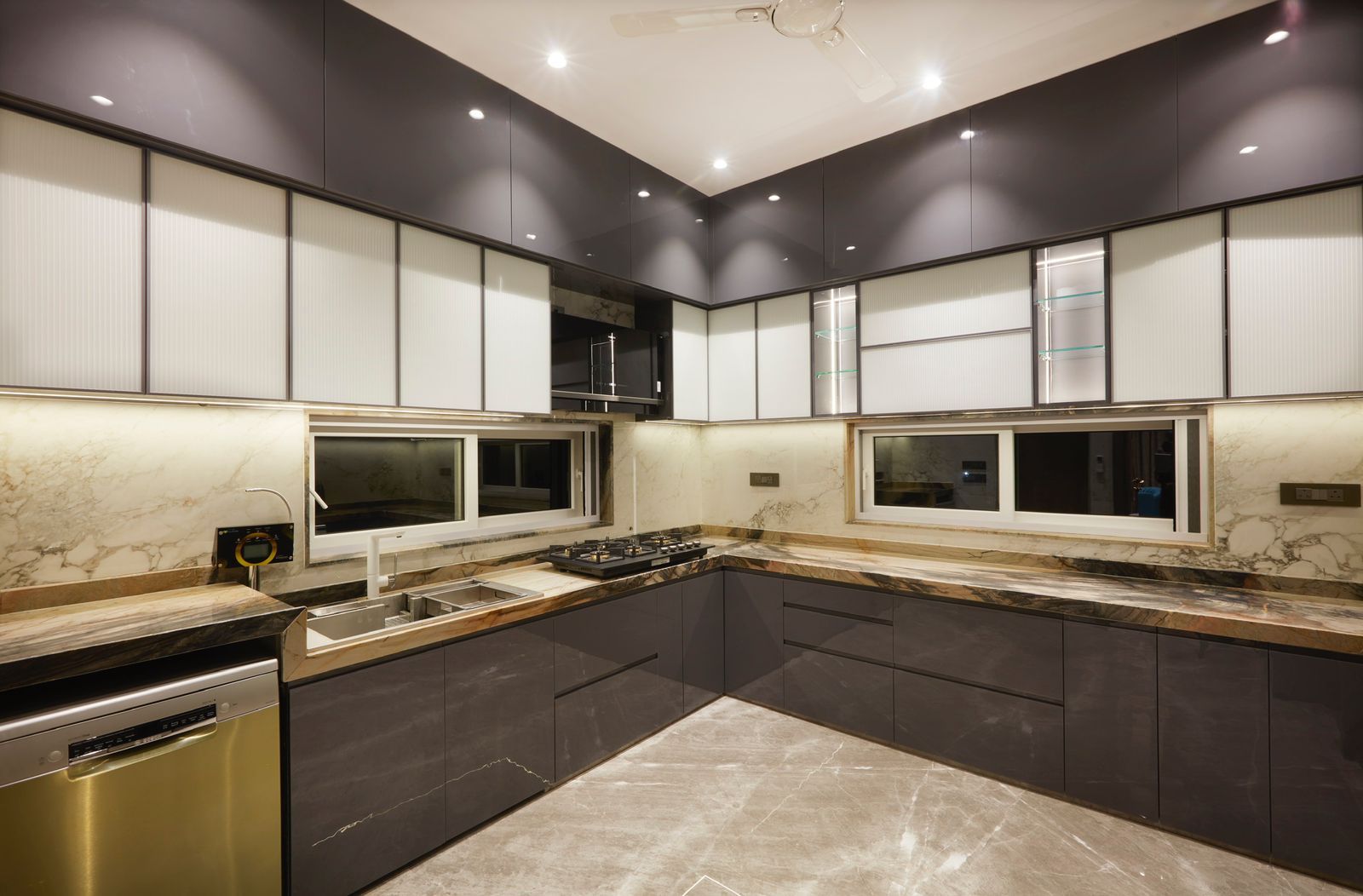
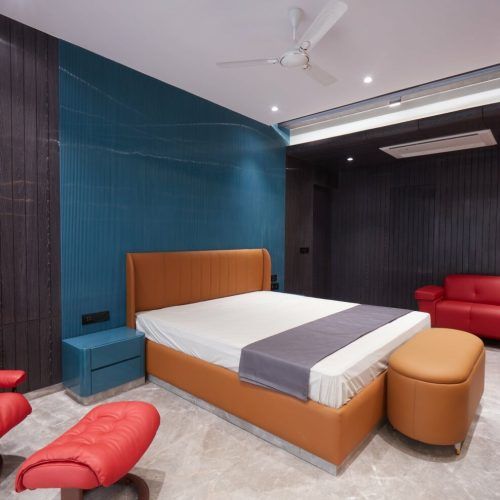
Selected work by Greenbox Design Studio. Tap any image to enlarge.
Frequently asked questions
How much waterproofing do I need for a bathroom?+
Floor area plus the perimeter times the coping height. A 7 × 4.5 ft bathroom with 4 ft of coping needs about 123 sq ft treated — four times the floor area. Take the shower wall to full height and run the membrane 6 inches past the door.
What does bathroom waterproofing cost in Mumbai?+
₹160 per sq ft of treated surface for a two-coat acrylic polymer system, which puts a standard bathroom at around ₹19,800 plus ₹2,500 for the ponding test. Cementitious is ₹135 and polyurethane ₹190. It is roughly 3% of a bathroom renovation.
How high should waterproofing go up the wall?+
Four feet generally, full height on the shower wall, and 12 inches on a terrace parapet. Anywhere water can be splashed or driven by wind needs membrane, and the cost of going a foot higher is trivial against the cost of not.
What is a ponding test?+
Plug the floor trap, flood the waterproofed area to about two inches and leave it for 48 hours, checking the ceiling below. It is the only test that proves the work, it costs about ₹2,500 in lost time, and it is the step contractors under programme pressure quietly skip.
How long does waterproofing last?+
Eight to twelve years for an acrylic system under tile, ten to fifteen for cementitious, fifteen to twenty for an APP membrane on a terrace. In practice the membrane usually outlives the detail — failures cluster at junctions and pipe penetrations, not in the field.