
Build your mood board
Six choices. The board and the indicative rate update as you go.
How this builder works
- Each palette carries three published hex values — a dominant, a secondary and a grounding tone — chosen so the three work together rather than being generated on the fly.
- Flooring, joinery, upholstery and metal each carry one hex representing the material as it actually appears in a room.
- The indicative rate starts at ₹1,850 per sq ft of carpet area, the mid-point of the Mumbai premium band, and is multiplied by a factor for the style, the flooring, the joinery finish and the metal.
- Style multipliers: contemporary 1.00, industrial 1.08, warm minimal 1.12, Japandi 1.18, transitional classic 1.22, modern Indian craft 1.28.
- Joinery multipliers: laminate 1.00, acrylic 1.18, teak veneer 1.24, PU lacquer 1.32, fluted timber 1.36.
- The board is rendered live as seven swatches with their labels and hex codes.
| Element | Options | Cost effect |
|---|---|---|
| Style | Contemporary, industrial, warm minimal, Japandi, transitional, Indian craft | 1.00 to 1.28× |
| Palette | Oat and stone, clay and cream, ink and bone, moss and linen, charcoal and oak | No cost effect — paint is paint |
| Flooring | Grey tile, light oak, walnut, terrazzo, beige marble | 0.94 to 1.22× |
| Joinery finish | Laminate, acrylic, veneer, PU, fluted timber | 1.00 to 1.36× |
| Upholstery | Linen, bouclé, velvet, block-print cotton, wool | No cost effect at this level of estimate |
| Metal | Matt black, brushed steel, antique brass, dark bronze | 1.00 to 1.12× |
Palette and upholstery carry no multiplier because at whole-project level the cost of paint and of a few metres of fabric does not move a per-sq-ft rate. That does not mean they do not matter — they are the two choices people notice first.
Design and build under one accountable roof
Worked example — the default board
Contemporary Indian style, oat and stone palette, light oak flooring, matt laminate joinery and antique brass hardware. The rate builds up as ₹1,850 × 1.00 style × 1.00 flooring × 1.00 joinery × 1.10 metal, which rounds to ₹2,040 per square foot of carpet area. Across 700 sq ft that is about ₹14.3 lakh before GST — which is consistent with what our budget allocation calculator would call the premium band.
Change the joinery to fluted timber and the rate moves to ₹2,770, or ₹19.4 lakh on the same flat. That is the value of putting a number against a board: fluted timber is a beautiful thing that appears on every reference image people bring us, and it is a 36% uplift on the largest line in the budget. Knowing that before the drawings are made is the difference between a scheme that survives value engineering and one that gets stripped back in week six.
How to use a mood board with suppliers
Print it, or screenshot it, and take the hex codes. A laminate dealer in Mumbai will have three thousand boards in the showroom and no way to narrow them from a description. Give them #D9D2C6 and they will pull four boards within two shades of it in ten minutes. The same applies to a fabric supplier, a stone yard and a hardware showroom.
The second use is discipline. A mood board's real function is not inspiration, it is refusal — it gives you a reason to say no to the beautiful thing that does not belong. Every project accumulates attractive individual decisions that do not add up, and the board is the reference that catches them. We pin ours in the site office for exactly that reason.
What a mood board cannot do is replace samples. Screens lie about colour, and a laminate looks different under a showroom's 5000K lights than it will in your flat at 7 pm. Use the board to shortlist, then get physical samples of every material, put them together on your own floor, and look at them at three times of day before committing.
Every constant on this page comes from Greenbox site records — measured drawings, signed BOQs and completion certificates from projects delivered between 2023 and 2026 — rounded to the figures an estimator would actually write down. We publish them so the arithmetic can be audited rather than trusted. Treat the output as a planning figure: accurate enough to brief a landlord, a bank or a family, and not accurate enough to sign a contract against.
What this tool does not cover
- Screen colour accuracy. Swatches are approximations of a material, not a match.
- Actual material availability and price, which vary by supplier and by month.
- Loose furniture, art, lighting and styling, which sit outside the per-sq-ft rate.
- Civil work, appliances and GST, none of which are in the indicative figure.
- Workmanship. A warm-minimal scheme with poor detailing looks worse than a busier scheme done well, which is why the style multiplier for minimal is above 1.00 rather than below it.
- For a costed estimate rather than an indicative rate, use the interior design cost calculator.
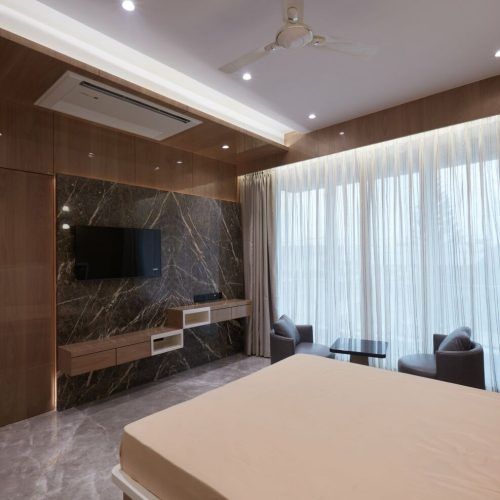
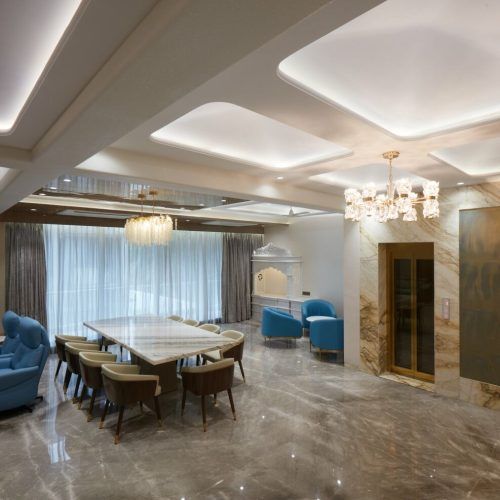
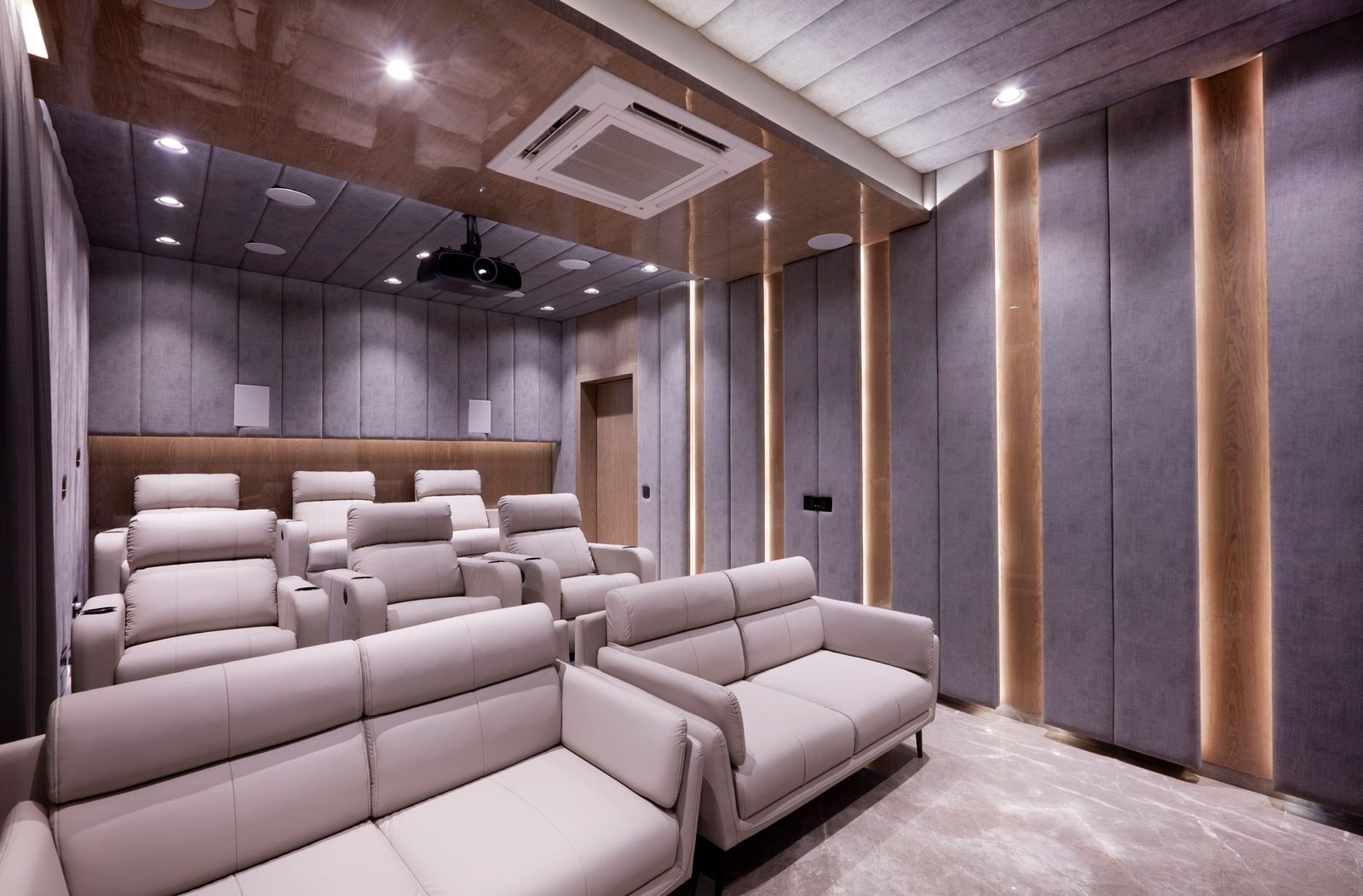
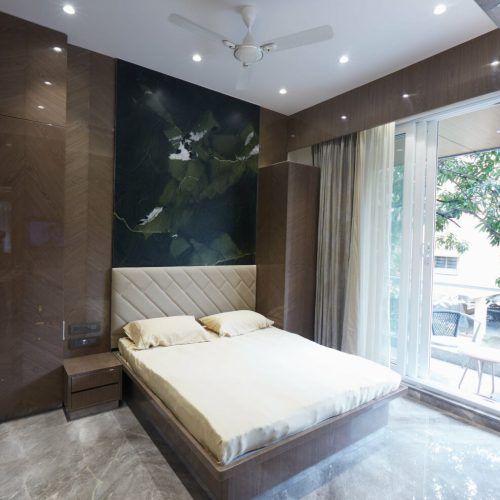
Selected work by Greenbox Design Studio. Tap any image to enlarge.
Frequently asked questions
What is a mood board in interior design?+
A single reference that fixes the material and colour decisions for a project — palette, flooring, joinery finish, fabric and metal. Its real function is not inspiration but refusal: it gives you a reason to decline the attractive thing that does not belong.
How do I make a mood board that is actually useful?+
Put hex codes and material names on it, not adjectives. A supplier cannot act on a style name and can act on #D8C3A2. Six decisions — style, palette, flooring, joinery finish, upholstery, metal — are enough to carry a whole flat.
Which finish choice costs the most?+
Joinery, by a distance. Moving from matt laminate to fluted timber adds 36% to the largest line in an interior budget, and PU lacquer adds 32%. Flooring moves the number by up to 22%, and metalwork by 12%.
Do I need physical samples if I have a mood board?+
Yes. Screens misrepresent colour and showroom lighting misrepresents material. Use the board to shortlist, then get physical samples of every material, lay them together on your own floor, and look at them in morning light, afternoon light and under your own lamps.
Can a mood board cover a whole flat or just one room?+
A whole flat, and it should. The most common failure in Indian homes is a scheme that changes at every doorway. One board with one palette, varied by room in emphasis rather than in colour, is what makes a flat read as a single home.