
Size your ceiling fan
Room dimensions and ceiling height decide the sweep and the downrod.
How this calculator works
- Area = length × width. The sweep is then looked up from a fixed table: ≤40 sq ft → 600 mm, ≤70 → 900, ≤110 → 1050, ≤160 → 1200, ≤250 → 1400.
- Above 250 sq ft the tool returns multiple 1200 mm fans, one per 160 sq ft, because two medium fans cover a large room more evenly than one large one.
- Clearance = (shorter room dimension − blade span) ÷ 2. Under 18 inches the tool tells you to drop a size.
- Downrod = ceiling height in inches − 102 − 10, rounded down to the nearest standard rod (0, 6, 12, 18, 24 or 36 inches). The 102 is the target blade height; the 10 is the fan canopy and motor drop.
- Air delivery is the typical rated figure for each sweep: 130 m³/min at 600 mm rising to 270 at 1400 mm.
- Running cost compares BLDC at roughly 28 W per 1200 mm of sweep against an induction motor at 75 W, at eight hours a day and ₹9 per unit.
| Room area | Sweep | Blade span | Typical room |
|---|---|---|---|
| Up to 40 sq ft | 600 mm | 23.6 in | Utility, small bathroom, walk-in closet |
| 40 – 70 sq ft | 900 mm | 35.4 in | Small study, kitchen, servant room |
| 70 – 110 sq ft | 1050 mm | 41.3 in | Second bedroom, compact 1BHK bedroom |
| 110 – 160 sq ft | 1200 mm | 47.2 in | Standard master bedroom |
| 160 – 250 sq ft | 1400 mm | 55.1 in | Living room, large master |
| Over 250 sq ft | 2 × 1200 mm | — | Open living-dining, hall |
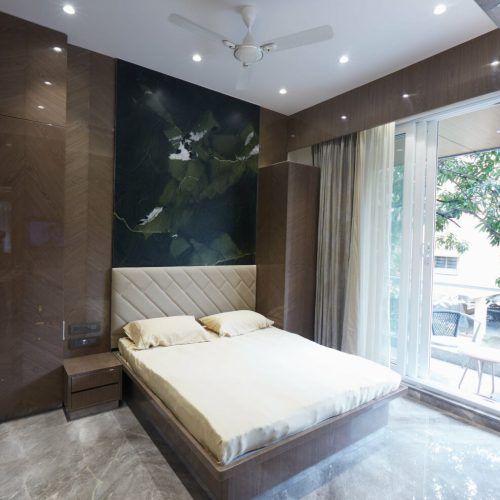
Design and build under one accountable roof
Worked example — the default bedroom
| Step | Arithmetic | Result |
|---|---|---|
| Room area | 12 × 12 | 144 sq ft |
| Sweep band | 110 < 144 ≤ 160 | 1200 mm |
| Blade span | 1200 ÷ 25.4 | 47.2 in |
| Wall clearance | (144 in − 47.2 in) ÷ 2 | 48.4 in each side |
| Downrod required | (10 × 12) − 102 − 10 | 8 in → 6 in standard rod |
| Blade height achieved | 120 − 6 − 10 | 104 in from floor |
| BLDC vs induction | 28 W vs 75 W | ₹1,235 a year saved |
Where the fan goes, and why it is usually wrong
Electricians centre the fan point on the room because that is what the slab drawing shows. In practice the fan should be centred on the activity, not the geometry. In a bedroom that means over the foot of the bed — air across the body rather than on the face, which is what wakes people at three in the morning. In a living room it means over the seating cluster, which in a rectangular Mumbai living-dining is rarely the centre of the room.
The second common error is fighting the false ceiling. If a peripheral cove drops 150 mm and the fan point sits in the cove zone, the fan either clashes with the cove or has to be moved. Coordinate the fan point with the ceiling drawing before the electrical conduiting is chased — moving a fan point afterwards means cutting the slab soffit, which no society will approve willingly.
Third, the beam. Older Mumbai buildings have a downstand beam through the middle of most rooms, and a fan hung from a beam sits 200–300 mm lower than one on the slab. Either accept the lower blade height or move the fan off the beam. Two smaller fans either side of the beam is often the better answer in a long living room.
One detail worth specifying in writing: the fan should be balanced and test-run before the false ceiling is closed and before the painter arrives. A fan that wobbles is almost always a blade balance or a loose canopy, both of which are two-minute fixes from a ladder and an hour-long argument once the ceiling is finished and the room is furnished.
Every constant on this page comes from Greenbox site records — measured drawings, signed BOQs and completion certificates from projects delivered between 2023 and 2026 — rounded to the figures an estimator would actually write down. We publish them so the arithmetic can be audited rather than trusted. Treat the output as a planning figure: accurate enough to brief a landlord, a bank or a family, and not accurate enough to sign a contract against.
What this tool does not cover
- Fan purchase cost, which ranges from ₹1,600 for a basic induction fan to ₹9,000 for a premium BLDC with a remote.
- The fan hook or box, which must be cast into the slab or anchored properly — a fan is the one ceiling fixture that must never hang from gypsum board.
- Regulators, remotes, IoT controls and the wiring for them.
- Sloped ceilings, which need an angled mounting kit, and double-height rooms, which need a rod longer than 36 inches made to order.
- Air circulators, wall fans and tower fans, which follow different sizing rules.
- For overall room lighting rather than air movement, see the lumens calculator, and for cooling load the AC tonnage calculator.
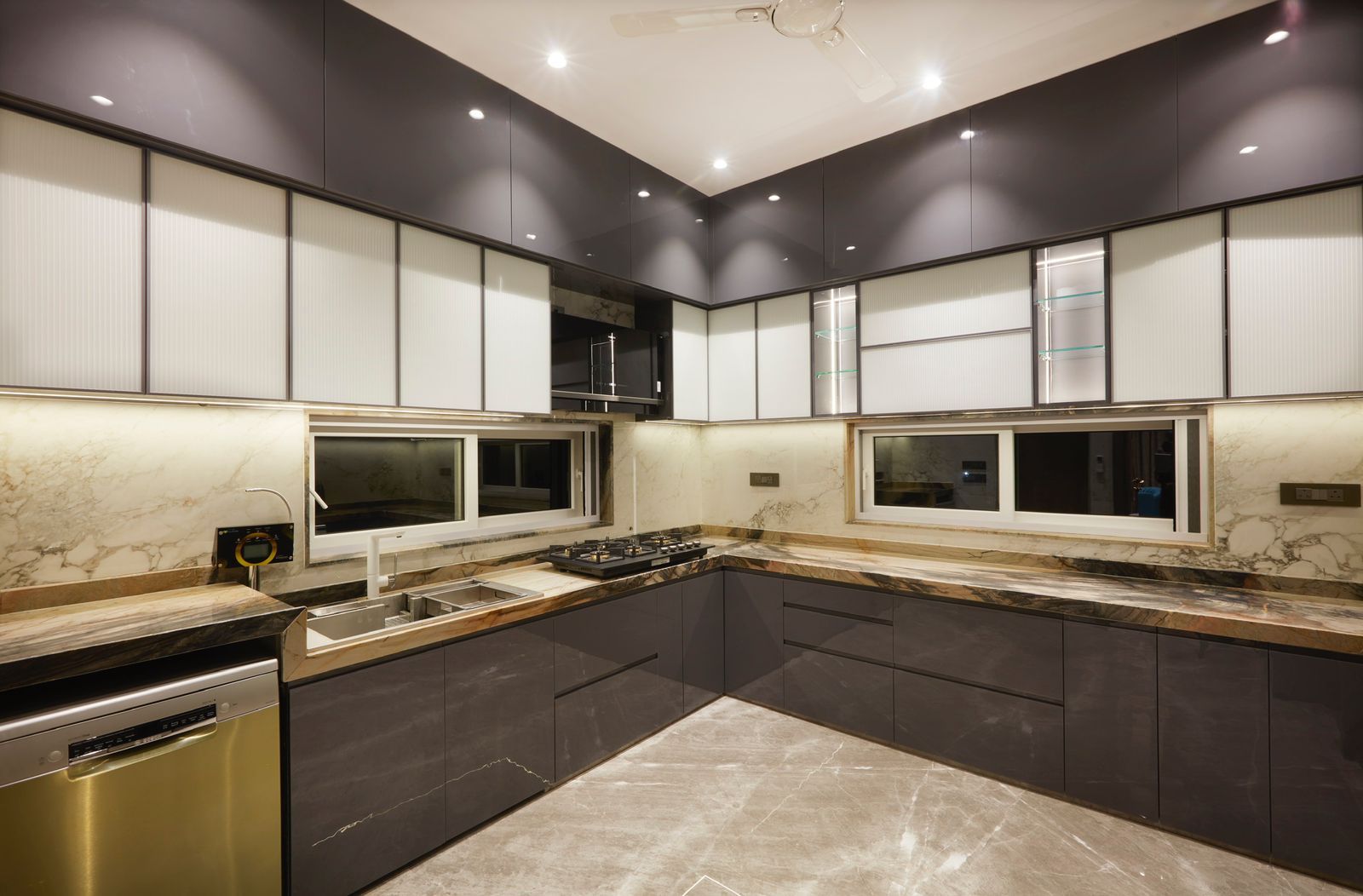
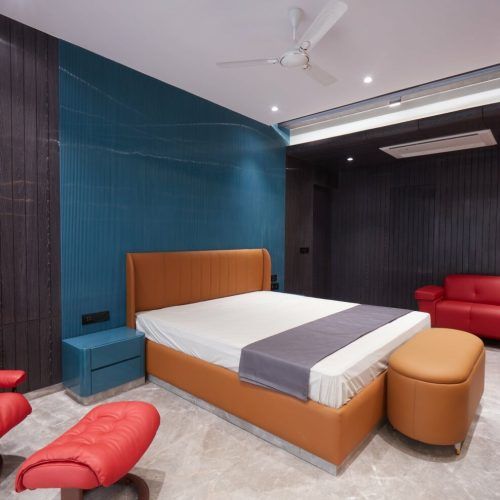


Selected work by Greenbox Design Studio. Tap any image to enlarge.
Frequently asked questions
What size ceiling fan for a 12 × 12 room?+
A 1200 mm sweep, which is the standard Indian bedroom fan. The room is 144 sq ft, which sits in the 110–160 sq ft band, and the blade tips end up more than four feet from every wall.
How low should a ceiling fan hang?+
Blades at 96 to 108 inches from the floor. In a 10 ft room that means a 6 inch downrod. Flush mounting is only for ceilings under 9 ft, and it costs you roughly 15% of the air movement because the blades cannot draw air from above.
Is a BLDC fan worth the extra cost?+
Yes, on any fan that runs more than four hours a day. A 1200 mm BLDC draws about 28 W against 75 W for an induction motor, saving roughly ₹1,200 a year at eight hours daily. The price difference is ₹2,000–3,500, so it pays back in two to three years and runs quieter throughout.
Can I put two fans in one room?+
In any room over 250 sq ft you should. Two 1200 mm fans spread air far more evenly than one 1400 mm fan, and they let you run only one when the room is half occupied. Space them at least 8 ft apart, centre to centre.
Does a false ceiling affect fan size?+
It affects the downrod, not the sweep. Measure the height to the finished ceiling, not the slab. And coordinate the fan point with the cove layout before conduiting — a fan point that lands inside a cove drop is the most common ceiling clash we are called in to fix.