
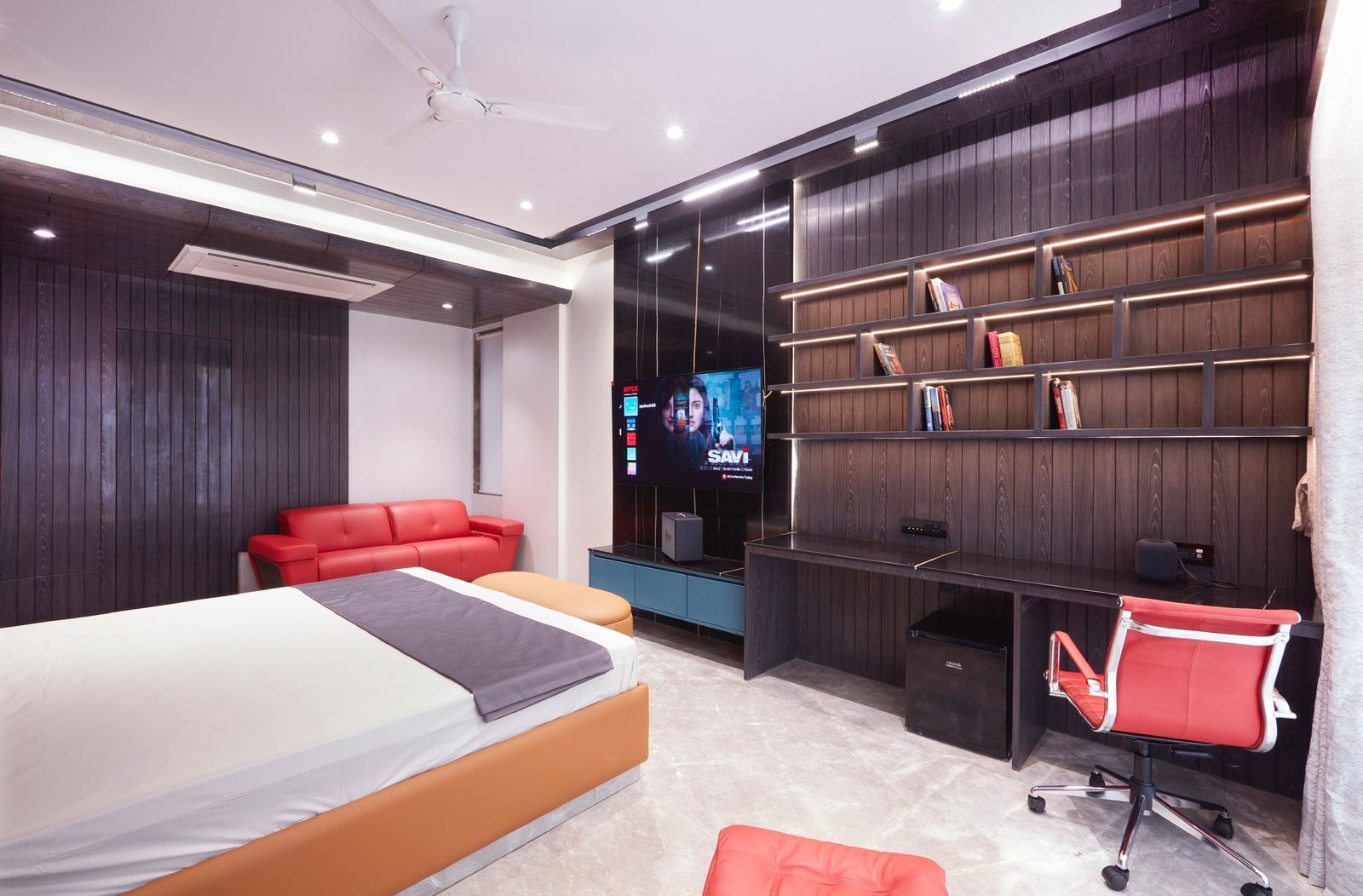
The four measurable decisions
- Desk orientationPerpendicular to the glazing, window on your left if you are right-handed. It is the only orientation that gives daylight without screen glare or a silhouette on a call, it costs nothing, and most home studies get it wrong.
- Desk dimensions1,500–1,800 mm wide, 600–700 mm deep, top at 750 mm. 600 mm is the minimum depth for a 27-inch monitor at a correct viewing distance; below that you sit too close and your neck knows within a week.
- Light at the surface500 lux on the desk from a dedicated task light at 4000K, plus ambient at 150–200 lux at 3000K. A ceiling light behind you puts your own shadow on the keyboard, which is the commonest lighting fault in a home study.
- Power and data at the surfaceTwo twin sockets and a data point at desk level, not at skirting level, plus a cable tray under the top. Every lead that crosses a floor in a study eventually gets pulled.
The modern study palette
Low contrast at the working end, so the eye is not constantly adapting, and one deeper tone behind the chair where the camera looks. Avoid anything that reflects into a screen.
- Warm white
#F2F0EA— the wall the desk faces — plain, low sheen, no pattern - Charcoal blue
#3B4347— the wall behind the chair, the camera background - Oak
#A67C4F— desk top and open shelving - Grey-green
#8E958F— acoustic panel fabric, the chair - Ink
#1E2022— task light, monitor arm, handles
What to build into a study
- A 25 mm desk top in veneered ply or solid wood with a 40 mm front edge, fixed to the wall on concealed brackets rather than legs. A wall-fixed top gives you the whole footwell.
- A monitor arm clamped to the top, not a monitor stand. It recovers 300 mm of desk depth and is the cheapest ergonomic upgrade available.
- Fabric-wrapped 50 mm acoustic panels at the first reflection points, which for a desk against a wall means the wall behind the screen and the one to your speaking side. Two panels of 600 × 1,200 mm are usually enough in a 75 sq ft room.
- A solid-core door with a drop seal. The difference between a study and a desk in a spare room is a door that closes properly.
What a modern study costs
| Element | Specification | 2026 Mumbai cost |
|---|---|---|
| Desk wall | 1,800 mm desk, open shelving above, cable tray and grommets | ₹92,000 |
| Storage | 1,200 mm credenza with drawers and a printer bay, below sill height | ₹56,000 |
| Acoustic and pinboard panel | Two fabric-wrapped 50 mm panels with an integrated pinboard | ₹38,000 |
| Lighting | Task light at 4000K, cove at 3000K, both separately switched and dimmable | ₹28,000 |
| Chair | Task chair with lumbar adjustment, gas lift and armrests | ₹32,000 |
| Paint and blinds | Full room, plus a light-filtering roller and a blackout layer | ₹22,000 |
Total at this specification: ₹2,68,000 ex-GST. Add 18% GST. The chair is the item most often cut and the one you sit in for 2,000 hours a year. Buy it before the joinery.
Three study-room mistakes
- Desk facing the window. It feels right and it makes you a silhouette on every video call, in a city where the light behind you is very bright for eight months of the year.
- Tall storage on the window wall. It blocks the daylight you built the room around. Keep the window wall below sill height and put the height on an internal wall.
- One ceiling light. A single overhead fitting puts your shadow on the desk and lights the room at the wrong level. Task plus ambient, separately switched.
Home studies in Mumbai flats
Most Mumbai home studies are a converted second bedroom of 70–90 sq ft, or a corner of the master, and they usually face an internal duct where the daylight is weak and the neighbour's kitchen is audible. If the room faces a duct, treat it as an artificial-light room: 500 lux at the desk and a 3000K ambient wash, and stop trying to position the desk for daylight that is not there. Noise is the other constraint — a 9am call competing with the flat above's washing machine is a real problem, and the cheapest fixes are a solid-core door with a drop seal at ₹12,000–₹22,000 and a heavy lined curtain over the window. Also check the electrical: an older flat's bedroom circuit is frequently a single 6A loop, which is not enough for a workstation, a printer and an AC.
Get the orientation, the lux and the sockets right; the rest is joinery. Other directions for the same room: Luxury study room ideas · Minimalist study room ideas. For rates and scope, see Home office — case study, or go back to all interior design ideas.
Frequently asked questions
How big does a home study need to be?+
About 55 sq ft for a single-person study with a 1,500 mm desk and a credenza. 75–90 sq ft lets you add a second chair and a bookcase. The binding constraint is usually the 1,000 mm you need behind the desk chair, not the desk itself.
Should a study have a window?+
It helps, but the orientation matters more than the view. A room with a duct-facing window and good artificial light works better than a bright room with the desk facing the glass. If there is a window, sit side-on to it.
What lighting level do I need for working from home?+
500 lux on the desk surface, measured with a phone app if nothing else. A single 9W desk lamp does not get there; a 15–20W task light at 4000K positioned to the side of your writing hand does. Keep the ambient warmer and dimmer.
How do I make video calls look better?+
Face a window or a soft light source, put a plain or lightly shelved wall behind you, and avoid a ceiling downlight directly overhead. A 1,200 mm wide plain wall behind the chair, painted one tone deeper than the rest, is all the background you need.