
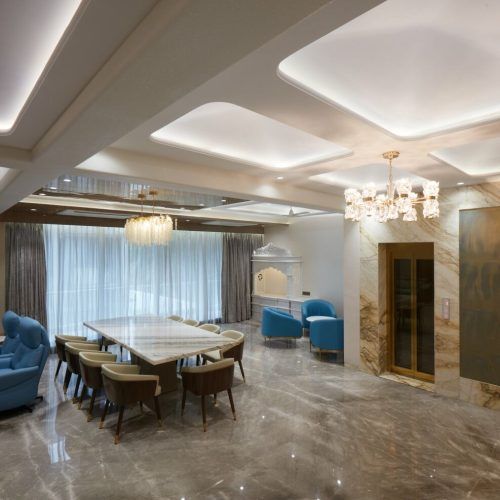
Designing around how Indian meals are served
- Table width before length1,000–1,100 mm wide, so a row of serving dishes can sit down the centre with place settings either side. A 900 mm European table forces the dishes to the ends, which changes how the meal works. Length follows the seat count at 600 mm per person.
- Low-backed chairsBacks at 850–900 mm overall rather than 1,050 mm, in carved or turned teak with a cane or upholstered seat. Low backs let food be served over the shoulder and keep a small room from feeling walled in by furniture.
- A crockery unit sized for steelIndian households store steel thalis, brass serving pieces, pressure cookers and festival crockery. That is 30–40% more volume than a European dining unit assumes. Closed below, jali or glazed above, 7–9 ft long.
- Warm low lightA brass hanging lamp at 780 mm over the table, plus wall lamps rather than downlights. Traditional dining rooms were lit low and warm, and the food looks better for it.
The traditional Indian dining palette
Warm and deep, taking colour from the wood and the textiles. A dining room is used at night, so the palette should be chosen under warm light.
- Ivory lime
#EFE2C4— walls above a dado or picture rail - Teak
#5C3A22— table, chairs and the crockery unit frames - Deep green
#2C5248— chair seat upholstery or the table runner - Brass
#B18A36— the hanging lamp, handles and serving pieces on display - Terracotta
#9E4B2F— the Athangudi or Kota floor band
Craft and practical specification
- Seasoned teak at 8–10% moisture with mortise-and-tenon joinery, and a matt PU or an oil finish on the table top. A polished top shows every mark from a hot serving dish; a matt or oiled one can be refreshed.
- Cane or a tight upholstered seat at 450 mm height. Cane is traditional, breathes in Mumbai heat and needs re-caning every eight to ten years, which costs ₹1,500–₹3,000 a chair.
- A jali or glazed upper section on the crockery unit with a dust-sealed rebate, so displayed brass and steel do not need weekly washing.
- Athangudi or Kota as a floor band under the dining zone, which defines the area without a partition and takes spills better than timber or a rug.
What a traditional dining room costs
| Element | Specification | 2026 Mumbai cost |
|---|---|---|
| Table | 1,800 × 1,050 mm commissioned teak, carved or turned base | ₹1,85,000 |
| Crockery unit | 8 ft, teak frames with jali and solid panels, sized for steel and brass | ₹1,55,000 |
| Flooring | Athangudi or Kota band defining the dining zone, with a border | ₹62,000 |
| Lighting | Brass hanging lamp, two wall lamps, warm dimmable circuit | ₹48,000 |
| Textiles | Table runner, chair seat upholstery, curtains | ₹32,000 |
Total at this specification: ₹4,82,000 ex-GST. Add 18% GST. Chairs are excluded and are typically ₹9,000–₹22,000 each in commissioned teak with cane seats, which is where the seat count shows in the budget.
Three traditional dining mistakes
- A 900 mm wide table. Standard European width, and it does not take serving dishes down the centre. This is the most consequential dimension in an Indian dining room.
- High-backed carved chairs. They look impressive and they block serving, dominate a small room and make the table hard to leave. 850–900 mm overall is the working height.
- A polished table top. Every hot serving dish leaves a mark on a high-gloss PU top. Matt or oil finish, which can be refreshed without stripping the table.
Traditional dining furniture in a Mumbai flat
A commissioned 1,800 × 1,050 mm teak table weighs 70–110 kg and rarely knocks down beyond removing the legs, so measure the lift car, the lobby turn and your flat's entrance before the karigar starts. The eight to twelve week lead time applies here too, and the table is usually the last thing to arrive and the first thing the client asks about. In a Mumbai flat the dining zone is generally a strip, so a 1,050 mm wide table leaves less pull-back than a 900 mm one — check that you still have 1,050 mm on the serving side and accept 900 mm against the crockery unit. Finally, teak moves seasonally; a wide solid top needs buttoned or slotted fixings to its frame, not rigid screws, or it will split within two monsoon cycles.
Get the width right, keep the backs low, and store for steel. Other directions for the same room: Scandinavian dining room ideas · Modern dining room ideas. For rates and scope, see Interior design cost in Mumbai, or go back to all interior design ideas.
Frequently asked questions
How wide should an Indian dining table be?+
1,000–1,100 mm, against the 900 mm of a typical European table, so serving dishes can sit down the centre. It is the single most useful change you can make to a dining table for Indian meals.
Is cane seating practical?+
Yes — it breathes, it suits Mumbai's heat and it looks correct with teak. It needs re-caning every eight to ten years at ₹1,500–₹3,000 per chair, which is a modest maintenance cost for a seat that lasts decades.
How much crockery storage does an Indian household need?+
Roughly 30–40% more than a European dining unit assumes, because of steel thalis, brass serving pieces and festival sets. An 8 ft unit at 450 mm depth, closed below and display above, is the working size for a family of four to six.
Can a traditional dining set work in a modern flat?+
Well, particularly if the architecture stays plain. A commissioned teak table and low-backed cane chairs in a room with white walls and a simple floor is a combination we build often and it reads better than a fully traditional room in a contemporary building.