
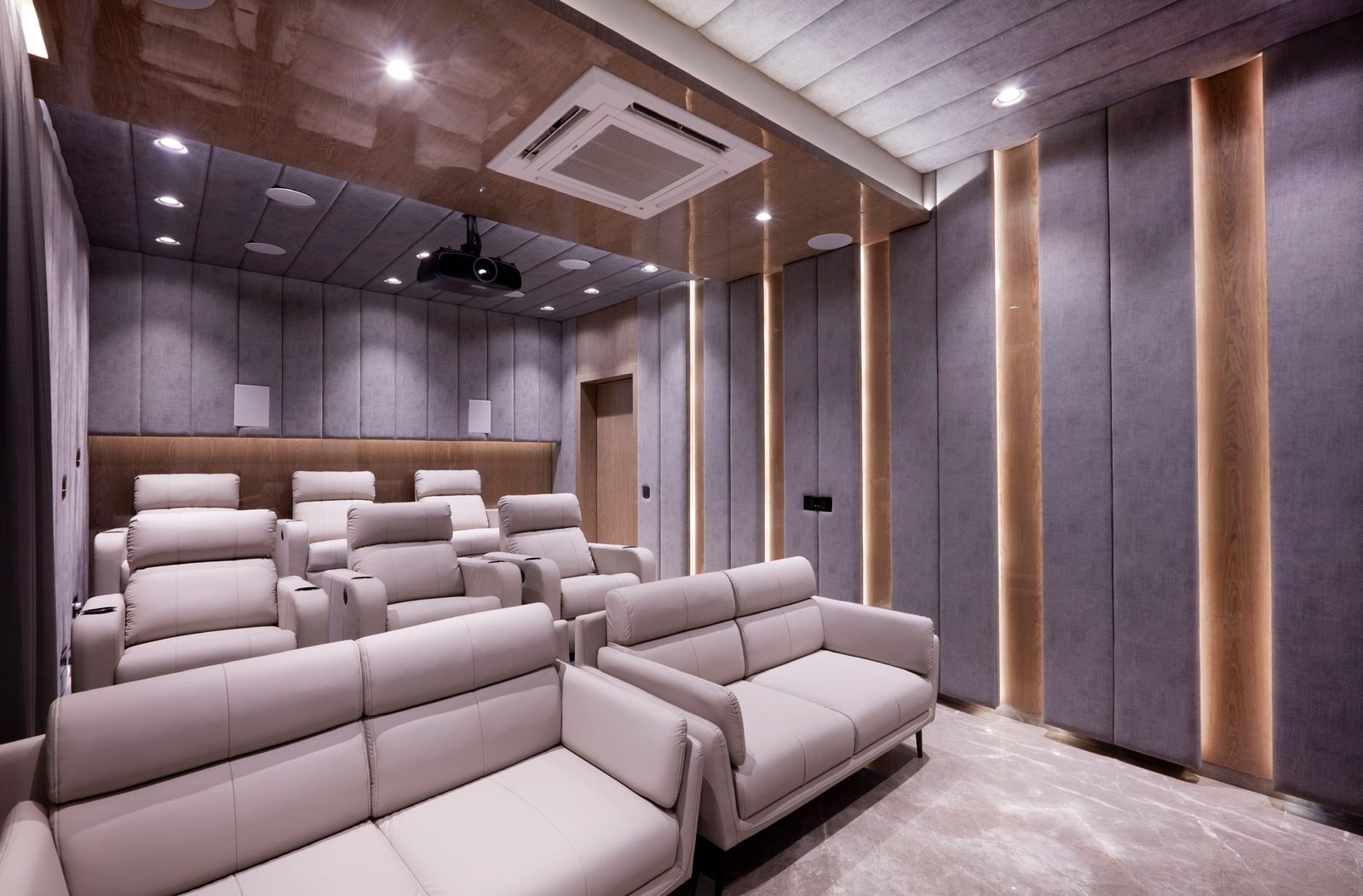
The neighbour problem, and what solves it
In an independent house the acoustic challenge is making the room sound good. In a Mumbai tower it is stopping 40 Hz from arriving in the flat below as a rhythmic thud. These are different problems and they need different money.
| Isolation approach | ₹ per sq ft of room | Low-frequency reduction | Height and width lost |
|---|---|---|---|
| Treatment only, no isolation | ₹900 – 1,600 | Negligible | 75 – 100 mm |
| Resilient channel on walls and ceiling | ₹1,400 – 2,400 | Moderate | 100 – 150 mm |
| Double-leaf walls, isolated ceiling | ₹2,200 – 3,600 | Good | 200 – 280 mm |
| Full room-within-a-room, floated floor | ₹2,800 – 5,500 | Very good | 280 – 400 mm |
Excluding 18% GST. A floated floor on neoprene pucks is the only measure that meaningfully stops structure-borne bass reaching the flat below, and it costs you 75–100 mm of finished height.
- Decouple the floor. A plywood deck on neoprene or rubber isolators over the slab, never mechanically fixed through to it. This is what stops the subwoofer being audible downstairs.
- Double-leaf walls with an air gap and mineral wool infill, with the two leaves never bridged by a screw or a conduit. A single rigid connection destroys most of the benefit.
- Isolated ceiling on hangers, not fixed to the slab. Also the only sensible place to run the HVAC plenum.
- Seal everything. Acoustic sealant at every perimeter, a solid-core door with full perimeter seals and a drop seal at the threshold. A 1% open area destroys around half the isolation of a wall.
- Two doors where the budget allows. An acoustic vestibule is more effective than any single door you can buy.
The neighbour below decides how loud your cinema can be. Spend on the floor before you spend on the amplifier.
Greenbox principal designer
Society rules and when the room gets used
Mumbai societies rarely have a written home-theatre policy, and they very quickly acquire one after a complaint. Three practical points, learned the hard way on other people's projects:
- Ambient noise norms apply after 10pm. Residential areas are held to lower night-time limits, and a genuine complaint to the society or the police is a real risk with an un-isolated room. Isolation is what allows a 10.30pm film.
- Construction needs its own NOC. A theatre build involves framing, board cutting and often a raised floor. Societies read raised floors as structural alteration, so we submit a drawing showing that the floated deck is non-structural and adds a defined, modest load.
- Slab loading. A floated floor, double-leaf walls and eight recliners add real dead load. On older Bandra or Dadar buildings we get a structural view before designing a full room-in-room.
- Talk to the neighbour below first. Unglamorous, and it has prevented more disputes than any acoustic detail we have ever drawn.
Design and build under one accountable roof
Humidity changes the material list
Mumbai's four wet months are unkind to conventional acoustic materials, particularly in a sealed room with limited air changes.
- No open-cell polyurethane foam. It absorbs atmospheric moisture, sags, discolours and eventually smells. We do not use it in Mumbai at any price point.
- Fabric-wrapped mineral wool at 48–64 kg/m³, in sealed timber frames with a breathable acoustic fabric face. Stable, non-combustible and dimensionally reliable through a monsoon.
- BWP-grade ply for all framing and the floated deck. The deck in particular sits on a slab that can sweat.
- Dehumidification in the HVAC brief. A cinema room shut for three weeks in August is a mould risk. We specify a dry mode cycle or a small dehumidifier as part of the design, not as an afterthought.
- Leather and fabric seating chosen for humidity tolerance — perforated leather and treated fabrics rather than untreated suede.
What Mumbai rooms actually cost
| Project type | Typical room | Room build | AV system | Total |
|---|---|---|---|---|
| Media wall in the living room | Shared space | ₹1,20,000 – 2,80,000 | ₹2,20,000 – 4,50,000 | ₹4 – 8 L |
| Converted bedroom, treated | 10 x 13 ft | ₹3,20,000 – 6,00,000 | ₹3,50,000 – 8,00,000 | ₹8 – 16 L |
| Converted bedroom, isolated | 11 x 15 ft | ₹6,50,000 – 11,00,000 | ₹6,00,000 – 14,00,000 | ₹14 – 26 L |
| Dedicated room-in-room, larger flat | 12 x 18 ft | ₹10,00,000 – 18,00,000 | ₹9,00,000 – 20,00,000 | ₹18 – 35 L |
Excluding 18% GST. Room build covers isolation, acoustic treatment, joinery, seating, lighting, HVAC modification and finishes.
A delivered example, with the sequencing decisions and photographs, is in our Mumbai home theatre case study.
The floated floor was the part we nearly cut. The flat below hears nothing at reference volume, which is the only reason we actually use the room at night.
They talked us out of Atmos because our ceiling was 2,600. Honest, and the 5.1 in a properly treated room sounds better than the demo we heard.
Getting the equipment in and the heat out
Two practical problems that are specific to building a cinema room inside a Mumbai tower, and are easier to solve at design stage than afterwards.
- Seating will not fit the lift. A four-seat recliner row arrives as individual seats, and even single recliners are frequently too deep for a Mumbai service lift car. We confirm the lift dimensions before the seating is ordered and specify knock-down construction where necessary.
- The rack generates real heat. An AV rack with an amplifier, processor and sources dissipates 400 to 900 watts into a sealed, well-insulated room. It needs either a ventilated rack position outside the room or a dedicated extract, or the room warms noticeably within an hour.
- The projector needs its own cooling path. A ceiling-mounted projector inside an isolated ceiling with no air movement runs hot and shortens lamp or laser life.
- Size the AC for the heat load, not the floor area. Eight people, a projector and a rack in a 150 sq ft sealed room is a far higher load than the same area as a bedroom — and the unit still has to run under 30 dB.
- Plan a conduit to the rack from the ceiling and the screen wall, with a pull string left in. HDMI standards change every few years; the conduit does not.
Design fundamentals
For room ratios, RT60 targets, screen and seating geometry and channel configurations, see our home theatre design guide.
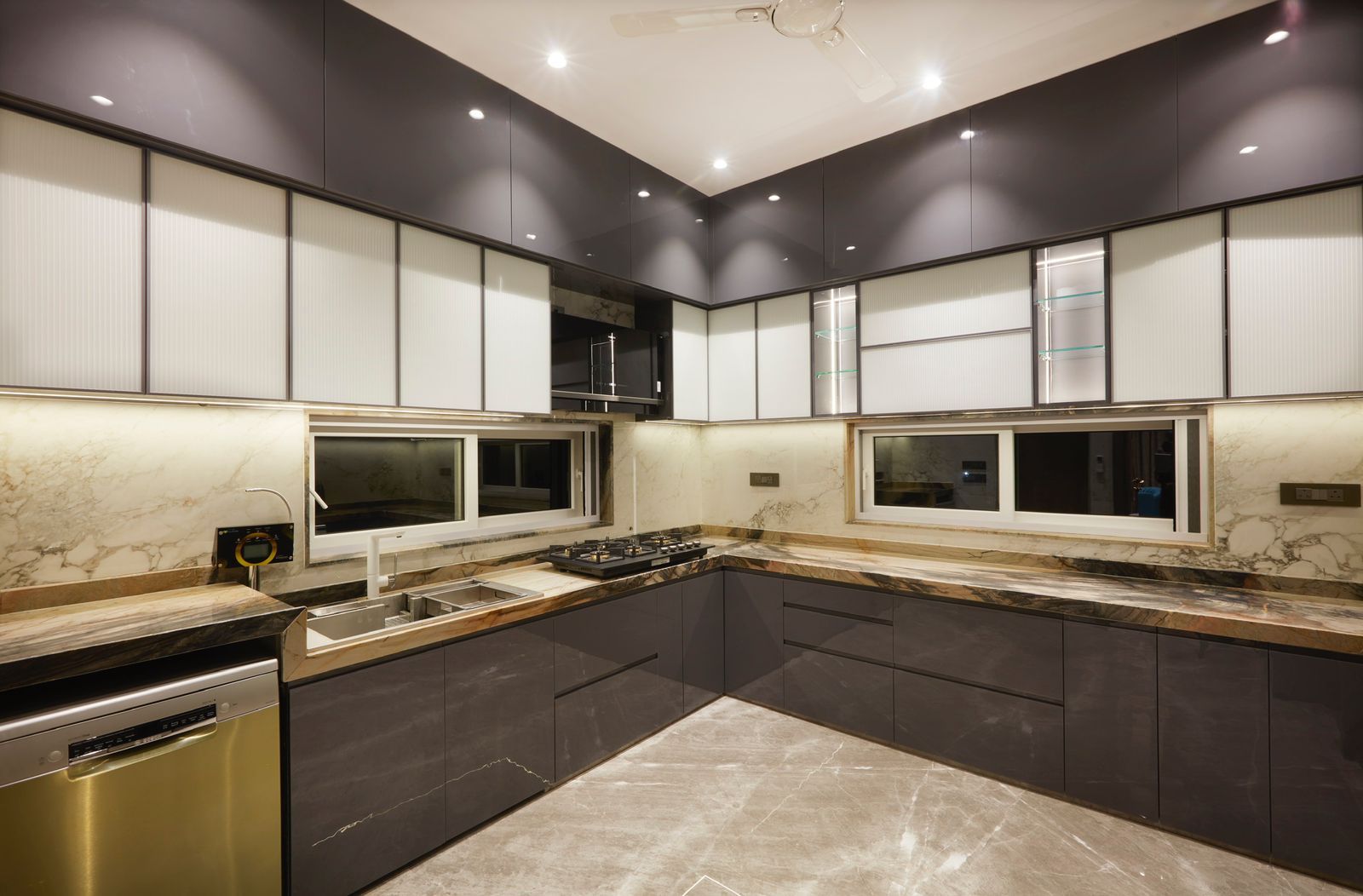
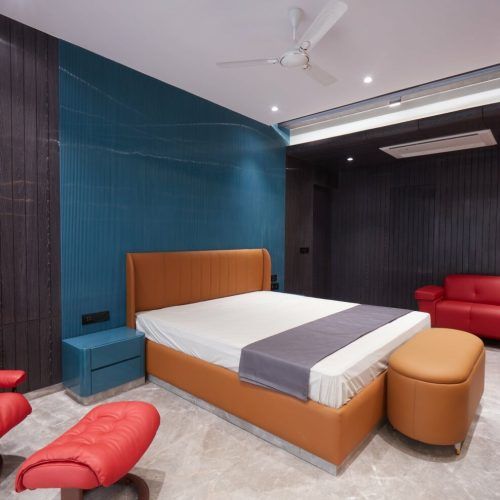
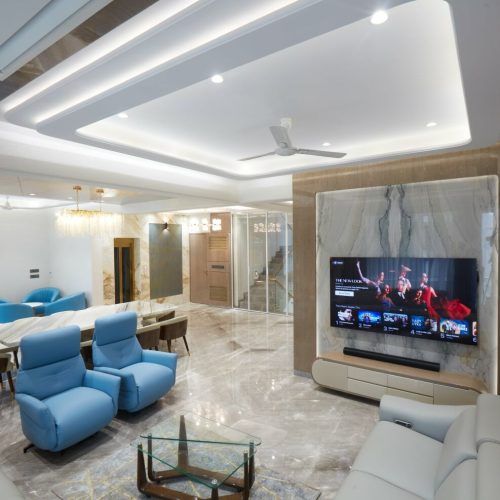
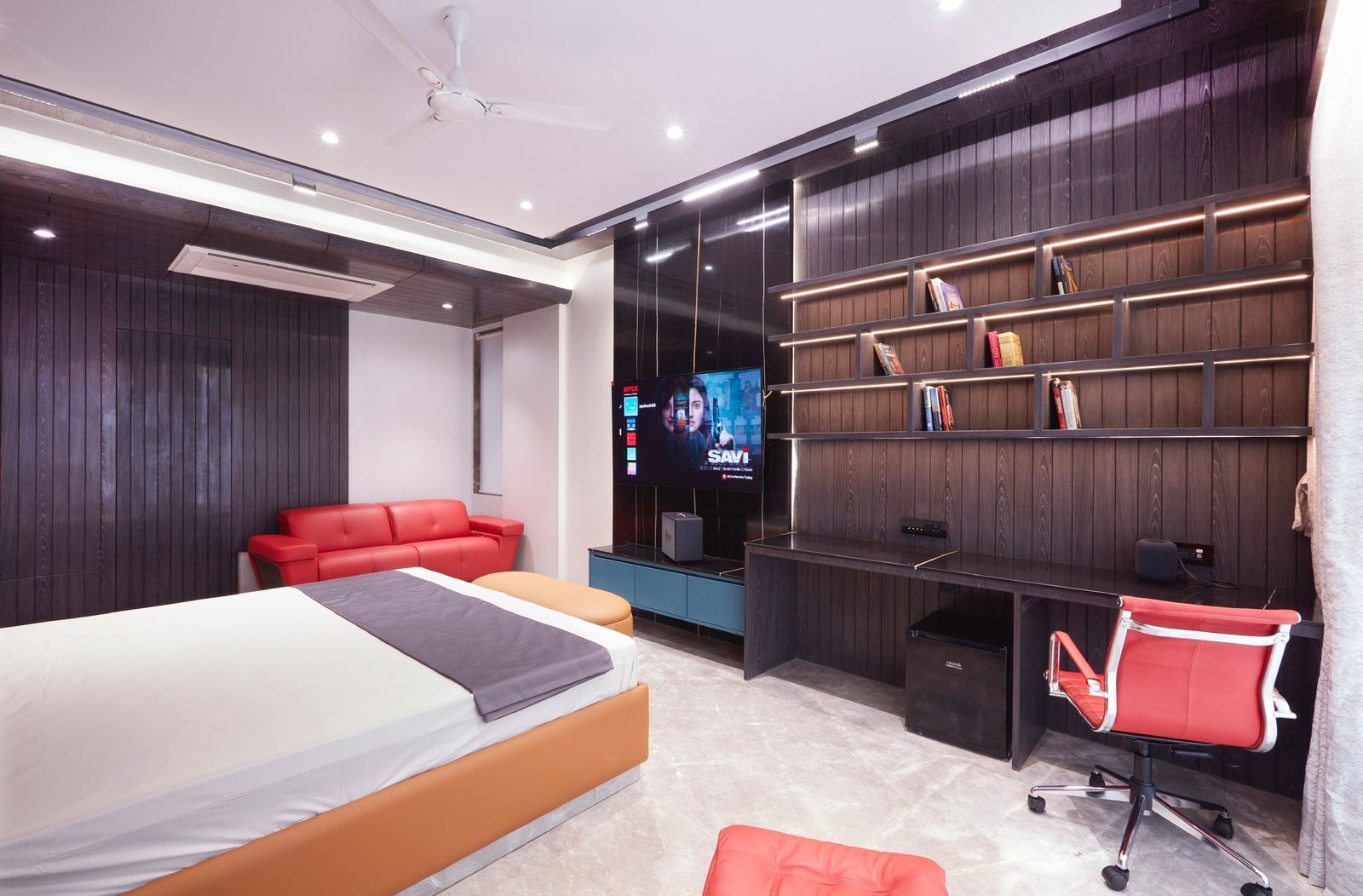
Selected work by Greenbox Design Studio. Tap any image to enlarge.
Frequently asked questions
How much does a home theatre cost in Mumbai?+
₹4–₹8 lakh for a media wall in a living room, ₹8–₹16 lakh for a treated converted bedroom, ₹14–₹26 lakh once proper isolation is added, and ₹18–₹35 lakh for a dedicated room-within-a-room in a larger flat. All figures exclude 18% GST and include room build, treatment, seating and the AV system.
Will my neighbours hear the home theatre?+
Without isolation, yes — low frequencies travel through the slab rather than the air, so the flat below hears the subwoofer clearly. A floated floor on neoprene isolators, double-leaf walls and an isolated ceiling at ₹2,800–₹5,500 per sq ft of room area is what allows reference-level listening at night.
Do I need society permission for a home theatre?+
You need the standard renovation NOC, and we submit a drawing showing that any raised floor is a non-structural floated deck with a defined load. Societies tend to read a raised floor as structural alteration, so presenting it properly at application stage avoids the question being asked mid-build.
Can I fit Atmos in a Mumbai flat?+
Only with genuine ceiling height. Height channels need 2,700 mm or more of finished height, and an isolated ceiling costs you 150–250 mm before you start. In a typical 2,850 mm Andheri tower that leaves too little, so we normally recommend an excellent 5.1 or 7.1 over a compromised Atmos layout.
Which acoustic materials survive Mumbai humidity?+
Fabric-wrapped mineral wool at 48–64 kg/m³ in sealed frames, with BWP-grade ply for framing and the floated deck. We do not use open-cell polyurethane foam in Mumbai at all — it absorbs atmospheric moisture, sags and eventually smells in a sealed room through the monsoon.