
Cost and what is in it
| Kitchen size | Running feet | Basic | Mid | Premium |
|---|---|---|---|---|
| Small galley | 8–10 rft | ₹1.6–₹2.2 L | ₹2.4–₹3.2 L | ₹3.6–₹5.2 L |
| Standard L | 10–14 rft | ₹2.2–₹3.0 L | ₹3.2–₹4.4 L | ₹4.8–₹7.5 L |
| U-shaped | 14–18 rft | ₹3.0–₹4.0 L | ₹4.4–₹6.2 L | ₹7.0–₹11 L |
| With island | 18–24 rft | ₹4.2–₹5.6 L | ₹6.2–₹8.8 L | ₹10–₹18 L |
Includes carcass, shutters, hardware, basic accessories and countertop. Excludes appliances, chimney, sink, tap and backsplash tiling.
What is included in a modular kitchen quotation?+
Carcass, shutters, hinges and channels, handles, a countertop and usually a basic accessory set. Commonly excluded: appliances, chimney, sink and tap, backsplash tiling, electrical points, plumbing modification and loose accessories. The exclusions are where two quotations that look ₹60,000 apart turn out to be identical. Full rates on the Mumbai kitchen cost page.
Why do kitchen quotes vary so much?+
Carcass board grade, hardware brand and how the area is measured. Some suppliers quote per square foot of shutter, some per running foot, and the two are not directly comparable without knowing the height. Ask every supplier for the same basis: per running foot at a stated height, with board grade and hardware brand named.
Is a branded modular kitchen worth the premium?+
Branded systems give you factory-machined panels, consistent tolerance and a warranty from an entity that will exist in five years, at a 25–50% premium over a good local fabricator. A capable local workshop with a panel saw and edge bander can match the quality; the difference is that you are relying on that specific workshop rather than on a system.
Can I reuse my existing kitchen carcass?+
Sometimes. If the carcass is BWP, square, and the layout is not changing, replacing shutters, hardware and countertop costs 40–55% of a new kitchen and can be done in two weeks. If the carcass is MR board or the bottom rails have swollen, it is not worth the labour of trying.
Materials and construction
What board should a kitchen carcass be?+
BWP plywood to IS:710, without exception, in a Mumbai kitchen. It absorbs 6–9% water against MR ply's 18–25%, which is the difference between a carcass that survives two decades and one whose bottom rails swell in the third monsoon. The premium is ₹38–₹52 per sq ft and it is the last line to cut.
Which shutter finish lasts best?+
Matte laminate at 1 mm is the most forgiving in daily use — it hides fingerprints, resists heat near the hob and can be cleaned with anything mild. Acrylic looks best and shows every mark. Membrane and PU shutters give a seamless look and are the hardest to repair locally if damaged. See choosing a shutter finish.
What countertop should I choose?+
Quartz for most Indian kitchens: non-porous, consistent, ₹450–₹1,100 per sq ft, and it does not need sealing. Granite is cheaper and harder but has natural variation and needs sealing. Marble stains and etches from turmeric, lemon and oil within weeks and is a poor choice for a kitchen that cooks Indian food daily.
Do I need soft-close on everything?+
On every drawer and every shutter, yes. It costs roughly ₹340 per shutter more, it prevents finger injuries, and it eliminates the slamming that loosens a carcass over ten years. It is one of the few upgrades with no counter-argument.
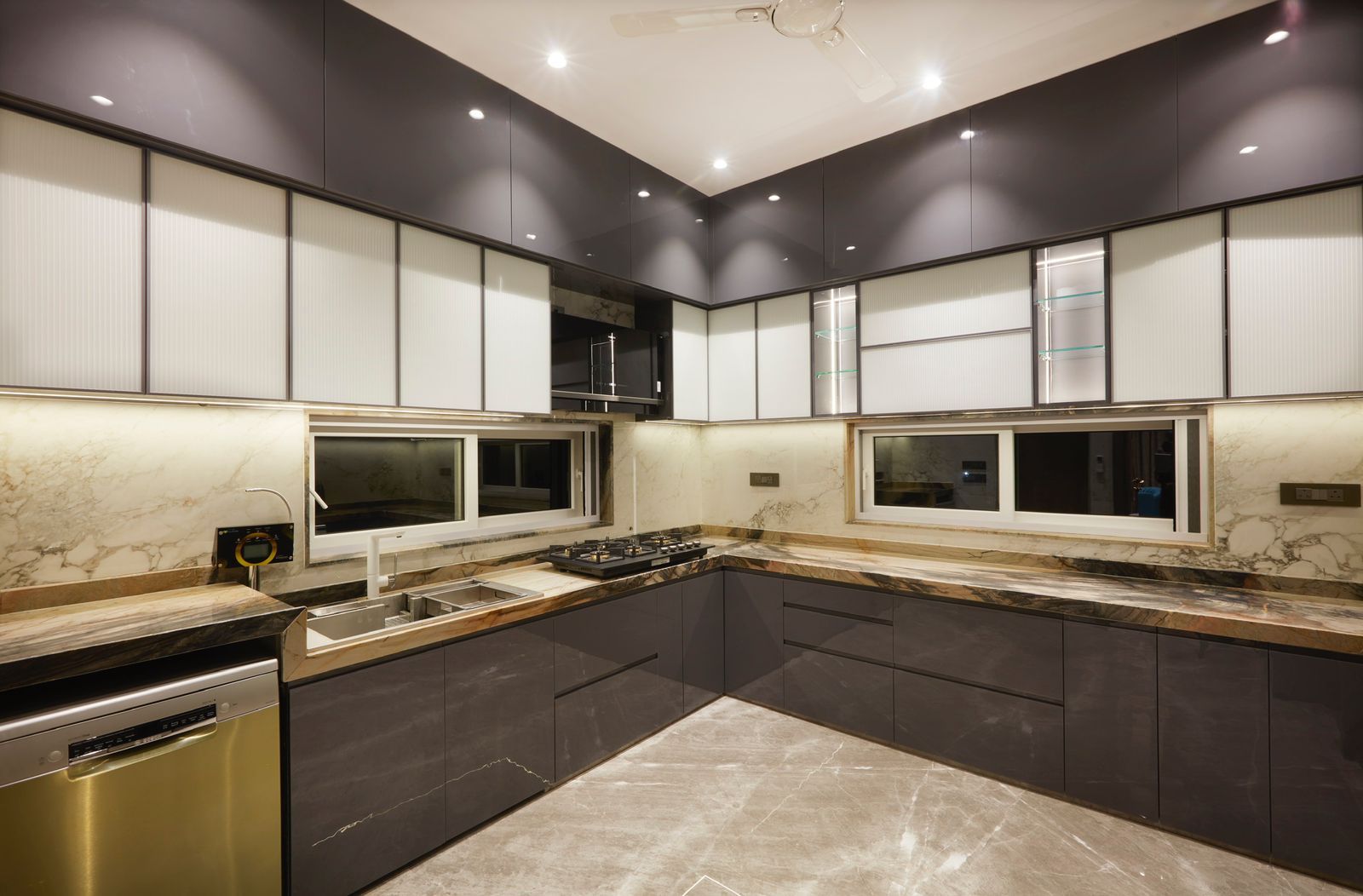
Design and build under one accountable roof
Layout and ergonomics
What is the best kitchen layout?+
The one the room's plumbing and window position allow. In Mumbai flats that is usually an L or a parallel galley. The working test is the triangle: sink, hob and refrigerator should form a triangle whose sides total 3.6–6.6 m, with no through-traffic crossing it. Full detail in kitchen layouts explained.
What counter height should I use?+
850 mm is the Indian default and it suits a user of about 165 cm. The correct height is roughly 150 mm below the primary cook's elbow, which for a 152 cm user is nearer 800 mm and for a 175 cm user nearer 900 mm. A 50 mm error is felt in the lower back within an hour of cooking.
How much counter space do I actually need?+
600 mm of clear landing space on at least one side of the hob and one side of the sink, and a continuous preparation run of 900 mm somewhere between the two. A kitchen with 18 running feet of units and no clear 900 mm run is harder to cook in than a smaller one that has it.
Should the kitchen have a window?+
Strongly preferable in Mumbai. Indian cooking generates heat, moisture and oil aerosol, and an openable window plus a chimney removes it far better than a chimney alone. Where there is no window, size the chimney generously and add an exhaust fan in the utility to create a path for air to move.
Accessories, appliances and services
Which accessories are worth the money?+
Deep drawers in place of low shutters, a pull-out for bottles and oils beside the hob, a cutlery organiser, and a bin pull-out. Those four are used daily. The corner carousel, the tall pantry pull-out and the plate rack are used by some households constantly and by others never — decide from how you actually cook.
What chimney size and suction do I need?+
A chimney 60 mm wider than the hob on each side, with suction of 1,000–1,200 m³/hr for a standard Indian kitchen and 1,200–1,500 where frying and tempering are frequent. Duct length matters — every metre and every bend costs suction, so a short straight duct to the outside beats a powerful motor pushing through five metres of bends.
When do I need to finalise appliances?+
Before joinery fabrication begins, with model numbers rather than categories. Built-in ovens, hobs, dishwashers and refrigerators all have specific cut-out and ventilation clearances. Changing an appliance after the carcass is cut costs ₹15,000–₹60,000 and a week, and it happens on a large share of projects.
How many electrical points does a kitchen need?+
Twelve to eighteen, planned against actual appliance positions: chimney, hob ignition, refrigerator, microwave, oven, dishwasher, water purifier, mixer positions with two spare above the counter, and one inside the tall unit. Plan them before tiling. Retrofitting a point into a tiled kitchen means cutting tile.
How long does a kitchen take?+
Six to nine weeks in total: two to three weeks of design and appliance finalisation, three to four weeks of fabrication, and one to two weeks on site for installation, countertop templating and services connection. The countertop alone adds a week because it is templated after the carcass is installed.
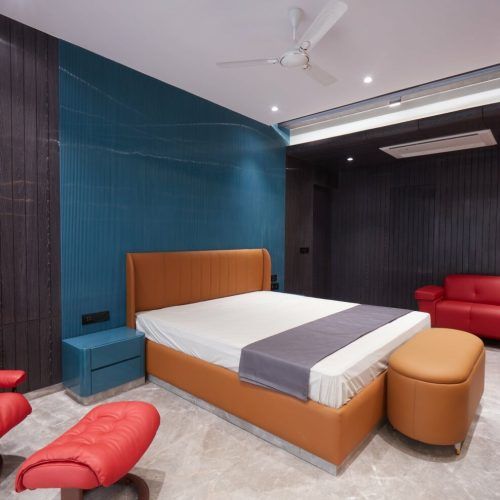
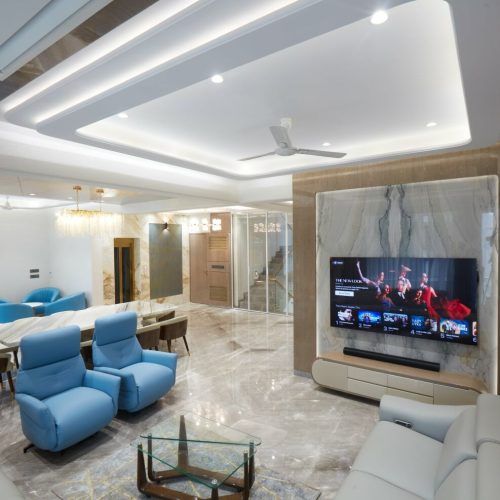
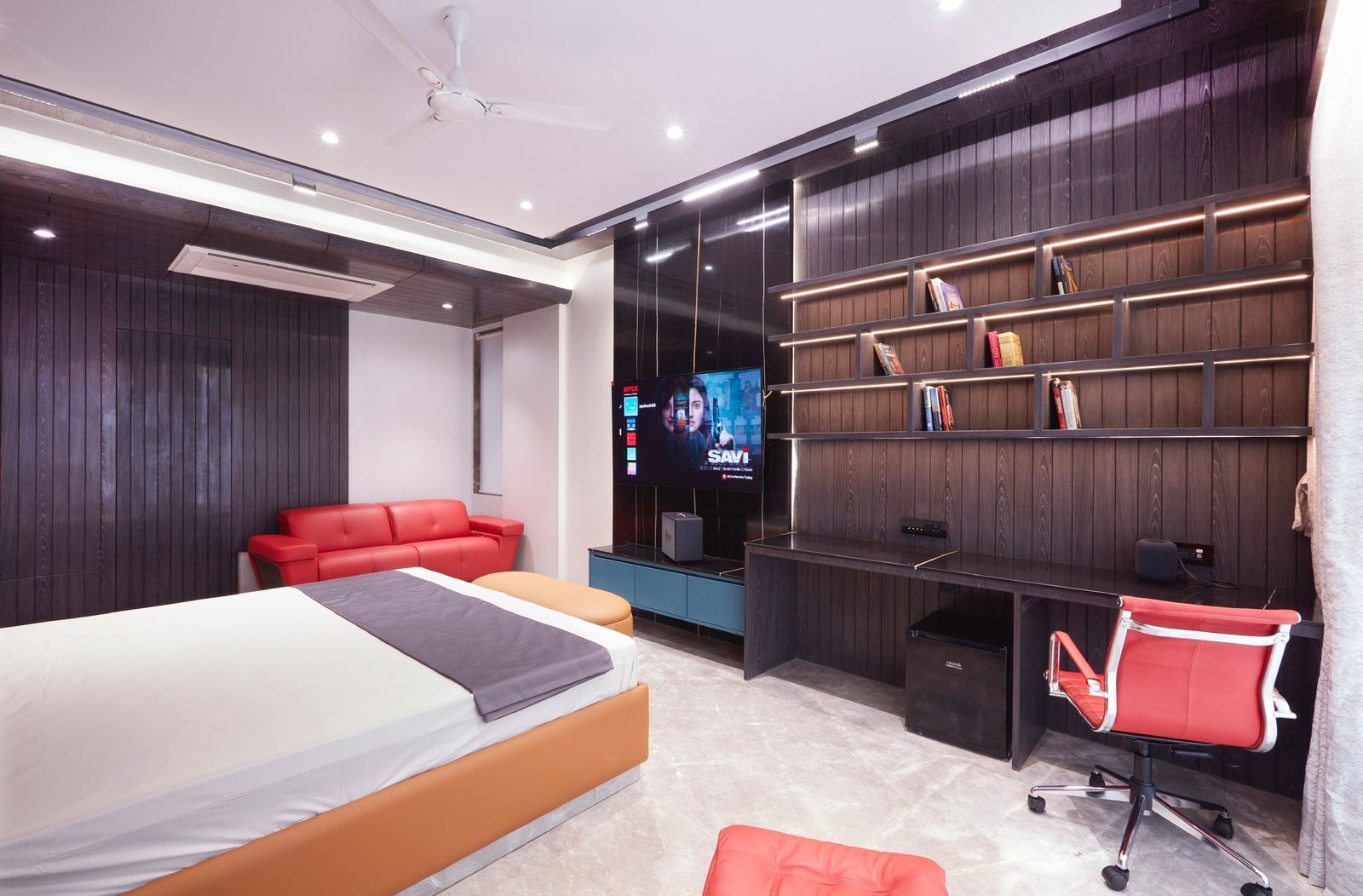
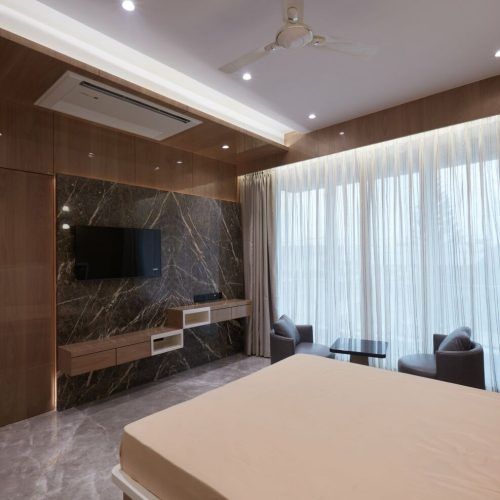
Selected work by Greenbox Design Studio. Tap any image to enlarge.
Frequently asked questions
What does a modular kitchen cost in Mumbai?+
₹1.6–₹4.8 lakh ex-GST for a typical 10–14 running-foot kitchen, depending on carcass grade, hardware brand and shutter finish. A U-shaped kitchen at premium specification reaches ₹7–₹11 lakh, and an island kitchen more. Appliances, chimney, sink and backsplash are usually excluded.
What plywood should a kitchen carcass use?+
BWP plywood to IS:710, without exception, in Mumbai. It absorbs 6–9% water against 18–25% for MR ply, which decides whether the bottom rails survive. The premium is ₹38–₹52 per sq ft and it is invisible in the finished kitchen, which is exactly why it gets substituted.
Which countertop is best for Indian cooking?+
Quartz at ₹450–₹1,100 per sq ft: non-porous, consistent and needs no sealing. Granite is harder and cheaper but varies and needs sealing. Marble etches and stains from turmeric, lemon and oil within weeks, which makes it a poor choice for a kitchen used daily for Indian food.
What chimney suction do I need?+
1,000–1,200 m³/hr for a standard Indian kitchen and 1,200–1,500 where frying and tempering are frequent, in a unit 60 mm wider than the hob on each side. Keep the duct short and straight; every bend costs suction, and a short duct with a modest motor beats a powerful one pushing through five bends.
How long does a modular kitchen take?+
Six to nine weeks: two to three for design and appliance finalisation, three to four for fabrication, and one to two on site. The countertop adds about a week on its own because it is templated only after the carcass is installed and cannot be made in advance.
What kitchen accessories are actually worth buying?+
Deep drawers instead of low shutters, a bottle pull-out beside the hob, a cutlery organiser and a bin pull-out. Those four earn their cost in daily use. Corner carousels, tall pantry pull-outs and plate racks divide opinion sharply — buy them only if you can describe how you will use them.