
Rates by micro-market
| Micro-market | ₹ per sq ft | Rent context | The building reality |
|---|---|---|---|
| BKC and Bandra East | ₹3,080 – 4,620 | The highest in India | Grade-A manuals, night-only work, mandated MEP vendors, strict barricade specification |
| Lower Parel and Worli | ₹2,880 – 4,320 | Very high | Mill-land towers, tall floor plates, developer fit-out rules |
| Andheri East, Marol, SEEPZ fringe | ₹2,400 – 3,600 | Mid | Mixed Grade-A and older stock; the deepest coworking market in the city |
| Powai and Vikhroli | ₹2,320 – 3,480 | Mid | Planned campuses, good loading access, organised facilities teams |
| Goregaon, Malad, Nesco belt | ₹2,200 – 3,300 | Lower | Large plates, easier logistics, more flexible landlords |
| Navi Mumbai and Thane | ₹2,160 – 3,240 | Lowest in the region | Best value per seat; longer commute is the trade |
Ex-GST. Excludes loose furniture, AV and IT hardware. Includes an allowance for landlord-mandated works, which are priced as named provisional sums. The rates come from workspace projects we have completed and invoiced, not from market survey, and are held at October 2026.
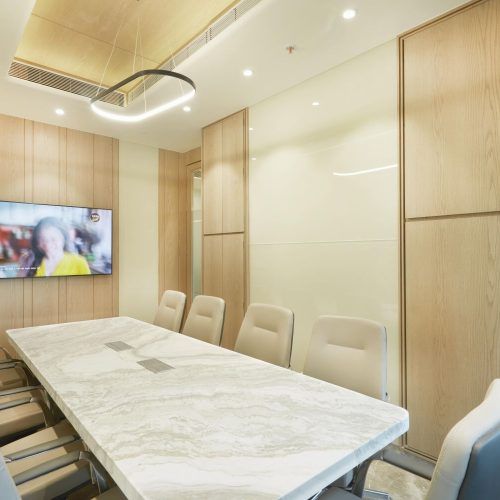
Rent per seat is the design brief nobody writes down
The rent-per-seat arithmetic
Everything about a Mumbai coworking layout follows from one calculation, and it is worth doing before the first plan.
- Take the rent. A BKC Grade-A floor at ₹280–₹350 per sq ft a month; Andheri East at ₹110–₹160; Navi Mumbai at ₹65–₹95.
- Divide by the density. At 65 sq ft per seat, a BKC seat carries ₹18,200–₹22,750 a month of rent alone. At Andheri East it carries ₹7,150–₹10,400.
- Add the fit-out amortisation. At ₹3,600 per sq ft over a five-year lease, that is ₹60 per sq ft a month, or ₹3,900 per seat.
- Add operations — staffing, utilities, internet, cleaning, consumables — at roughly ₹3,500–₹6,000 per seat a month in this city.
- Now look at the seat price. If the arithmetic only works at 50 sq ft per seat, the honest conclusion is that the floor plate is in the wrong building, not that the design should be compressed further.
What the Grade-A landlord will mandate
- Named vendors for fire detection and sprinkler modification, almost always, at the building’s rates. Frequently also the BMS interface, the HVAC tie-in and sometimes the access-control integration.
- A fit-out deposit and supervision charge. Typically ₹200–₹500 per sq ft refundable plus a non-refundable supervision fee, neither of which appears on a contractor’s quotation.
- Night-only working in most BKC and Lower Parel towers, 10pm to 7am, with material movement through a nominated service lift on booked slots.
- A barricade to the building’s specification around the lift lobby and any common-area interface, plus protection of the lobby finishes.
- Load limits. A slab loading limit and a soffit hanging limit that between them decide whether your acoustic rafts are suspended or the ceiling is left open.
- A de-snag and fit-out completion certificate from the building before you can occupy. Build two weeks into the programme for it.
Designing for the Mumbai attendance pattern
Occupancy here is not flat. It peaks Tuesday to Thursday between eleven and five, and it collapses on a heavy monsoon morning. Sizing amenities for the average produces a floor that fails exactly when members are watching.
| Amenity | Sized for | Mumbai note |
|---|---|---|
| Phone booths | Peak, not average | Commute means members take calls from the office that they would take at home elsewhere |
| Meeting rooms | Peak Tuesday to Thursday | Friday and Monday utilisation is typically 40–55% of midweek |
| Pantry seating | Peak lunch, plus a second coffee point above 150 seats | Very few members leave the building for lunch in this city |
| Washrooms | Code, then add 20% | Under-provision is the single most damaging amenity failure |
| Entrance | A wet-umbrella strategy | Four months of monsoon; a drip zone, a stand and a 1,800 mm mat well |
| Lockers | One per hot-desk member | Longer commutes mean members store more, including a change of clothes |
Older Mumbai stock, and when it is the better buy
Not every coworking floor in this city needs to be Grade-A. Older buildings in Andheri East, Goregaon and Vikhroli are a third of the rent and they work, provided five things are checked before signing.
- Electrical supply and the route to increase it. A 1990s building sanctioned for a conventional office will not carry 55–75 VA per sq ft. Raising the load takes weeks and sometimes a transformer, and the landlord may not agree to either.
- Fresh-air capability. Many older Mumbai floor plates were designed around window air conditioning and have no fresh-air shaft at all. Retrofitting a treated fresh-air unit needs a facade or shaft route, and the society or landlord has to permit it.
- Washroom core capacity. An older floor plate built for forty people will not serve a hundred and fifty. Adding washrooms means new drainage into a shared stack, which is a building-wide consent.
- Floor-to-soffit height. Below about 2,900 mm, the exposed-services look becomes claustrophobic and a suspended acoustic ceiling costs you head height you cannot spare.
- Lift capacity and waiting time. Two lifts serving a building where you are adding a hundred and fifty people is a member experience problem you cannot design around from inside the floor.
An operator in BKC wanted seventy more seats on the same floor. We showed them what that did to booth availability at three in the afternoon on a Wednesday, and we built sixty.
Greenbox commercial fit-out lead
Programme and night working
Twelve to eighteen weeks for a full floor, and in a Grade-A tower most of it happens between ten at night and seven in the morning. Night work costs 18–28% more on labour and is roughly 15% less productive per hour, but it is not optional in those buildings. Material comes up in booked service-lift slots, debris leaves the same night, and the barricade goes up before anything else. We plan backwards from the landlord’s completion inspection with two weeks of float, because the certificate, not the joinery, is what lets members in.
The sector fundamentals
Density bands, acoustic zoning, amenity ratios and services loads are the same everywhere, and are set out on coworking space interior design. For conventional workplace in this city see office interior designers in Mumbai, and for per-sq-ft benchmarks office interior cost per sq ft in Mumbai.
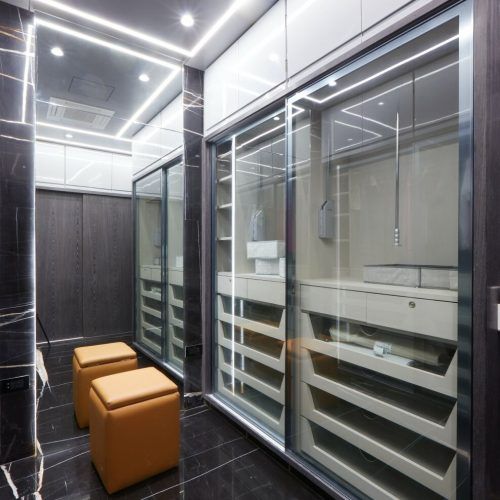
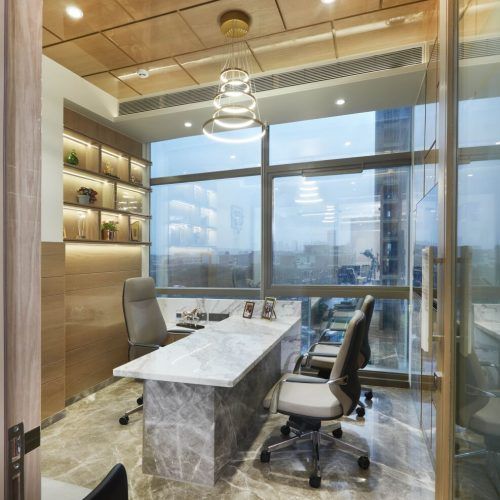
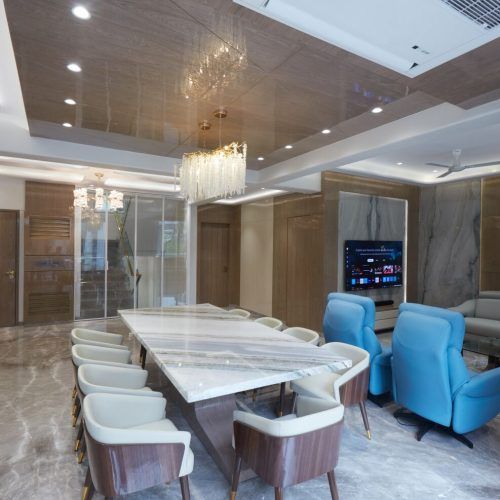
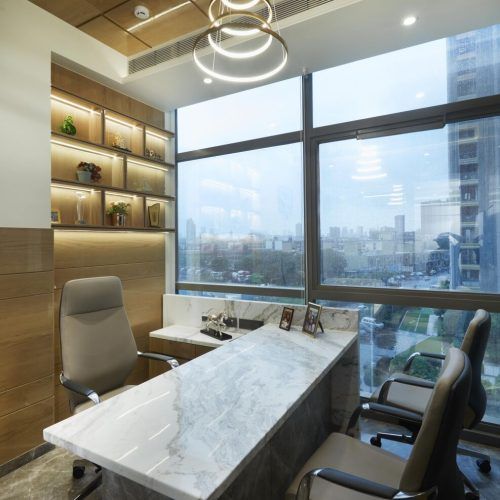
Selected commercial work by Greenbox Design Studio. Tap any image to enlarge.
Frequently asked questions
What does a coworking fit-out cost in Mumbai?+
₹2,160–₹3,240 per sq ft in Navi Mumbai and Thane, ₹2,400–₹3,600 in Andheri East, ₹2,880–₹4,320 in Lower Parel and Worli and ₹3,080–₹4,620 in BKC. Ex-GST, excluding loose furniture, AV and IT hardware, and including a named allowance for landlord-mandated works.
What density does Mumbai rent force?+
Fifty-five to sixty-five square feet per seat in most operating models. At a BKC rent of ₹280–₹350 per sq ft a month, a 65 sq ft seat carries ₹18,200–₹22,750 of rent before fit-out amortisation and operations. If the model only works below 55 sq ft per seat, the floor plate is usually in the wrong building.
Why do Grade-A buildings make a fit-out more expensive?+
Mandated vendors for fire, sprinkler, BMS and often HVAC tie-ins at the building's rates; a refundable fit-out deposit of ₹200–₹500 per sq ft plus a supervision fee; night-only working at an 18–28% labour premium; a barricade to the building's specification; and a completion certificate process that adds about two weeks.
When is a Mumbai coworking floor busiest?+
Tuesday to Thursday between about 11am and 5pm. Monday and Friday utilisation typically runs at 40–55% of midweek. Size phone booths, meeting rooms and pantry seating against the midweek peak, because that is when members judge whether the space works.
Does the monsoon affect coworking design?+
At the entrance, yes. Four months of wet umbrellas, bags and shoes need a designed drip zone, an umbrella stand, an 1,800 mm recessed mat well in the direction of travel and R11 slip resistance in the entrance area. Attendance also drops sharply on heavy rain days, which is a revenue pattern rather than a design one.
How long does a Mumbai coworking fit-out take?+
Twelve to eighteen weeks for a full floor, most of it at night in a Grade-A tower, with material moving in booked service-lift slots and debris leaving the same night. Plan backwards from the landlord's completion inspection with two weeks of float — the certificate, not the construction, is what lets members in.