
Why the same flat gets two very different rates
A per-square-foot rate is a ratio: total project value divided by area. Nothing about it is standardised. Two studios quoting the same 1,000 sq ft flat can both be honest and land 130% apart, because they are dividing different scopes by different areas. Before comparing any two rates, normalise three things — the area basis, the GST treatment, and whether loose furniture and appliances are inside or outside the number. Only then are you looking at a design difference rather than an arithmetic one.
| Variable | Low end | High end | Effect on rate |
|---|---|---|---|
| Joinery density | 22 rft per 100 sq ft | 48 rft per 100 sq ft | ₹480 – ₹900 / sq ft |
| Carcass grade | MR commercial ply | BWP IS:710, branded | ₹90 – ₹140 / sq ft |
| Shutter finish | 0.8 mm laminate | PU or high-gloss acrylic | ₹180 – ₹420 / sq ft |
| Hardware | Generic soft-close | Blum / Hettich full set | ₹110 – ₹260 / sq ft |
| Ceiling and lighting | Peripheral cove, basic LED | Full ceiling, profile, dimmers | ₹120 – ₹300 / sq ft |
| Services rework | Existing points retained | Full rewire and replumb | ₹90 – ₹240 / sq ft |
| Site condition | New tower handover | 45-year-old flat | ₹80 – ₹220 / sq ft |
Rates are on carpet area, ex-GST. Add 18% GST on the service component.
Joinery density is the dominant variable
Everything else is noise beside this one. Joinery — wardrobes, kitchen, TV unit, crockery unit, study, beds, lofts — is between 45% and 60% of a residential budget, and it is priced per running foot, not per square foot of flat. So two identical flats diverge the moment one client wants a wardrobe in every bedroom plus a utility loft and the other wants two wardrobes and nothing else.
A useful way to sanity-check a quote is to count running feet rather than argue about rates. Thirty running feet of wardrobe at ₹1,850 per sq ft of shutter face is the same money regardless of whether the flat is 800 or 1,100 sq ft — but it produces two very different per-sq-ft headlines. Ask your designer for the running-foot schedule; it is a more honest document than the rate.
| Home | Typical joinery | Running feet | Joinery value at ₹1,850/sq ft face |
|---|---|---|---|
| 1BHK, lean | 1 wardrobe, kitchen, TV unit | 24 rft | ₹3.6 L – ₹4.4 L |
| 2BHK, standard | 2 wardrobes, kitchen, TV, crockery | 38 rft | ₹6.2 L – ₹7.4 L |
| 2BHK, storage-heavy | As above plus 2 lofts, study, bed storage | 54 rft | ₹8.8 L – ₹10.5 L |
| 3BHK, standard | 3 wardrobes, kitchen, TV, crockery, study | 58 rft | ₹9.4 L – ₹11.2 L |
| 3BHK, full storage | As above plus lofts, utility, walk-in | 76 rft | ₹12.4 L – ₹14.8 L |
Design and build under one accountable roof
Why smaller homes cost more per sq ft
Clients find this counter-intuitive until they see it written out. A modular kitchen costs roughly the same in a 1BHK as in a 3BHK — it has the same appliances, the same counter, the same plumbing. Divided across 450 sq ft rather than 1,150 sq ft, the same ₹3.5 lakh becomes ₹780 per sq ft instead of ₹300. The same logic applies to bathrooms, the entrance and the electrical distribution board. Fixed costs do not scale down with area, so the rate rises as the home shrinks.
Site condition: the variable nobody quotes for
A new tower handover needs almost no civil work. A flat from the 1980s in Dadar or Matunga needs plaster repair, floor levelling, a new distribution board, often a full rewire, and sometimes waterproofing in the bathroom below the level of the existing tiles. None of this is visible in a photograph, all of it is chargeable, and it is the main reason renovation rates in old buildings run 15–25% above new-flat rates for identical finishes.
- Plaster and levelling: ₹45–₹110 per sq ft of affected wall or floor.
- Full rewire, 2BHK: ₹85,000–₹1,60,000 including a new DB and earthing.
- Bathroom waterproofing and re-tiling: ₹55,000–₹1,40,000 per bathroom.
- Window replacement to aluminium or uPVC: ₹650–₹1,400 per sq ft.
- Structural beam and column exposure treatment: quoted case by case after inspection.
Finish and hardware: where the rate climbs quietly
Shutter finish is the second largest lever after density, and it is the one clients change their mind about most often, usually after fabrication has started. The carcass behind a laminate shutter and the carcass behind an acrylic shutter are identical; only the surface differs, and the surface is where ₹180 to ₹420 per square foot of project rate sits. It is worth knowing what each finish buys before committing, because the difference on a 3BHK is comfortably ₹3 lakh.
| Shutter finish | Rate per sq ft of shutter | Durability | Best use |
|---|---|---|---|
| 0.8 mm laminate | ₹140 – ₹190 | 8 – 10 yrs | Lofts, utility, budget bedrooms |
| 1 mm laminate, matte | ₹190 – ₹250 | 10 – 14 yrs | The sensible default almost everywhere |
| Acrylic, high gloss | ₹380 – ₹520 | 10 – 12 yrs | Kitchen wall units, statement pieces |
| Acrylic, suede matte | ₹420 – ₹580 | 10 – 12 yrs | Fingerprint-prone areas |
| PU spray on MDF | ₹520 – ₹780 | 8 – 12 yrs, repairable | Curved and profiled shutters |
| Natural veneer with melamine | ₹480 – ₹900 | 15 yrs+ | Living room and feature joinery |
What does not move the rate as much as people expect
Three things get argued about far beyond their financial weight. Paint is 6–9% of budget; changing from a mid-range emulsion to a premium one moves the whole project by about 1%. Flooring, if the existing floor is sound, should usually be left alone — replacing serviceable vitrified tile is the most common avoidable expense we see. And the design fee itself, at 5–8%, is rarely where a project goes wrong; the scope it produces is.
People negotiate the rate and accept the scope. It should be the other way round — the scope is where the money is.
Greenbox principal designer
How to use this when comparing quotes
- Convert both quotes to carpet areaDivide by the measured carpet figure, not the builder's built-up. This alone closes most of a 30% gap.
- Strip GST out of bothCompare like for like, then add 18% back at the end.
- Count running feet, not rupeesAsk each studio for the joinery schedule in running feet. Different totals mean different scopes, not different prices.
- Line up the six specification itemsCarcass grade, shutter finish, hinge brand, channel brand, edge banding, ceiling board.
- Price the differenceWhatever remains after those four steps is the genuine commercial difference — usually under 10%.
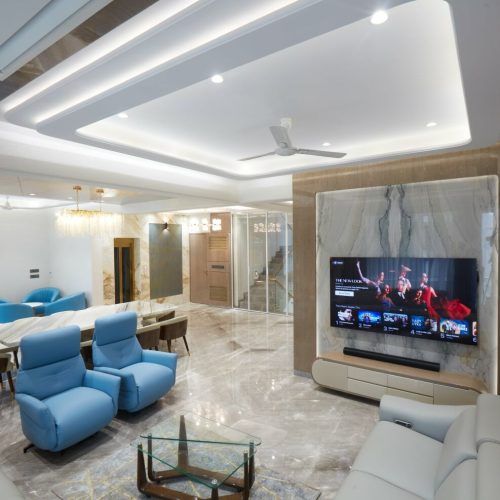
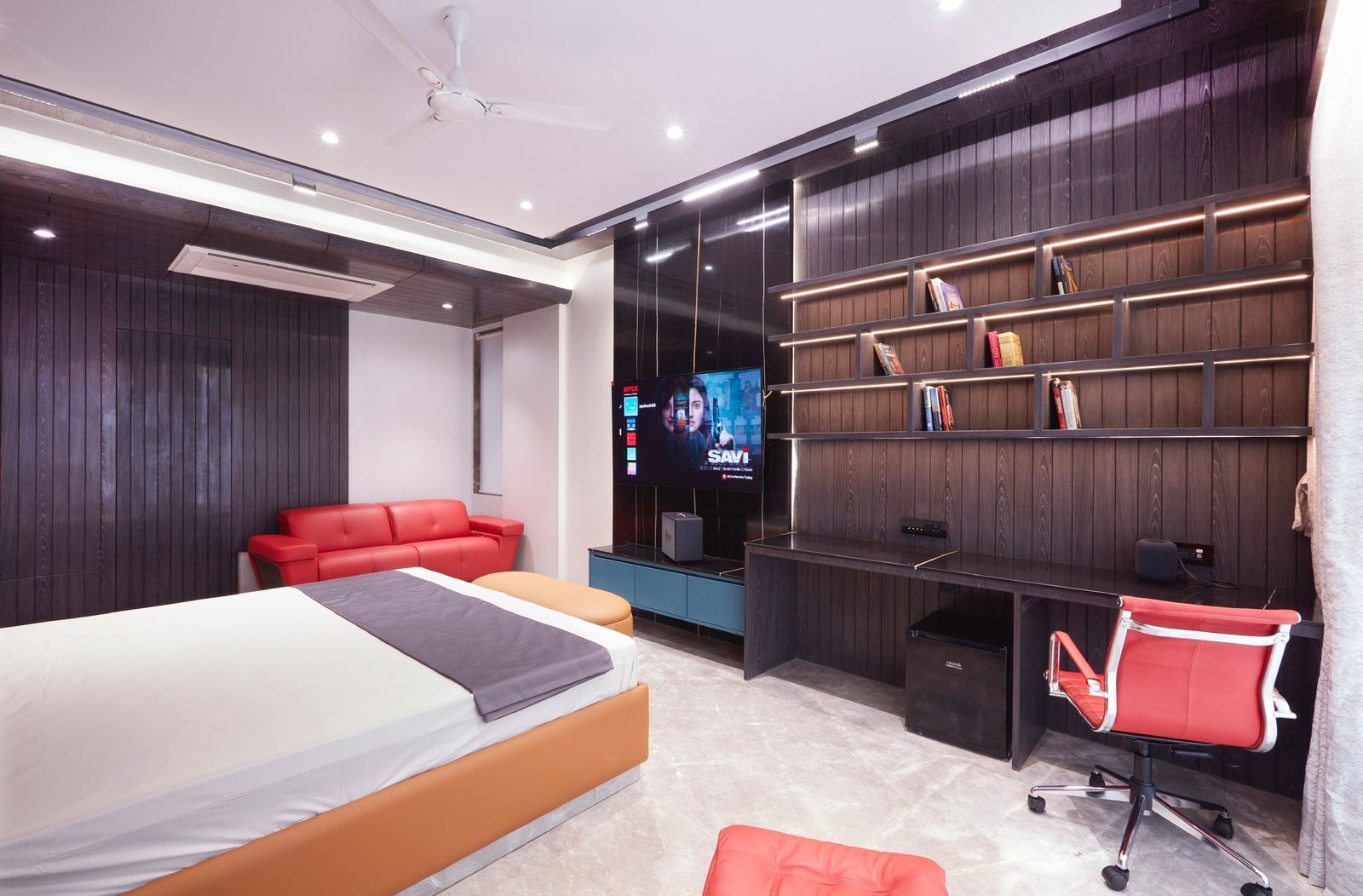
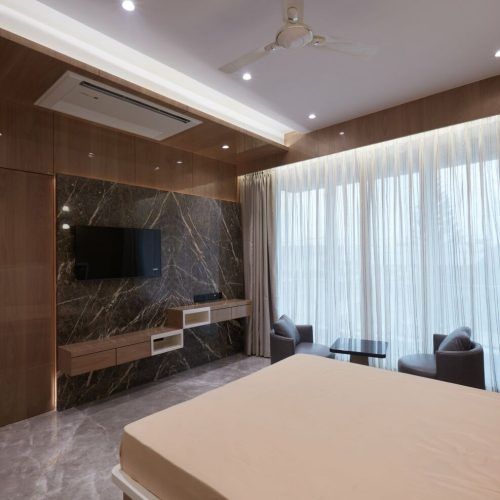
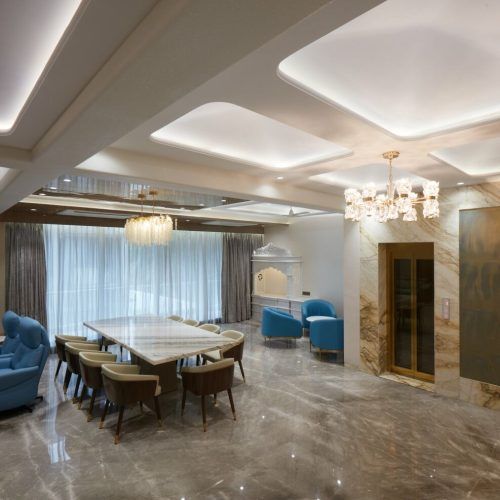
Selected work by Greenbox Design Studio. Tap any image to enlarge.
Frequently asked questions
What is a reasonable interior cost per sq ft in 2026?+
On carpet area and ex-GST, ₹1,200–₹1,600 per sq ft for essential finishes, ₹1,700–₹2,400 for premium and ₹2,500 upward for luxury. Mumbai sits at the upper half of each band because of labour rates, access constraints and restricted working hours.
Why is my 1BHK quoted at a higher rate than a friend's 3BHK?+
Because kitchens, bathrooms and the electrical distribution board are fixed costs that do not shrink with the flat. A ₹3.5 lakh kitchen across 450 sq ft is ₹780 per sq ft; the same kitchen across 1,150 sq ft is ₹300. The absolute spend is lower; the ratio is higher.
Does a higher per-sq-ft rate mean better quality?+
Not reliably. It may mean more joinery, which is scope rather than quality. Check the six specification items — carcass grade, shutter finish, hinge and channel brand, edge banding and ceiling board — before reading a higher rate as a better build.
How much does upgrading from MR to BWP plywood add?+
Roughly 18–25% on the carcass line, or ₹90–₹140 per sq ft on the overall project rate. In a humid coastal city it is the single upgrade we argue hardest for, because carcass is the one element that cannot be changed later without dismantling the joinery.
Should I ask for a lump sum or a per-sq-ft rate?+
Neither, on its own. Ask for a line-item BOQ with quantities. The per-sq-ft rate is useful for benchmarking at the enquiry stage, but it is an output of the BOQ, and no contract should be signed against it.