

What the quotation usually leaves out
These are the items we see excluded most often across quotes clients bring us for review. The amounts are for a 900–1,100 sq ft carpet-area Mumbai flat in 2026, ex-GST unless stated.
| Excluded item | Typical amount | Who usually pays |
|---|---|---|
| Society refundable deposit | ₹25,000 – ₹2,00,000 | Owner, refunded at closure |
| Society NOC / renovation charges | ₹5,000 – ₹25,000 | Owner |
| Debris removal and disposal | ₹4,500 – ₹7,500 per trip | Owner, unless written in |
| Electrical point shifting and new circuits | ₹380 – ₹650 per point | Usually extra |
| Plumbing relocation (per fixture) | ₹6,000 – ₹18,000 | Usually extra |
| Appliance cut-out modification | ₹3,000 – ₹9,000 per unit | Owner, if models change late |
| Loose furniture, curtains, blinds | ₹1.2 L – ₹6 L | Almost always excluded |
| Post-work deep cleaning | ₹12,000 – ₹28,000 | Owner |
| GST on service component | 18% | Owner |
Why quotations are built this way
It is worth understanding the mechanics, because they are not sinister. Interior work is sold on a headline per-square-foot number, and clients compare those numbers before they compare anything else. A studio that includes society deposits, debris, civil contingency and GST in its headline rate prices itself out of the shortlist against one that does not. So the industry converged on a convention: quote the manufactured and installed scope, exclude the site and statutory costs, and mention the exclusions in a paragraph at the end that almost nobody reads.
The convention is workable as long as both sides know it exists. The failure mode is a client who reads a ₹14 lakh quotation as a ₹14 lakh project, and a studio that lets them, because correcting the impression costs the job. Everything in this article is an attempt to move that conversation from month four to week one.
Design and build under one accountable roof
The five billing practices that catch people out
These are industry habits rather than deceptions, but each one produces a bill the client did not expect. Name them in your first meeting and most of them stop being a problem.
- Area basis switching. A rate quoted on built-up area and a rate quoted on carpet area differ by 20–30% for identical work. Insist both the rate and the total are stated on carpet.
- Running-foot joinery quoted at a nominal height. A kitchen quoted per running foot usually assumes a 900 mm base and a 700 mm wall unit. A floor-to-ceiling tall unit is then billed separately.
- Hardware 'as per selection'. The quote is costed on the base hinge and channel; at selection stage you are shown Blum tandem boxes and the difference appears as an upgrade of ₹25,000–₹90,000.
- Civil work billed at actuals. Plaster repair, levelling screed, waterproofing and chasing are genuinely unpredictable, but 'at actuals' with no cap is an open cheque. Ask for a provisional sum with a not-to-exceed figure.
- Wastage and transport as a percentage. A 3–5% wastage line on materials is normal; a 10% one is a margin line with a technical name.
What an honest exclusions list looks like
Exclusions are not a red flag. A missing exclusions list is. The healthy version is specific, priced where possible, and attached to the BOQ rather than mentioned in conversation.
- Named items, not categories: 'chimney, hob, oven and dishwasher' rather than 'appliances'.
- A provisional sum for civil work with a stated cap and a rate for overruns.
- A stated rate card for the three most common additions: electrical point, plumbing point, extra loft.
- Society charges listed as pass-through at actuals with receipts.
- A clear statement of whether GST is inside or outside every figure on the page.
Mumbai-specific costs that rarely appear in a quote
Some of these are peculiar to working in a city of housing societies and tall buildings, and they surprise people moving from an independent house or from another city.
- Service-lift charges and lift operator overtime. ₹500–₹2,000 per day in some towers, and material movement outside permitted hours is often billed separately.
- Restricted working hours. Most societies allow noisy work roughly 10am to 6pm with no Sunday working. That removes about a quarter of available site time and lengthens the programme, which has a cost even when no line item names it.
- Hoisting charges for oversized items. A 2,400 mm stone slab or a two-piece sofa that will not fit the lift is craned or carried; ₹8,000–₹35,000 depending on floor.
- Common-area protection. Lobby and lift protection sheeting is a society condition in most newer towers; ₹6,000–₹15,000.
- Water and electricity for construction. Some societies meter it and bill it separately at commercial rates.
- Parking for the contractor's vehicle. Trivial in principle, ₹200–₹600 a day in practice, for four months.
A realistic all-in budget
Take the signed quotation as the base. The table below is how a ₹14,00,000 quotation for a Mumbai 2BHK typically becomes the amount that actually leaves your account.
| Line | Amount | Running total |
|---|---|---|
| Signed BOQ (ex-GST) | ₹14,00,000 | ₹14,00,000 |
| Society deposit and NOC (deposit refundable) | ₹65,000 | ₹14,65,000 |
| Debris — 4 trips | ₹24,000 | ₹14,89,000 |
| Electrical additions — 22 points | ₹11,000 | ₹15,00,000 |
| Hardware upgrade on kitchen drawers | ₹38,000 | ₹15,38,000 |
| Deep clean and handover | ₹18,000 | ₹15,56,000 |
| GST at 18% on ₹14,00,000 | ₹2,52,000 | ₹18,08,000 |
₹40,000 of the deposit is refundable at closure, so the true net is around ₹17.68 lakh.
We would rather lose a job on an honest number than win it on a number we both know will move.
Greenbox principal designer
How to close the gap before you sign
- Ask for the exclusions list in writingBefore the advance, not with the first bill. Read it as carefully as the inclusions.
- Convert every 'at actuals' to a capped provisional sumCivil work, waterproofing and chasing can all carry a not-to-exceed figure.
- Fix appliances and sanitaryware during designThis alone removes the most common variation on a kitchen project.
- Get a written rate card for additionsOne page: electrical point, plumbing point, loft, extra shutter, drawer upgrade.
- Hold 10% contingency outside the budgetNot inside it. Money inside a budget is spent by week six.



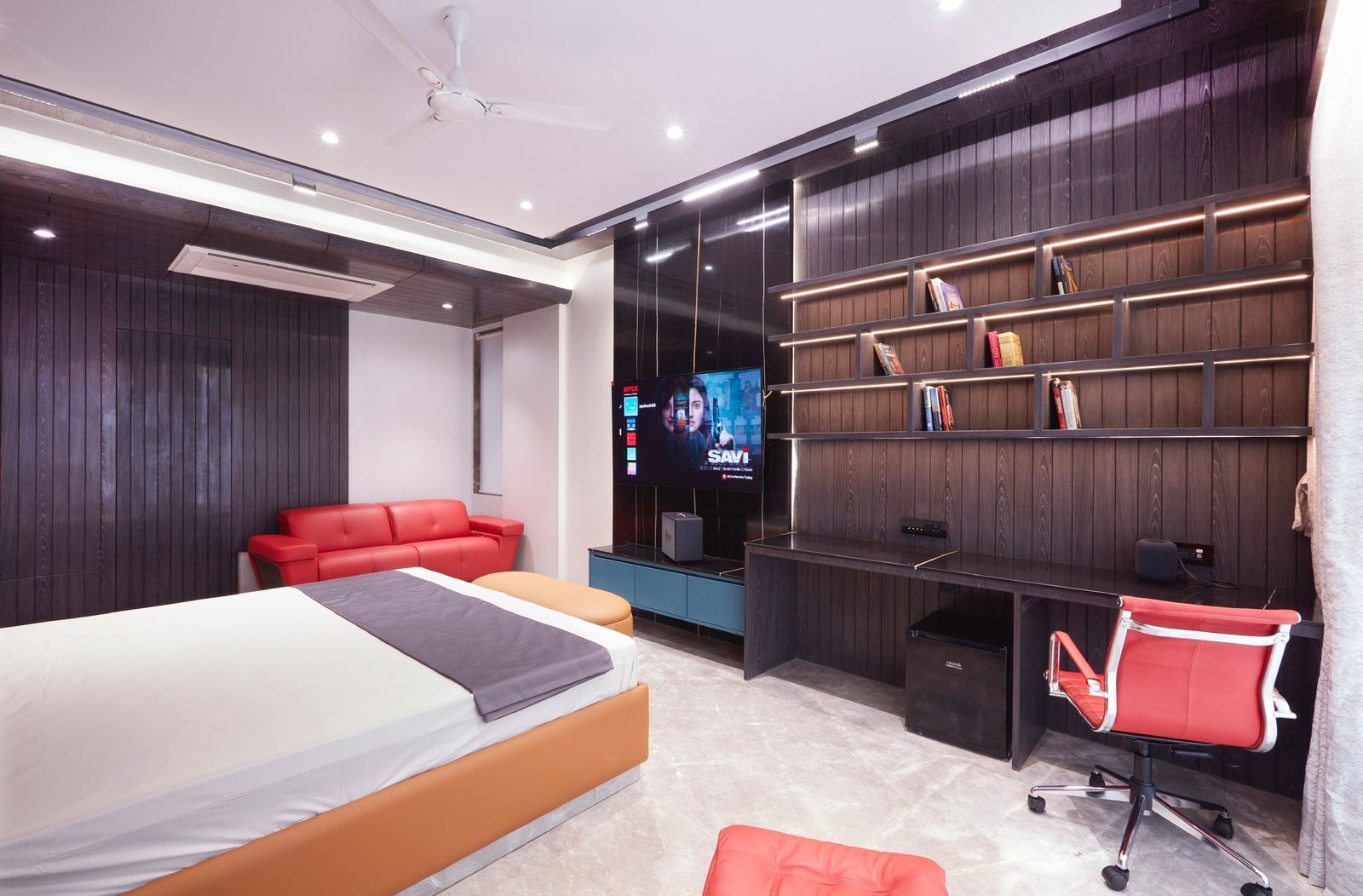
Selected work by Greenbox Design Studio. Tap any image to enlarge.
Frequently asked questions
How much more than the quote should I budget?+
Twelve to eighteen per cent above the signed quotation, plus 18% GST if the quote is ex-GST. For a ₹14 lakh quotation on a Mumbai 2BHK, expect around ₹17.5–₹18 lakh to actually leave your account once society charges, debris, additions and tax are counted.
Is GST really extra on interior work?+
Almost always, and at 18% on the service component it is the largest single addition. Some studios quote inclusive; most do not. The only thing that matters is that the quotation says which, in words, on every page.
Are society deposits refundable?+
The deposit usually is, once the society inspects common areas and confirms no damage. The renovation or NOC charge generally is not. Refunds in Mumbai commonly take one to three months after closure, so treat the deposit as blocked cash rather than a cost.
Can I ask a designer to remove hidden costs from the contract?+
You can ask them to bring the costs into the contract, which is more useful. A capped provisional sum for civil work and a written rate card for additions turns unpredictable spending into a bounded number without pretending the work is free.
Does a higher quote mean fewer hidden costs?+
Often, yes — a complete quotation looks more expensive because it includes what the cheap one excluded. Normalise the two on scope before comparing totals; the gap usually falls from 40% to under 10%.