
What you are actually buying
Kitchen hardware divides into three categories with very different economics. Hinges, at ₹180–₹700 each, of which a kitchen has 25 to 50. Drawer systems, at ₹2,200–₹9,000 per drawer, of which a kitchen has 6 to 14. And lift-up, corner and specialist mechanisms, at ₹4,000–₹22,000 each, of which a kitchen has none to six. The second category dominates the budget, which is where the specification conversation should focus.
Across all three, the number that predicts life is the cycle rating — the number of open-close operations the manufacturer tests to. A kitchen drawer used four times a day reaches 30,000 cycles in twenty years, so an 80,000-cycle rating is genuinely generous and a 20,000-cycle one is not.
The brands compared
| Brand | Origin | Hinge (soft-close) | Drawer system | Cycle rating | Service in Mumbai |
|---|---|---|---|---|---|
| Blum | Austria | ₹420 – ₹700 | ₹4,800 – ₹9,000 | 100,000+ | Good, through dealers |
| Hettich | Germany | ₹210 – ₹520 | ₹2,800 – ₹5,400 | 80,000 | Excellent, widely stocked |
| Hafele | Germany | ₹230 – ₹540 | ₹3,000 – ₹5,800 | 80,000 | Excellent, own showrooms |
| Ebco | India | ₹140 – ₹300 | ₹1,900 – ₹3,400 | 50,000 | Good, cheapest spares |
| Godrej Locks & Fittings | India | ₹130 – ₹280 | ₹1,700 – ₹3,100 | 40,000 – 50,000 | Good |
| Unbranded / generic | Varies | ₹45 – ₹110 | ₹700 – ₹1,400 | Unrated | None |
Prices are for the component, excluding fitting. A 10-foot kitchen has roughly 28–36 hinges and 8–10 drawers.

Design and build under one accountable roof
Hinges: the series matters more than the brand
Every major brand makes several hinge families at different price points, and a quotation that says 'Hettich hinges' has told you very little. Hettich Sensys is their premium soft-close hinge with integrated damping and three-dimensional adjustment; Hettich Intermat is the older, cheaper workhorse. Both are genuine Hettich. The price difference is roughly ₹180 per hinge, which across 32 hinges is ₹5,760 — small in the context of a kitchen, and worth paying.
- Ask for the series name in writing: Sensys, Intermat, Blum Clip-top Blumotion, Hafele Metalla, Ebco Slimline.
- Check the opening angle — 110 degrees is standard, 165 degrees is needed on a blind corner unit.
- Count the hinges: two up to 900 mm of shutter height, three to 1,600 mm, four above. Under-hinging is why shutters drift out of alignment.
- Specify integrated soft-close rather than a clip-on damper. Clip-ons fall off and get lost.
- For wall units above a hob, heat over years degrades the damping fluid; a lift-up mechanism handles it better than a side hinge.
Drawers: where the money actually goes
A kitchen with ten drawers spends ₹28,000 to ₹90,000 on drawer hardware alone, depending on the system. Three levels exist and the difference between them is visible in use within days.
| System | How it works | Cost per drawer | Best for |
|---|---|---|---|
| Telescopic channel on a ply box | Ball-bearing runner, carpenter-made box | ₹900 – ₹1,800 | Lofts, utility, budget builds |
| Metal box (Hettich Quadro / Hafele Alto) | Steel sides form the drawer | ₹2,800 – ₹4,200 | The sensible default |
| Tandem box with rail (Innotech / Legrabox) | Steel sides plus gallery rail, full extension | ₹4,200 – ₹9,000 | Base units carrying weight |
| Internal drawer behind a shutter | Same systems, no shutter of its own | ₹2,400 – ₹5,200 | Tall units and pantry |
| Bottle pull-out, 150 mm | Narrow full-height pull-out | ₹4,500 – ₹9,500 | Only if there is a genuine 150 mm gap |
Lift-ups, corners and the specialist mechanisms
The third category is where kitchens acquire expensive items that are used twice a week. Some are genuinely transformative; several are showroom theatre. A lift-up mechanism on a wall unit above the hob is the clearest winner — it keeps the shutter out of your face while cooking, it avoids the heat-damaged side hinge problem, and at ₹4,500–₹12,000 it earns its place. A magic corner for a blind base unit recovers volume that would otherwise be dead, though at ₹12,000–₹22,000 it is the most expensive volume in the kitchen.
Against that, the tall pantry pull-out at ₹18,000–₹40,000 gives you less usable volume than four fixed shelves behind a pair of shutters, because the mechanism and the clearances consume the space. The plate-and-cutlery inserts that look organised in a showroom are typically ₹3,000–₹7,000 per drawer and lock you into a fixed layout. And the electric flap-up that opens at a touch is a mechanism, a driver and a power supply in a wet room — three more things to service.
Where to spend and where not to
Spend: base unit drawers
Everything heavy lives here. Full-extension tandem boxes carrying 40–50 kg are worth the money.
Spend: soft-close hinges throughout
The single most-touched mechanism in the house, 30–50 times a day.
Spend: under-sink hardware
Stainless fittings and a proper pull-out bin. This is the wettest cabinet you own.
Save: wall unit drawers
Wall units hold light things. Metal box systems are ample; tandem boxes are not needed.
Save: corner carousels
₹8,000–₹18,000 for a mechanism that loses volume. A hinged corner shelf or a blind-corner pull-out is often better.
Save: branded handles
A ₹400 handle and a ₹2,200 handle feel identical after a week. Spend it on the drawer behind it.
Clients ask which brand. The better question is which series, because every brand sells a good one and a cheap one under the same name.
Greenbox principal designer
Coastal and humid conditions
Within about two kilometres of the sea, specify stainless steel fittings and check the finish on everything else. Standard hardware uses zinc-plated or nickel-plated steel, which performs well inland and pits within three to five years in salt air, particularly on the screws rather than the mechanism itself. SS 304 as a minimum and SS 316 for exposed screws and utility fittings adds roughly 30–45% to those items — a real but small sum against having to replace a full set of channels in year six. Ask specifically about the screws; they are usually supplied loose and are usually the cheapest component in the box.
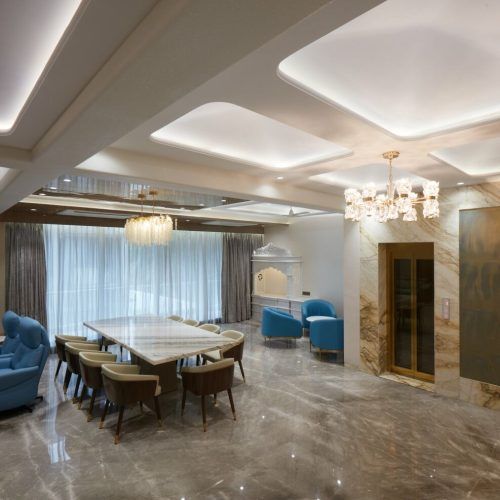
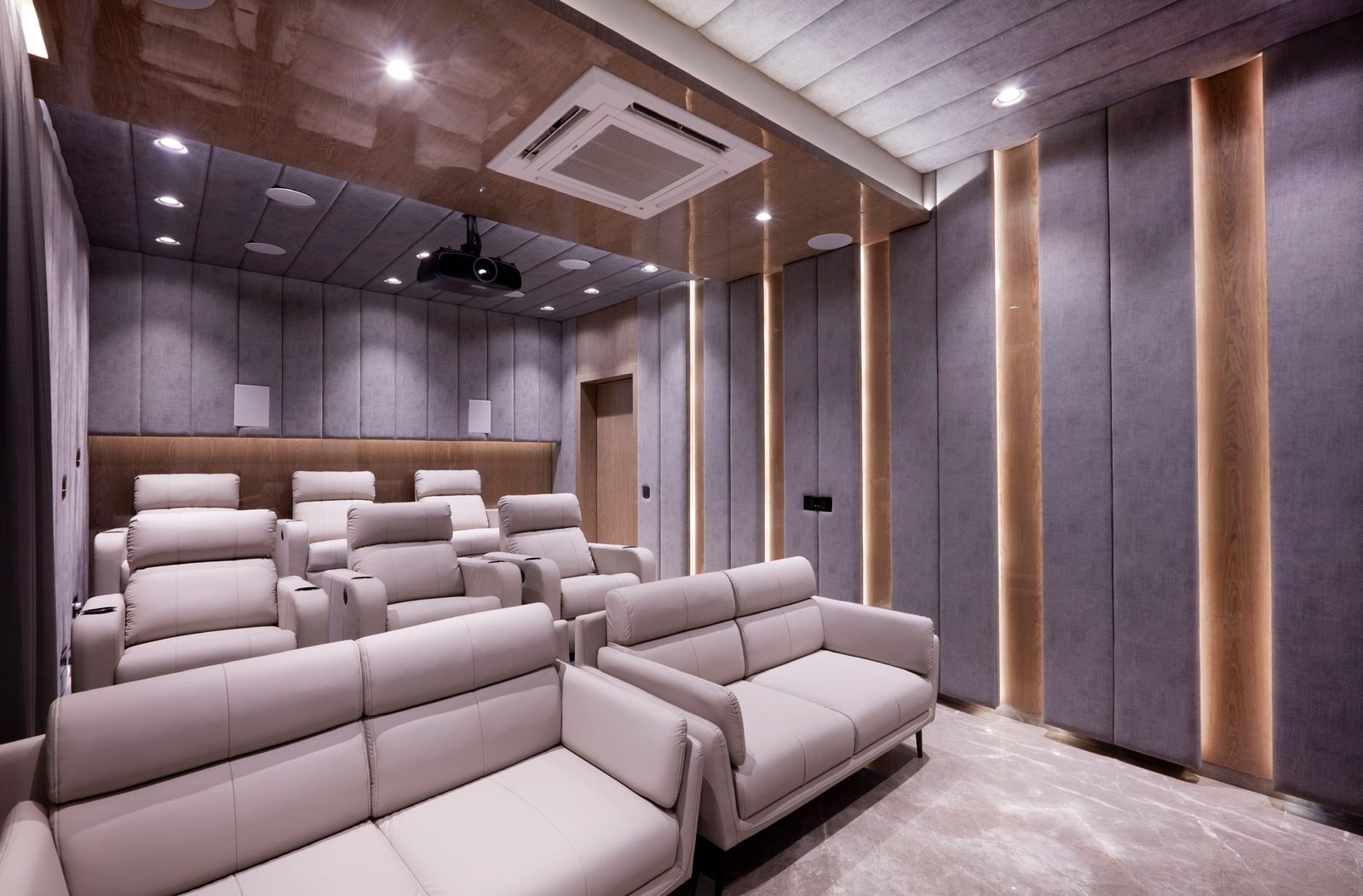
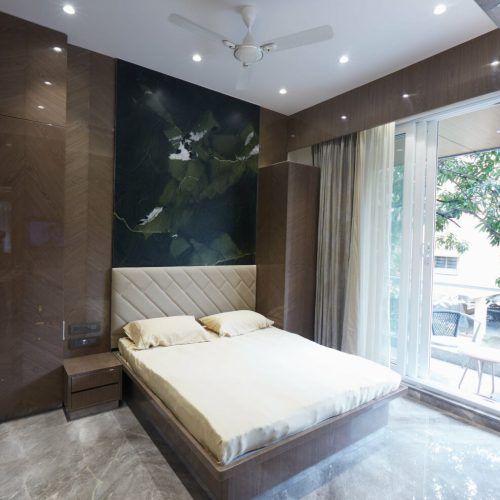
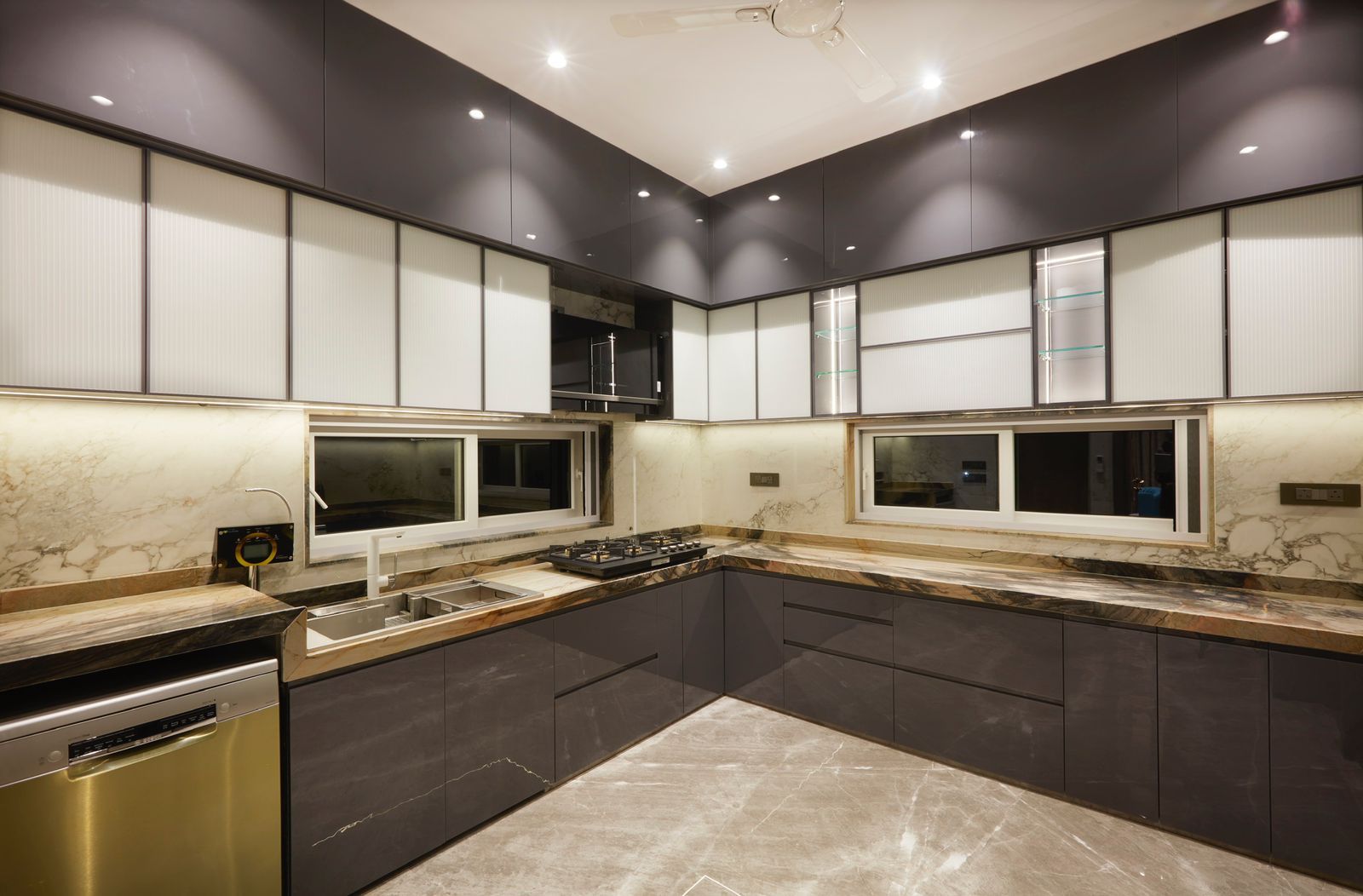
Selected work by Greenbox Design Studio. Tap any image to enlarge.
Frequently asked questions
Is Blum worth the extra cost over Hettich?+
Marginally better in feel and cycle rating, at 25–40% more. For a kitchen with ten drawers that is ₹15,000–₹35,000 of difference. Both will outlast the shutters in front of them, so most of our clients specify Hettich or Hafele and spend the difference on carcass grade or lighting.
What cycle rating should kitchen hardware have?+
Eighty thousand cycles, which is the standard for Hettich and Hafele premium series and equates to roughly twenty years of domestic use at four operations a day. Fifty thousand is acceptable for a budget build; anything unrated should not be in a kitchen at all.
How many hinges does a kitchen shutter need?+
Two for shutters up to 900 mm tall, three up to 1,600 mm, and four above that. Under-hinging is the most common cause of shutters that drift out of alignment within a year, and it saves about ₹250 per shutter — which is not a saving worth making.
Are tandem box drawers worth it?+
In base units, yes — they carry 40–50 kg, extend fully so the back of the drawer is reachable, and cost ₹4,200–₹9,000 against ₹2,800–₹4,200 for a metal box. In wall units, which hold light items, the metal box system is ample and the upgrade is wasted.
What hardware should I use near the sea in Mumbai?+
SS 304 as a minimum and SS 316 for exposed screws, handles and utility fittings within about two kilometres of the coast. Standard zinc- or nickel-plated steel pits within three to five years in salt air, and it is usually the supplied screws rather than the mechanism that fails first.
Should the hardware brand be in my quotation?+
The brand and the series, in writing. 'Branded hardware' or even 'Hettich hinges' leaves the specification open by ₹180 or more per hinge, because every brand sells both a premium and an economy line under the same name.