
The four handle-less systems
Handle-less is not one thing. Four distinct mechanisms get sold under the same word, and they behave very differently in a kitchen that cooks Indian food twice a day. The decision is usually made from a showroom photograph, where all four look identical.
| System | How it works | ₹ per running foot extra | Best for | Weakness |
|---|---|---|---|---|
| G-profile (integrated) | A recess milled into the shutter's top edge | ₹280–₹420 | Base units, drawers | Collects dust and oil in the groove |
| J-profile | A J-shaped return on the shutter bottom | ₹300–₹450 | Wall units | Awkward on low base drawers |
| Gola / C-channel | An aluminium channel between shutter rows | ₹380–₹620 | Full handle-less kitchens | Channel needs anodising near the sea |
| Push-to-open | Sprung or electric latch behind the shutter | ₹420–₹900 | Tall units, appliance garages | Oily palm prints on the shutter face |
| Conventional handle | Screwed hardware, 96–320 mm centres | Baseline | Heavy-use Indian kitchens | Projects 32–45 mm into circulation |
Rates are the premium over a conventional 128 mm SS handle at around ₹340 per piece fitted.
Ergonomics: who actually opens the drawer
A handle is a grip, and a grip matters most to the person with the least hand strength in the household. Gola channels need a finger hooked into a 20–25 mm aperture and a pull; that is comfortable for most adults and genuinely difficult for someone with arthritis or a weak grip. Push-to-open needs a firm push with a flat palm, which a child can do easily and an elderly user often cannot do accurately.
Height changes the answer too. On a wall unit at 1,400 mm, a J-profile under the shutter is the most comfortable option because the hand approaches from below anyway. On a bottom drawer at 250 mm, a G-profile means bending to hook a finger into a groove you cannot see. Many of the best kitchens we build are mixed: gola on the base run, J-profile on the wall units, and a conventional handle on the tall pantry that gets pulled fifteen times a day.
Design and build under one accountable roof
Cleaning, and the Indian cooking test
This is where showroom logic and Mumbai kitchens part company. Indian cooking produces aerosolised oil. It settles on every horizontal and recessed surface within two metres of the hob, and it combines with dust into a film that needs degreasing rather than wiping. A G-profile groove runs horizontally across the top edge of every base shutter, directly in the path of that film, and it is a 20 mm-deep channel you must clean with a cloth wrapped around a finger.
- Gola channels are the easiest handle-less type to clean because the aluminium is smooth and the channel is open at both ends; a flat cloth passes straight along it.
- Milled G-profiles in laminate are the hardest — the milled edge is often sealed with a thin edge band that eventually lifts where it is scrubbed.
- Push-to-open transfers the cleaning problem to the shutter face. On a matte dark laminate, palm marks are visible from across the room and need wiping daily.
- Conventional handles keep grease on the handle, which is a 200 mm object you can wipe in three seconds, or unscrew and soak twice a year.
- High-gloss acrylic shows everything whichever system you choose; matte laminate and fenix-type surfaces are far more forgiving in an Indian kitchen.
What each choice costs on a real kitchen
Take a common Mumbai layout: an L-shaped kitchen with 9 running feet of base units, 7 running feet of wall units and one 3-foot tall unit, in a 2BHK at Andheri. Here is what the hardware decision does to the total.
| Specification | Base run | Wall run | Tall unit | Hardware total |
|---|---|---|---|---|
| Conventional SS handles | ₹4,760 (14 pcs) | ₹2,720 (8 pcs) | ₹680 (2 pcs) | ₹8,160 |
| G-profile milled | ₹8,100 | ₹5,600 | ₹1,900 | ₹15,600 |
| Gola channel, anodised | ₹12,600 | ₹8,400 | ₹2,600 | ₹23,600 |
| Push-to-open, mechanical | ₹16,200 | ₹10,500 | ₹3,400 | ₹30,100 |
| Mixed: gola base, J wall, handle tall | ₹12,600 | ₹6,300 | ₹680 | ₹19,580 |
Ex-GST. The mixed specification is what we recommend most often; it costs 17% less than full gola and works better daily.
Resale, trends and honesty about durability
Handle-less has been the dominant showroom aesthetic for about a decade, which means it is no longer a differentiator and is not yet dated. It photographs well and it makes a small kitchen read as one continuous plane, which genuinely helps in the 55–90 sq ft kitchens most Mumbai flats have. Those are real benefits.
The durability picture is more mixed. A conventional handle is a ₹340 part that can be replaced in four minutes when it loosens. A gola channel is structural to the shutter layout — if the anodising pits or the channel dents, replacing it means dismantling a row. Push-to-open mechanisms are the shortest-lived component in any kitchen we service: mechanical latches typically need replacing at year five to seven, electric ones sooner and at higher cost. Specify them only where the door is opened occasionally.
In a kitchen that cooks twice a day, put the handle-less where it looks good and the handle where the hand actually goes.
Greenbox principal designer
One detail that decides whether a handle-less kitchen looks expensive or cheap: the shutter gaps. Handle-less shutters have nothing to distract the eye from the reveals between them, so a 3 mm gap that varies to 5 mm across a run is immediately visible, whereas the same variation on a handled kitchen goes unnoticed. This means handle-less demands better fabrication tolerance and better site levelling, and it is the reason a cheap handle-less kitchen looks worse than a cheap handled one. If your fabricator works to ±2 mm, specify handles. If they work to ±0.5 mm with machine-cut panels, handle-less will look like the showroom.
Finally, plan the bin. Every kitchen we service has one shutter that gets opened with a knee, an elbow or the back of a wrist because both hands are full — almost always the bin. A push-to-open bin drawer works well for exactly that reason, and a gola channel does not, because you cannot hook a finger into a channel with a handful of vegetable peelings. It is a small decision that gets made forty times a week.
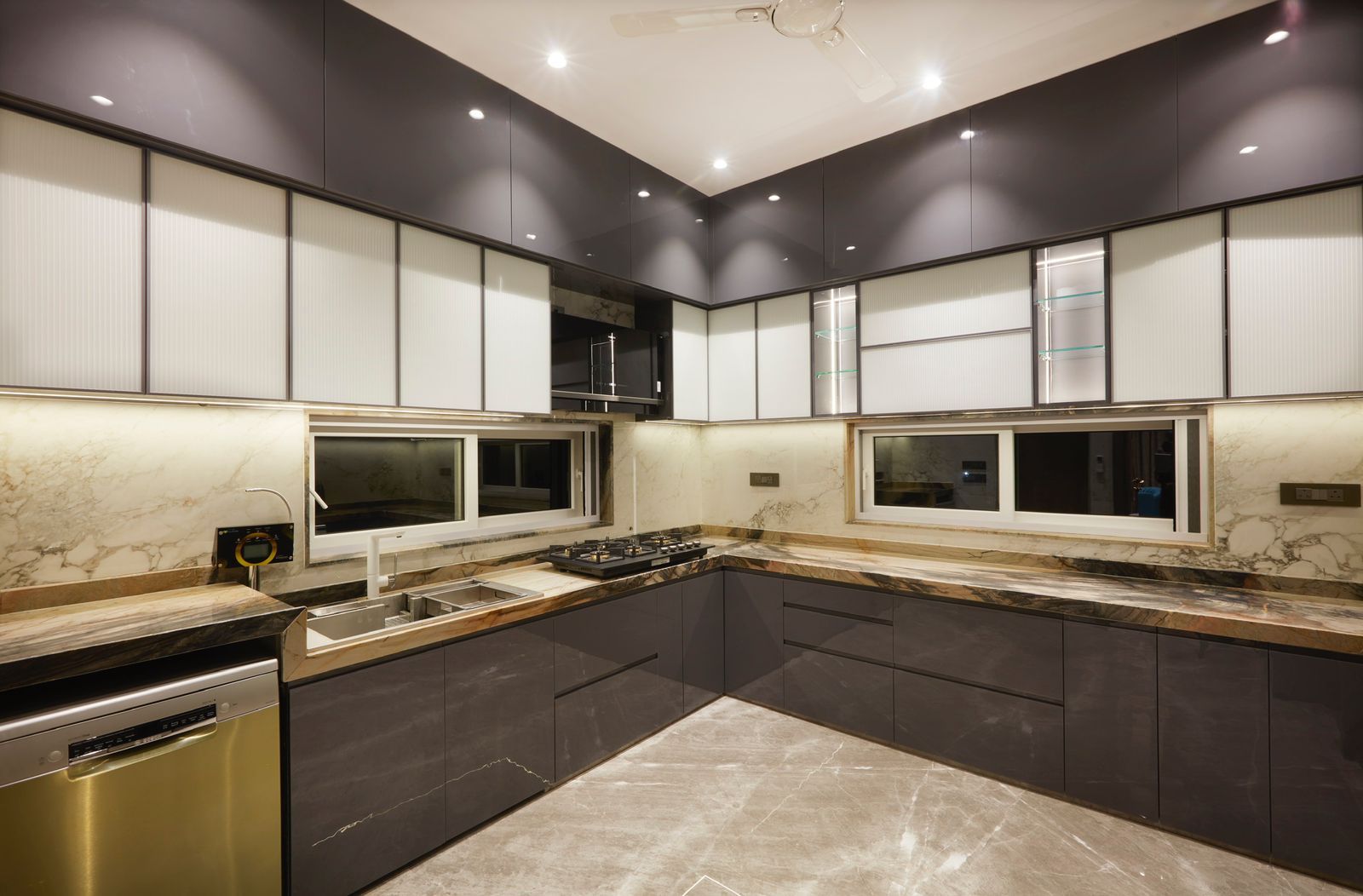
Selected work by Greenbox Design Studio. Tap any image to enlarge.
Frequently asked questions
Is a handle-less kitchen more expensive?+
Yes, by roughly ₹280–₹620 per running foot depending on the system, which is ₹18,000–₹42,000 on a typical 14 running-foot Mumbai kitchen. Gola channel is the most expensive of the practical options; milled G-profile is the cheapest handle-less route and about double the cost of conventional handles.
Is push-to-open good for Indian kitchens?+
Rarely on base and wall units. Indian cooking deposits an oil film, and push-to-open means pushing the shutter face with a working hand several times an hour. It is excellent on tall pantry doors, appliance garages and anywhere a handle would be visually intrusive but the door opens only a few times a day.
Do handle-less kitchens work in small spaces?+
Very well — this is their strongest argument. A conventional handle projects 32–45 mm into the aisle, and in a galley kitchen with 900 mm between runs that is 10% of your passing width on each side. Handle-less returns it, and it removes the hip-catch on the drawer you walk past.
Which handle-less system needs least maintenance?+
An anodised aluminium gola channel. It is a smooth, open profile that wipes clean in one pass, and at 15–20 microns of anodising it resists the salt air in coastal Mumbai. Milled G-profiles in laminate need the most attention because the edge band at the milled recess is the wear point.
Can I mix handles and handle-less?+
Yes, and it is usually the better answer. Gola or G-profile on the base and drawer runs where the clean line matters most, J-profile on wall units, and a proper handle on the tall unit and the appliance-adjacent drawers that get the heaviest use. It costs about 17% less than a fully handle-less kitchen.