
The three phases, honestly proportioned
Clients consistently underestimate the front end. A 12,000 sq ft office fit-out that takes eighteen weeks from signed design to handover spends roughly five of those weeks on drawings, approvals and procurement before anything happens on site, and the site work itself — which is the only part anyone watches — is eleven or twelve. Trying to compress the site phase to recover a delay in the front end is the standard error and it produces snagging, not speed.
| Phase | 3,000–5,000 sq ft | 10,000–15,000 sq ft | 25,000+ sq ft | What happens |
|---|---|---|---|---|
| Design development and GFC drawings | 2–3 weeks | 3–5 weeks | 6–8 weeks | Layouts, services coordination, GFC set |
| Landlord and statutory approvals | 2–3 weeks | 2–4 weeks | 3–6 weeks | Fit-out manual compliance, deposits, NOCs |
| Procurement of long-lead items | Runs in parallel | Runs in parallel | Runs in parallel | HVAC, workstations, glazing, AV |
| Civil, partitions, MEP first fix | 3–4 weeks | 5–6 weeks | 8–10 weeks | The noisy phase |
| Ceilings, flooring, second fix | 2–3 weeks | 4–5 weeks | 6–8 weeks | Trades overlap heavily here |
| Joinery, furniture, AV install | 2–3 weeks | 3–4 weeks | 4–6 weeks | Depends entirely on delivery dates |
| Testing, snagging, handover | 1–2 weeks | 2–3 weeks | 3–4 weeks | Do not compress this one |
| Total | 10–14 weeks | 16–20 weeks | 24–32 weeks | — |
Measured from signed design. Add 3–6 weeks if design is still being developed, and 2–3 weeks for occupied-premises or night-work restrictions.
The long-lead list
Four or five items set the critical path on almost every fit-out, and none of them are construction activities. If they are ordered in week one they are not a problem; if they are ordered when the site is ready for them, they add their full lead time to the programme.
- HVAC equipment: 8–14 weeks. VRF outdoor units and AHUs, particularly in a specification the supplier does not stock. This is the commonest single cause of a delayed handover.
- Workstations and task chairs: 8–12 weeks. Indian manufacturers quote six and deliver ten on a large order. Place the order against the approved layout, not against the final one.
- Glazed partition systems: 6–10 weeks. Imported systems longer. Site dimensions must be confirmed before ordering, which means the partitions must be built and measured first.
- AV and video-conferencing hardware: 6–12 weeks. Specific models are frequently unavailable; agree substitutions early rather than at installation.
- Bespoke joinery: 5–8 weeks. Reception desks, boardroom tables and feature walls. Factory time, not site time.
- Access control and networking: 4–8 weeks. Usually the client's IT vendor, usually not on the contractor's programme, and frequently the reason a finished office cannot be occupied.
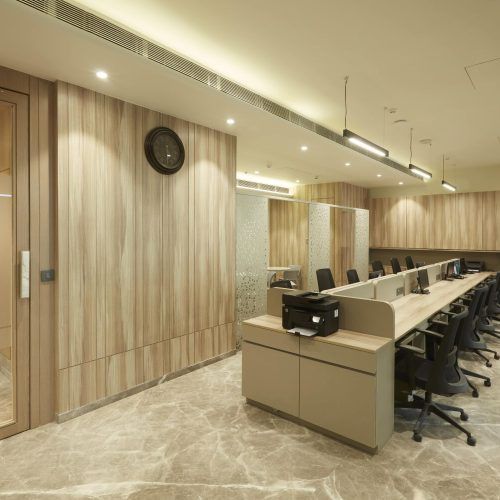
Design and build under one accountable roof
Where Indian fit-outs actually slip
In our experience of Mumbai, Pune and Bengaluru fit-outs, delay is rarely caused by slow trades. It is caused by decisions and approvals. The landlord's fit-out manual requires drawings in a particular format and a particular sequence; the building manager takes ten working days rather than five; a nominated vendor for fire suppression has a three-week queue; a client stakeholder who was not in the design meetings sees the plan in week six and asks for a change.
- Landlord approval: budget 2–4 weeks, submit early, and ask for the fit-out manual before the design starts rather than after.
- Nominated vendors: fire suppression, sprinkler modification and BMS tie-ins are usually restricted to the landlord's vendors at their own rates and their own timetable. Get their quotation and their lead time in week one.
- Client-side decisions: agree in advance who signs off and by when. A named decision-maker with a 48-hour response commitment is worth two weeks on a large programme.
- Building access: service lift bookings, permitted working hours, material movement windows. In a Grade-A Mumbai building, material can often move only between 10 pm and 6 am.
- Monsoon: June to September affects deliveries, external works and curing times. A programme that runs through July needs a week of float that a January programme does not.
- Power availability: temporary construction power and the timing of the permanent supply. Commissioning cannot begin without the latter.
Occupied premises and phased handover
Fitting out a floor a company is still working on changes the programme fundamentally. Noisy work moves to nights and weekends, which costs a 15–25% labour premium and halves the effective working hours. Dust separation, protected routes and daily reinstatement add time to every activity. A phased fit-out of an occupied 15,000 sq ft floor in three zones typically takes 26–32 weeks against 18–20 for the same area vacant.
Where the timeline matters more than the cost, the alternative worth pricing is a temporary decant — moving staff to a serviced office for eight weeks while the floor is done vacant. On a 15,000 sq ft fit-out the decant frequently costs less than the night-work premium plus the extended preliminaries, and it removes the productivity cost of running a business inside a construction site.
Order the four long-lead items in week one against the approved layout. Everything else can be caught up; those cannot.
Greenbox commercial fit-out lead
Reading a contractor's programme
Every fit-out contractor produces a bar chart, and most of them are optimistic in the same three ways. First, activities are drawn as if they run in sequence with no gap, when in reality there is a day of clearing and setting out between most trades. Second, the procurement bars start at week one regardless of when the order will actually be placed, which depends on approvals nobody controls. Third, there is no float. A programme with no float is not a plan; it is a best case presented as a commitment.
Three questions make the chart useful. Which activities are on the critical path, and what is the float on the rest? What is the assumed date for landlord approval, and what happens if it takes two weeks longer? Which items have been ordered, with a purchase order number and a confirmed delivery date, rather than merely specified? A contractor who can answer all three has a real programme. One who cannot is showing you a picture of a fit-out rather than a plan for one.
- Ask for a two-week look-ahead every Friday, not a monthly update against the master chart. It is the document that shows drift early.
- Track long-lead items on a separate one-page log, with PO number, supplier, promised date and revised date. Four rows, updated weekly.
- Agree what a delay notice looks like and when it must be issued — within 48 hours of the cause, not at the end of the month.
- Build in two weeks of float before the occupancy date, and do not tell anyone in the business that it exists.
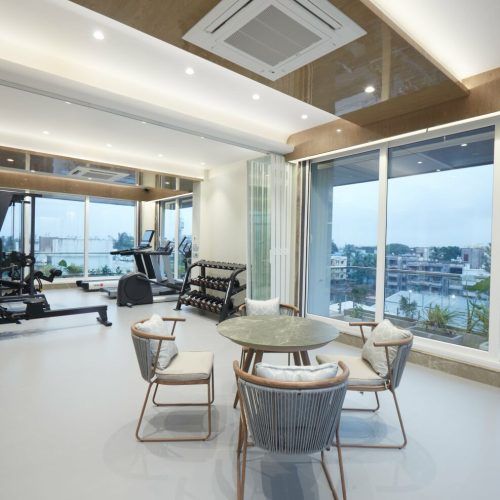
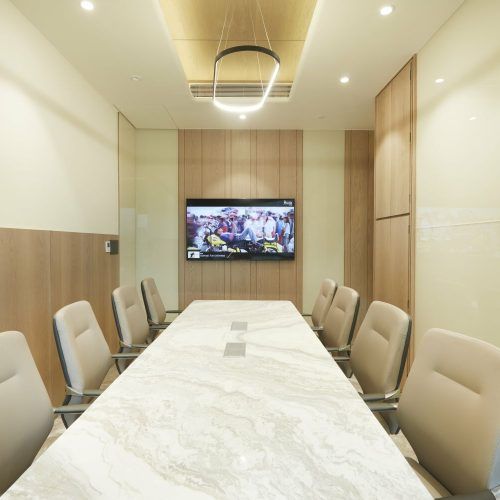
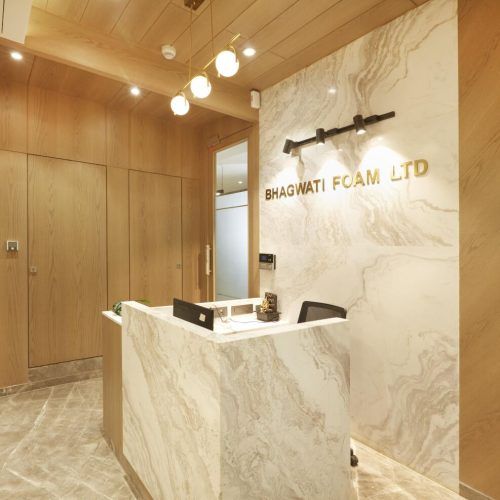
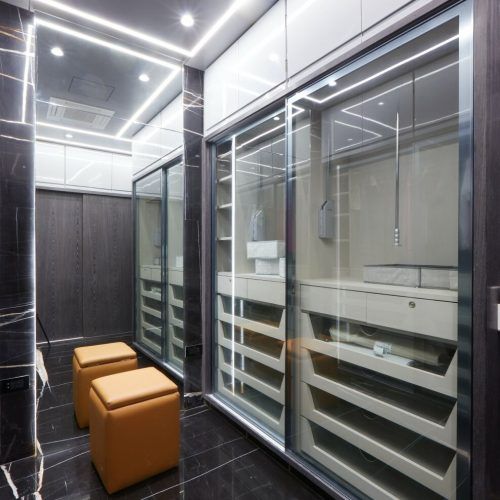
Selected work by Greenbox Design Studio. Tap any image to enlarge.
Frequently asked questions
How long does a 10,000 sq ft office fit-out take?+
Sixteen to twenty weeks from a signed design to handover, of which roughly five are design development, approvals and procurement before site work begins. Add two to three weeks if the premises are occupied and noisy work is restricted to nights, and three to six weeks if the design is not yet finalised.
What delays commercial fit-outs most?+
Long-lead equipment and approvals, not construction. HVAC equipment at eight to fourteen weeks, workstations at eight to twelve, landlord drawing approval at two to four, and nominated-vendor works such as fire suppression that run on the landlord's timetable rather than yours.
Can a fit-out be done while the office is occupied?+
Yes, in phases, and it takes considerably longer — typically 26–32 weeks for a 15,000 sq ft floor against 18–20 vacant. Noisy work moves to nights at a 15–25% labour premium. Price a temporary decant as an alternative; it is often cheaper as well as faster.
When should furniture be ordered?+
In week one, against the approved layout, not when the site is ready for it. Indian workstation manufacturers quote six weeks and commonly deliver in ten on a large order. Furniture arriving late is the most visible form of delay because the office looks finished and cannot be occupied.
How long does landlord approval take?+
Two to four weeks in most Grade-A Indian buildings, longer where the drawings need revision to comply with the fit-out manual. Request the manual before design starts, submit a complete set rather than a partial one, and treat the approval as a critical-path activity rather than a formality.
Does the monsoon affect fit-out timelines?+
In Mumbai, yes. June to September affects material deliveries, any external or facade work, and curing and drying times for wet trades and finishes. A programme running through the monsoon should carry about a week of additional float compared with the same programme in the dry season.