

Work out your veneer
Elevation area of the panels being veneered, then the grade and polish.
How this calculator works
- Surface = elevation area × faces factor. The 1.15 option covers the outer face in your chosen veneer and the reverse in an economical balancing veneer.
- Veneer to buy = surface × wastage factor. Ten per cent on large uniform panels, 15 standard, 25 where leaves must follow in sequence.
- Sheets = ceiling(area to buy ÷ 32). A standard veneer sheet is 8 × 4 ft, the same as plywood.
- Pressing and finishing labour = surface × ₹95, which covers hot pressing onto the substrate, trimming and sanding.
- Polish = surface × rate. Polish is applied to the visible surface, so it follows the same area as the veneer.
- Lipping = running feet × rate, which is measured separately because it depends on how many panel edges are exposed.
| Grade | Rate | What it is | Where to use it |
|---|---|---|---|
| Indian teak | ₹165 / sq ft | Locally sliced teak, variable figure | Budget wardrobes, back panels |
| Reconstituted | ₹210 / sq ft | Dyed fast-growth wood re-sliced to a uniform grain | Where consistency matters more than character |
| Natural imported | ₹420 / sq ft | Oak, walnut, ash, sliced and bundled by log | Living-room panelling, feature joinery |
| Figured or burl | ₹680 / sq ft | Crotch, burl and quilted figure | Small feature areas only — it overwhelms a room |
| Melamine polish | ₹90 / sq ft | Fast, cheap, yellows in 5–7 years | Rentals, back-of-house |
| Lacquer polish | ₹140 / sq ft | Better clarity, still ambers slowly | Bedrooms, low-traffic panels |
| PU matt polish | ₹180 / sq ft | Holds colour, water and scratch resistant | The standard on anything visible |
Design and build under one accountable roof
Worked example — 80 sq ft of wardrobe elevation
| Line | Arithmetic | Amount |
|---|---|---|
| Surface with balancing | 80 × 1.15 | 92 sq ft |
| With 15% wastage | 92 × 1.15 | 105.8 sq ft |
| Sheets at 32 sq ft | ceiling(105.8 ÷ 32) | 4 sheets |
| Reconstituted veneer | 105.8 × ₹210 | ₹22,218 |
| Pressing and finishing | 92 × ₹95 | ₹8,740 |
| PU matt polish | 92 × ₹180 | ₹16,560 |
| Veneer lipping | 60 ft × ₹120 | ₹7,200 |
| Total | sum | ₹54,718 |
| All-in rate | ₹54,718 ÷ 80 | ₹684 |
Why veneer jobs go wrong
Almost always at the matching stage. A veneer bundle is a stack of leaves sliced consecutively from one flitch, and they match because they are effectively adjacent slices of the same piece of wood. Take two leaves from different bundles and put them on adjacent wardrobe shutters and you get two different colours, two different figures and a client who is unhappy for the next decade. The instruction that prevents it is simple: buy the whole job at once, keep the bundle in order, and number the leaves before anything is pressed.
The second failure is book-matching versus slip-matching, which should be a decision rather than an accident. Book-matching opens consecutive leaves like a book, producing a mirrored pattern down the centre join — dramatic, and it exaggerates any colour variation between leaves. Slip-matching slides each leaf across without flipping, which gives a repeating pattern and a more even colour. On a long wardrobe run we usually slip-match; on a single feature panel we book-match. Either is fine; not deciding is not.
Third, polish. A veneered panel is 0.5 mm of real wood over a substrate, and that 0.5 mm is porous. Left raw it absorbs every mark within a week. The polish is not a finishing touch, it is part of the product, and it should be applied in a controlled space rather than on a dusty site — which is why we press and polish veneer in the workshop and bring finished panels to site wherever the sizes allow.
Veneer leaf, polish and lipping are bought goods, and their prices here are what the market charges in October 2026 rather than anything we set. The ₹95 per sq ft of pressing and finishing is Greenbox labour. Worth saying plainly: the audited card prices finished veneered work per sq ft of elevation — ₹950 to ₹1,450 for panelling, ₹2,450 to ₹3,700 for a full-height wardrobe — so read this page as a bill of material with our labour added, not as a quotation for a completed unit. Treat the output as a planning figure: accurate enough to brief a landlord, a bank or a family, and not accurate enough to sign a contract against.
What this tool does not cover
- The substrate — plywood, MDF or HDHMR — priced in the plywood sheet calculator and the MDF board calculator.
- Hardware, hinges and handles.
- Site polishing, which costs more than workshop polishing and gives a poorer finish in a dusty flat.
- Repairs. A veneer surface can be re-polished but a deep scratch through the 0.5 mm face cannot be sanded out.
- Curved and post-formed panels, which need flexible veneer and vacuum pressing.
- For laminate instead, see the laminate sheet calculator.
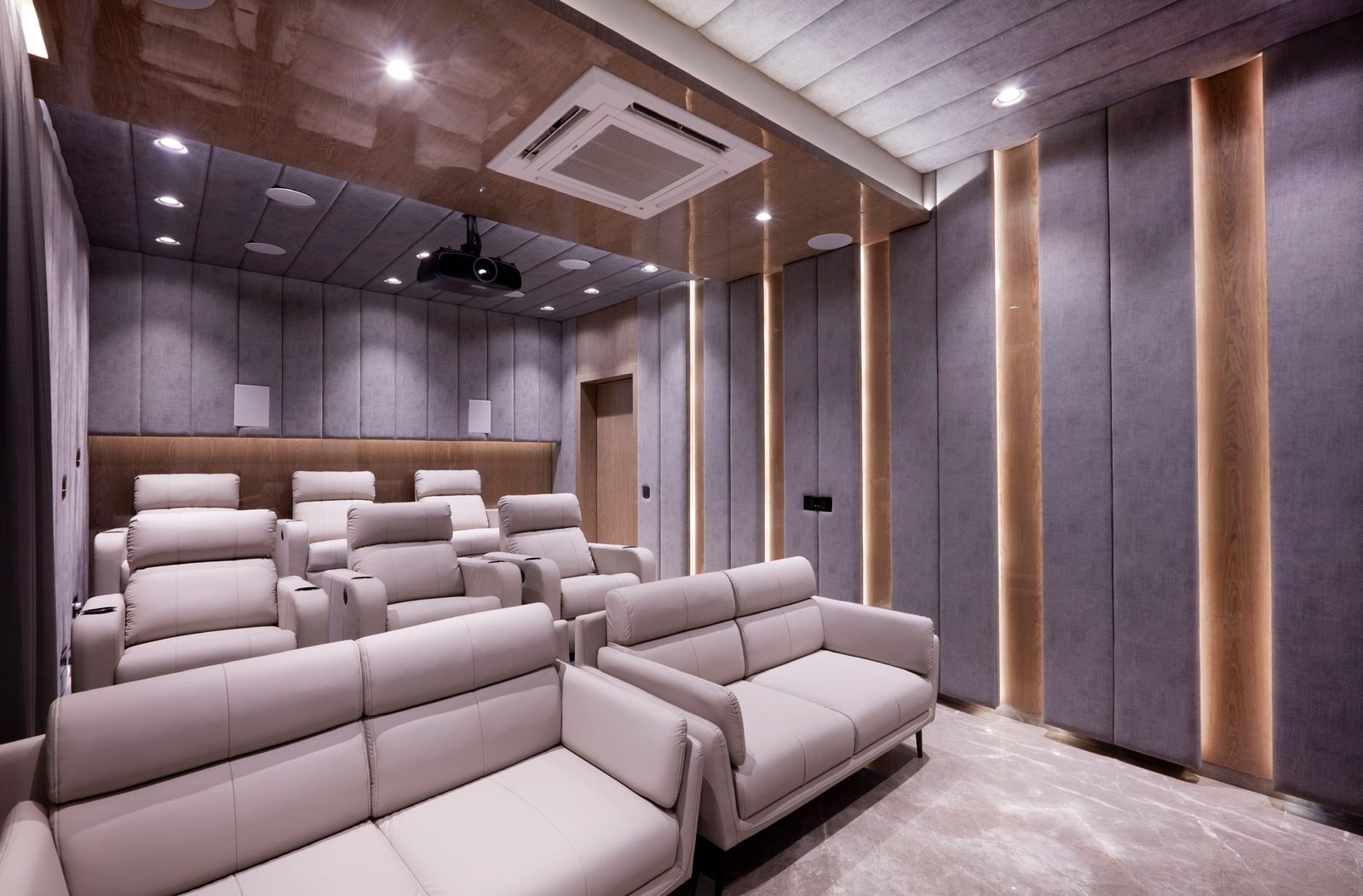
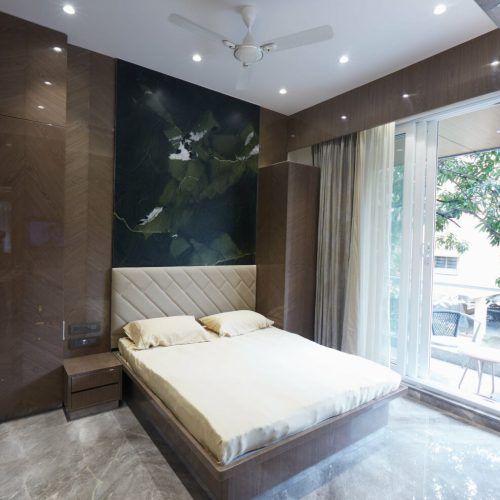
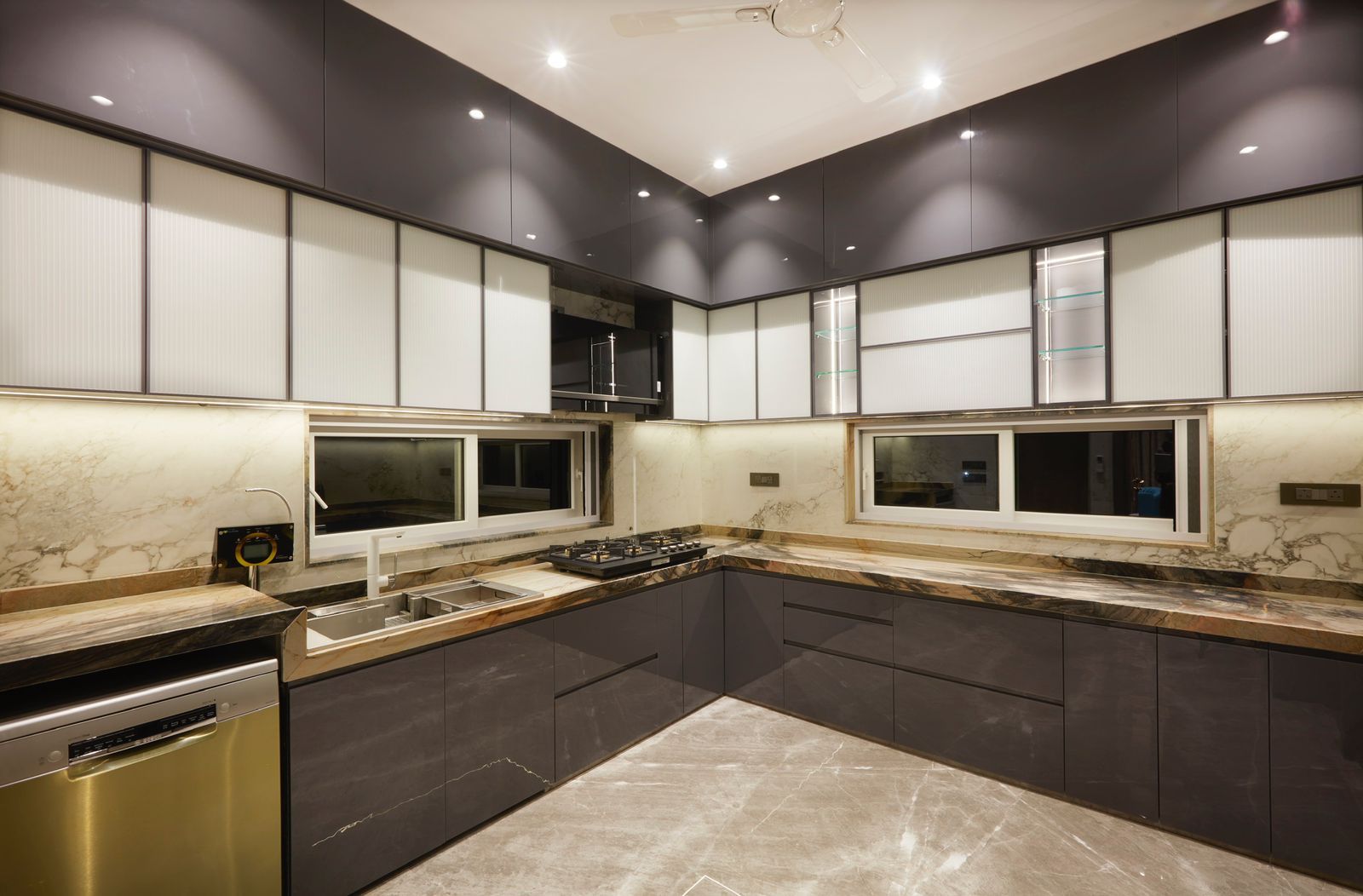
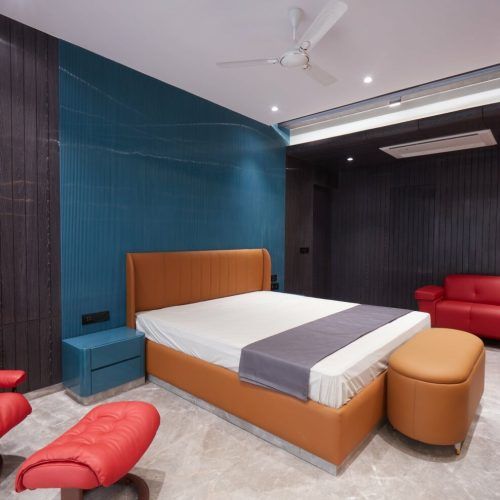
Selected work by Greenbox Design Studio. Tap any image to enlarge.
Frequently asked questions
How much does veneer cost per square foot?+
₹165 per sq ft for Indian teak, ₹210 for reconstituted, ₹420 for natural imported and ₹680 for figured or burl — material only. Add pressing at ₹95 and polish at ₹90–180, and the all-in rate lands between ₹450 and ₹1,000 per sq ft of elevation.
Do both sides of a veneered panel need veneer?+
Both sides need something. The reverse can be a cheap balancing veneer rather than the decorative one, but a panel finished on one side only will cup within a year in Mumbai humidity, and the shutters will stop aligning.
What is the difference between natural and reconstituted veneer?+
Natural veneer is sliced from a real log, so it has genuine figure and variation between leaves. Reconstituted veneer is fast-growth wood dyed, laminated into a block and re-sliced, which gives a completely uniform grain. Natural has character and needs sequencing; reconstituted is predictable and forgiving.
Which polish is best for veneer?+
PU matt at about ₹180 per sq ft. It holds its colour, resists water and scratches, and looks right for a decade. Melamine at ₹90 is the budget option and visibly yellows within five to seven years, which on a pale oak veneer is very noticeable.
Why does my veneer look like two different woods?+
Because the leaves came from different bundles, or were pressed out of sequence. Veneer matches only when consecutive leaves from one flitch are used in order. It cannot be corrected afterwards without replacing the panels, which is why sequencing is the single most important instruction on a veneer job.