
Set up a desk properly
Start with the user's height. Everything else is derived from it.
How this calculator works
- Seat height = 0.26 × standing height, an anthropometric approximation of popliteal height plus shoe allowance.
- Desk height = seat height + 0.185 × standing height. That places the work surface at seated elbow level, which is what keeps forearms parallel to the floor.
- Standing desk height = 0.62 × height − 5 cm, which is standing elbow height less a small allowance.
- Seated eye height = seat height + 0.41 × standing height. The monitor's top edge is placed there.
- Screen distance = monitor diagonal in centimetres × 1.1, which for a 24-inch panel is about 67 cm — roughly an arm's length.
- Desk depth is banded by screen size and width is derived from screen count, at 88% of the diagonal per screen plus 20 cm of working margin, with a 100 cm floor.
| User height | Seat | Desk | Standing desk | Seated eye height |
|---|---|---|---|---|
| 155 cm | 40.3 cm | 69.0 cm | 91.1 cm | 103.9 cm |
| 163 cm | 42.4 cm | 72.5 cm | 96.1 cm | 109.2 cm |
| 172 cm | 44.7 cm | 76.5 cm | 101.6 cm | 115.2 cm |
| 180 cm | 46.8 cm | 80.1 cm | 106.6 cm | 120.6 cm |
| 188 cm | 48.9 cm | 83.7 cm | 111.6 cm | 125.9 cm |
Every figure is computed from the formulas above. The standard Indian desk at 75 cm suits a user of about 170 cm; at 188 cm the same desk is nearly 9 cm too low, which over eight hours a day is the difference between comfortable and not.

Design and build under one accountable roof
Worked example — a 172 cm user
| Step | Arithmetic | Result |
|---|---|---|
| Seat height | 0.26 × 172 | 44.7 cm |
| Desk height | 44.7 + (0.185 × 172) | 76.5 cm |
| Standing desk | (0.62 × 172) − 5 | 101.6 cm |
| Seated eye height | 44.7 + (0.41 × 172) | 115.2 cm |
| Monitor top edge | at eye height | 115.2 cm |
| Screen distance, 24 in | 24 × 2.54 × 1.1 | 67 cm |
| Minimum desk depth | 24-inch band | 68 cm |
| Minimum desk width | one screen | 100 cm |
Building a study desk that actually fits
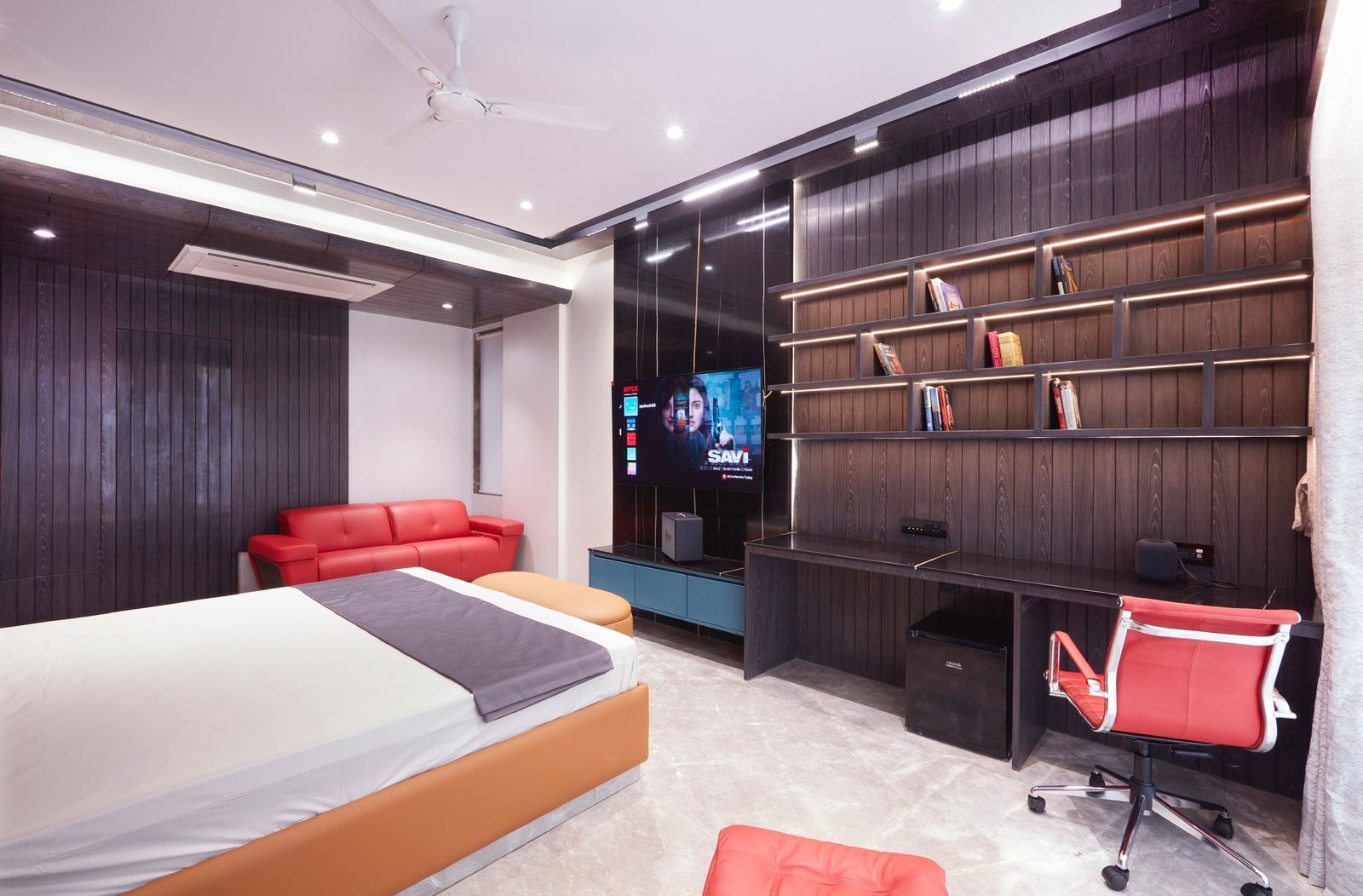
A built-in study desk is fixed for the life of the joinery, which makes the height decision unusually consequential. Our standard advice on a children's study is to build the desk at the height that will suit the child at fourteen rather than at eight, and to supply an adjustable chair and a footrest for the intervening years. A desk built for an eight-year-old is unusable within three, and rebuilding it means taking out a wall of joinery.
The second consideration is depth. A 45 cm desk looks elegant on an elevation and cannot hold a monitor at a sensible distance — the screen ends up 40 cm from the face, which is too close for a 24-inch panel. Sixty centimetres is the working minimum, 68 for a 24-inch screen and 75 for a 27-inch. Where wall depth is genuinely tight, a monitor arm recovers about 15 cm by moving the stand off the desk entirely, and it is the single best ₹4,000 in a home office.
Third, knee clearance. A desk with a drawer pedestal directly under the working position leaves no room for legs and forces the user to sit sideways. Keep 60 cm of clear width and 45 cm of clear depth under the work position, put the drawers to one side, and check the apron height — a deep apron can take 5 cm out of the knee space the surface height suggested.
Every constant on this page comes from Greenbox site records — measured drawings, signed BOQs and completion certificates from projects delivered between 2023 and 2026 — rounded to the figures an estimator would actually write down. We publish them so the arithmetic can be audited rather than trusted. Treat the output as a planning figure: accurate enough to brief a landlord, a bank or a family, and not accurate enough to sign a contract against.
What this tool does not cover
- Chair quality, which matters more than every dimension on this page combined. A good task chair with lumbar support and an adjustable seat pan is the first purchase, not the last.
- Individual proportion. These are population averages — someone with a long torso and short legs will want a slightly different relationship between seat and desk.
- Laptop-only working, which cannot be made ergonomic without either an external keyboard or an external screen. Pick one.
- Existing medical conditions and any clinical advice, which override everything here.
- Cable management, power and data provision at the desk, which belong on the electrical drawing.
- For the room rather than the desk, see the room size calculator and the lumens calculator.


Selected work by Greenbox Design Studio. Tap any image to enlarge.
Frequently asked questions
What is the standard desk height?+
Seventy-five centimetres, which suits a user of about 170 cm. It is a convention rather than a rule — a 155 cm user wants 69 cm and a 188 cm user wants nearly 84. For a built-in desk, set it to the person who will use it.
How high should a monitor be?+
Top edge at seated eye level, which for a 172 cm user is about 115 cm from the floor. Looking slightly down at a screen is comfortable for hours; looking up at one is the fastest route to neck pain. A monitor arm is the easiest way to get there.
How deep should a study desk be?+
Sixty centimetres minimum, 68 for a 24-inch monitor and 75 for a 27-inch, because you need the viewing distance behind the keyboard. A 45 cm desk looks elegant on a drawing and puts the screen too close to use.
What height should a standing desk be?+
0.62 times your standing height minus five centimetres — about 101.6 cm for a 172 cm user. Forearms should be parallel to the floor at the keyboard, exactly as when seated. If you alternate, a sit-stand desk needs both heights, which is why fixed-height standing desks rarely work for two people.
What height should a child's study desk be?+
Build it for the child at fourteen, not at eight, and use an adjustable chair and a footrest in the meantime. A built-in desk sized for a small child is unusable within three years, and it cannot be raised without taking the joinery apart.