
Convert an area
Enter a figure, pick the units, and read every other unit in the breakdown.
How this converter works
Every unit is stored as its exact value in square feet. Your input is multiplied to square feet, then divided by the target unit's factor. Nothing is rounded internally — only the display is rounded, to the number of decimal places you choose.
| Unit | Exact value in sq ft | Where it is used |
|---|---|---|
| Square foot | 1 | Interior quotes, carpet area, fit-out rates |
| Square metre | 10.763910417 | Architectural drawings, IS codes, imported specs |
| Square yard / gaj | 9 | Plot sizes in Delhi NCR, Punjab, Rajasthan |
| Square inch | 0.00694444 | Hardware, tile edges, small components |
| Cent | 435.6 | Land in Kerala, Tamil Nadu, Karnataka |
| Guntha | 1,089 | Agricultural land in Maharashtra and Gujarat |
| Acre | 43,560 | Land nationally; 40 gunthas or 100 cents |
| Hectare | 107,639.104 | Government records, town planning |
Derived from 1 ft = 0.3048 m exactly, which makes 1 sq m = 1 ÷ 0.3048² = 10.763910417 sq ft.
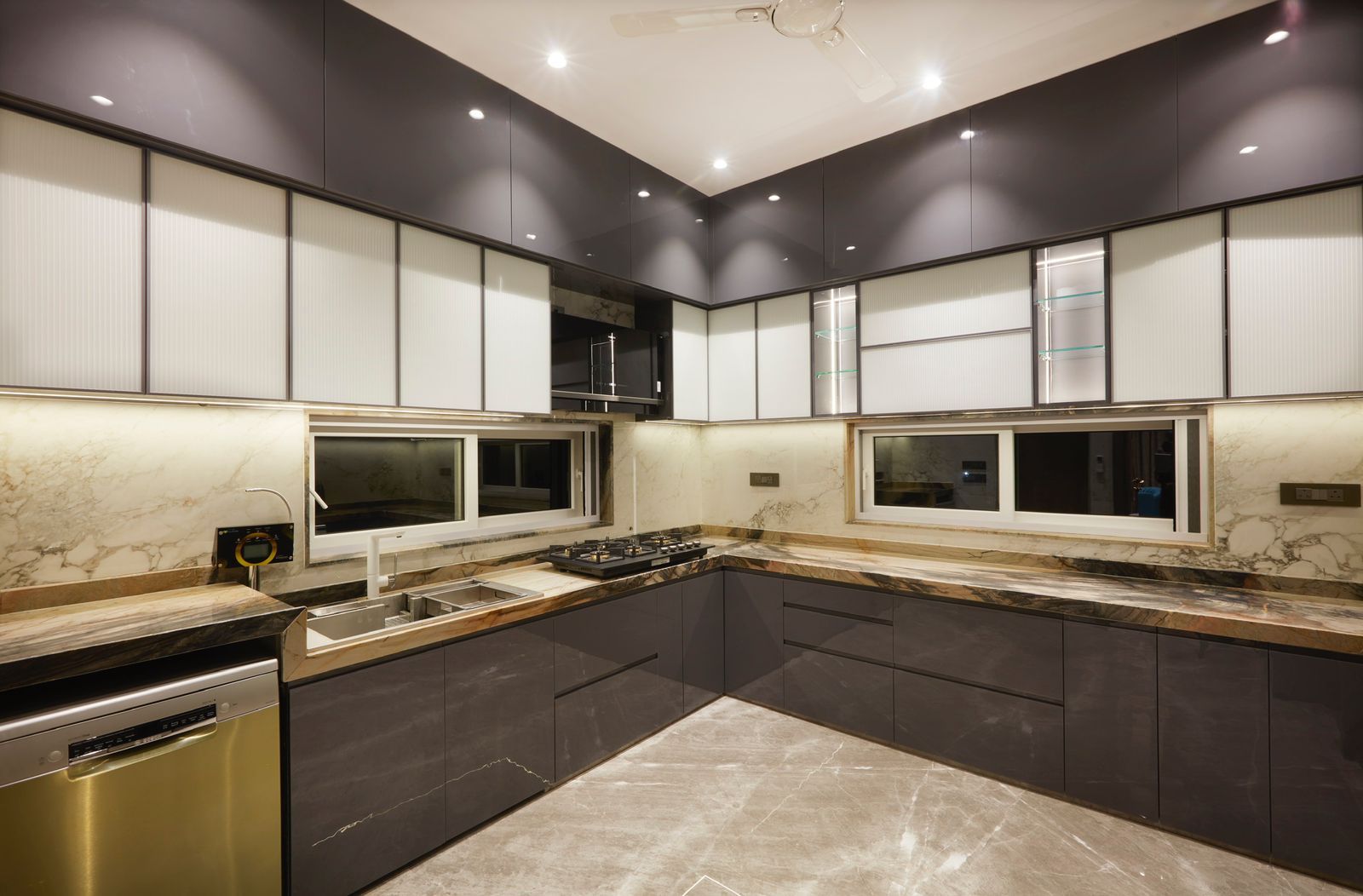
Design and build under one accountable roof
Worked example — the default conversion
The tool opens on 1,000 sq ft converting to square metres, displayed to one decimal place.
| Step | Arithmetic | Result |
|---|---|---|
| Input in square feet | 1,000 × 1 | 1,000 sq ft |
| Divide by the sq m factor | 1,000 ÷ 10.763910417 | 92.903 sq m |
| Rounded to one decimal | display only | 92.9 sq m |
| Same area in gaj | 1,000 ÷ 9 | 111.1 gaj |
| Same area in guntha | 1,000 ÷ 1,089 | 0.918 guntha |
| Same area in acres | 1,000 ÷ 43,560 | 0.0230 acre |
The area confusion that actually costs money
Unit conversion is the easy half. The expensive half is which area is being converted. Indian property is sold on super built-up area, taxed on built-up, and fitted out on carpet area — and the three differ by 25–40%. A quotation at ₹1,800 per sq ft on a 1,200 sq ft super built-up flat is not the same job as ₹1,800 per sq ft on its 820 sq ft carpet area, and the gap is nearly five lakh rupees.
RERA made carpet area the legally defined figure for a sale agreement, so the number in your agreement is the one to use. If a contractor quotes against the brochure figure instead, the per-sq-ft rate looks 30% cheaper than it is. Our carpet area to built-up converter handles that conversion; this page only handles units.
Convert the unit, then confirm the area definition. One is arithmetic, the other is where the money hides.
Greenbox design & build team
Land units add a second layer of confusion because they are regional. A guntha means 1,089 sq ft in Maharashtra and is not used at all in Kerala, where the same conversation happens in cents. Bigha varies not just between states but between districts within a state, which is why we have deliberately left it out of this tool rather than publish a number that is wrong in half the country. If a land document quotes bigha, get the local revenue office's conversion in writing before you rely on it.
Reading a drawing that mixes units
Indian construction drawings are a hybrid. The architect works in millimetres because that is what the software and the IS codes use. The contractor quotes in square feet because that is what the trade prices in. The client thinks in the brochure's super built-up figure. The site engineer marks out in feet and inches because the carpenter's tape is in inches. All four appear on the same project and nobody translates between them out loud.
Two habits prevent most of the resulting arguments. First, put the unit on every number, every time — 2400 means nothing, 2400 mm and 2400 sq ft are different universes. Second, agree one master unit at the start of the project and state it in the BOQ header. We write every Greenbox BOQ in square feet of carpet area with the millimetre drawing reference alongside, so the quantity surveyor and the carpenter are looking at the same job.
The conversions worth memorising are short: 1 m = 3.2808 ft, 1 mm = 0.03937 in, 1 sq m = 10.7639 sq ft, 1 ft = 304.8 mm. A 3600 mm wall is 11.8 ft; a 2100 mm door is 6 ft 11 in; a 1200 × 600 mm tile is 4 × 2 ft, near enough. Once those are in your head, a drawing stops being a translation exercise.
Every constant on this page comes from Greenbox site records — measured drawings, signed BOQs and completion certificates from projects delivered between 2023 and 2026 — rounded to the figures an estimator would actually write down. We publish them so the arithmetic can be audited rather than trusted. Treat the output as a planning figure: accurate enough to brief a landlord, a bank or a family, and not accurate enough to sign a contract against.
What this tool does not cover
- Carpet, built-up and super built-up area are different measurements of the same flat. This tool converts units, not definitions.
- Bigha, kanal, biswa and marla vary by state and even by district — we have left them out rather than publish a factor that is wrong somewhere.
- Local municipal definitions of built-up area include or exclude balconies differently. Check your sanctioned plan.
- For interior costing, always work from the measured carpet area on site, not from any brochure figure.
- This tool stores nothing and sends nothing — the whole conversion runs in your browser.



Selected work by Greenbox Design Studio. Tap any image to enlarge.
Frequently asked questions
How many square feet is 1 square metre?+
10.763910417 sq ft, which comes from 1 foot being exactly 0.3048 metres. For everyday use, 10.76 is accurate enough and 10.8 is fine in conversation.
How do I convert 1,000 sq ft to sq m?+
Divide by 10.7639, which gives 92.9 sq m. The same 1,000 sq ft is 111.1 gaj, 0.918 guntha and 0.023 of an acre.
What is a gaj?+
A square yard — exactly 9 square feet. Plot sizes in Delhi NCR, Punjab, Haryana and Rajasthan are commonly quoted in gaj, so a 200 gaj plot is 1,800 sq ft.
Is carpet area the same as usable area?+
Close, but not identical. Under RERA, carpet area is the net usable floor area within the walls of the apartment, excluding external walls and common areas but including internal partition walls. It is the figure an interior contractor should quote against.
Why does my brochure area differ from my agreement area?+
Because the brochure usually shows super built-up area — carpet plus walls plus a loaded share of lobbies, staircases and amenities. The RERA agreement must state carpet area. The difference is typically 25–40%.