
Size your rug
The rug is sized from the furniture it sits under, then checked against the room.
How this calculator works
- Living room: minimum width = sofa length ÷ 12 + 1 ft. Minimum depth is 5 ft for front-legs-on, 8 ft for all-legs-on and 4 ft for a floating rug.
- Bedroom: minimum width = bed width ÷ 12 + 4 ft, minimum depth 6.5 ft, which covers the bottom two thirds of a standard Indian bed plus a step-off at the foot.
- Dining: minimum width = table width ÷ 12 + 4 ft and depth = table width ÷ 12 + 2 ft, the 4 ft being 2 ft of chair pull-out on each side.
- The result is snapped up to the nearest standard rug size from 4 × 6, 5 × 8, 6 × 9, 8 × 10, 9 × 12, 10 × 14 and 12 × 15 ft.
- The room check confirms the chosen size still leaves at least six inches of bare floor at every wall.
| Standard size | Area | Suits | Typical Mumbai price band |
|---|---|---|---|
| 4 × 6 ft | 24 sq ft | Bedside, entry, a small floating rug | ₹6,000 – 22,000 |
| 5 × 8 ft | 40 sq ft | Two-seater group, small bedroom | ₹12,000 – 40,000 |
| 6 × 9 ft | 54 sq ft | Three-seater, front legs on | ₹18,000 – 60,000 |
| 8 × 10 ft | 80 sq ft | Standard living group, queen bed | ₹28,000 – 95,000 |
| 9 × 12 ft | 108 sq ft | Large living group, six-seat dining | ₹40,000 – 1,40,000 |
| 10 × 14 ft | 140 sq ft | All legs on, eight-seat dining | ₹58,000 – 2,00,000 |
Price bands are for machine-woven and hand-tufted rugs in Mumbai. Hand-knotted wool and silk run several times higher and are usually bought by the square foot rather than by the size.
Design and build under one accountable roof
Worked example — the default living room
| Step | Arithmetic | Result |
|---|---|---|
| Sofa length | 88 in | 7.33 ft |
| Minimum rug width | 7.33 + 1 | 8.33 ft |
| Minimum depth, front legs on | fixed | 5 ft |
| Nearest standard above both | from 8 × 10, 9 × 12 | 9 × 12 ft |
| Rug area | 9 × 12 | 108 sq ft |
| Gap to the wall | (12 − 9) ÷ 2 | 1.5 ft each side |
| Room fit | 9 ≤ 11 and 12 ≤ 15 | Fits |
Note that an 8 × 10 fails the width test by four inches. That is exactly the margin at which most people buy the smaller rug and then find the sofa arm hanging off the edge.
Why rugs end up too small
Because they are bought from a showroom floor where a 6 × 9 looks enormous, and because the next size up costs 40% more. The consequence is a rug that floats in the middle of the room with every piece of furniture around its edge, which visually shrinks the room rather than grounding it. If the budget forces a compromise, choose a cheaper material at the correct size rather than an expensive rug two sizes down.
The second reason is a misunderstanding of what the rug is for. A rug defines a zone — it tells you where the seating group is and where the circulation is. A rug that does not reach the furniture defines nothing. In an open-plan living-dining, which is most Mumbai flats, two correctly sized rugs are what make the single space read as two rooms.
On material, a practical note for Indian homes: wool wears best and sheds for the first three months; viscose looks like silk and marks permanently with water, which makes it a poor choice near a dining table; polypropylene is the only one that survives a balcony or a household with a dog. Cotton flatweaves are the value option and they need an underlay or they wrinkle within days.
Every constant on this page comes from Greenbox site records — measured drawings, signed BOQs and completion certificates from projects delivered between 2023 and 2026 — rounded to the figures an estimator would actually write down. We publish them so the arithmetic can be audited rather than trusted. Treat the output as a planning figure: accurate enough to brief a landlord, a bank or a family, and not accurate enough to sign a contract against.
What this tool does not cover
- Rug cost, which varies by more than ten times across materials at the same size.
- Anti-slip underlay, at about ₹45 per sq ft and genuinely necessary on a hard floor.
- Custom sizes, which most Indian suppliers will cut from a roll for a 15–25% premium.
- Runners and stair rugs, which follow different rules.
- Door clearance — a thick rug plus underlay can be 18 mm, which is enough to stop a door that already clears the floor by a whisker.
- For the seating layout the rug has to serve, see the sofa size calculator and the furniture arrangement planner.
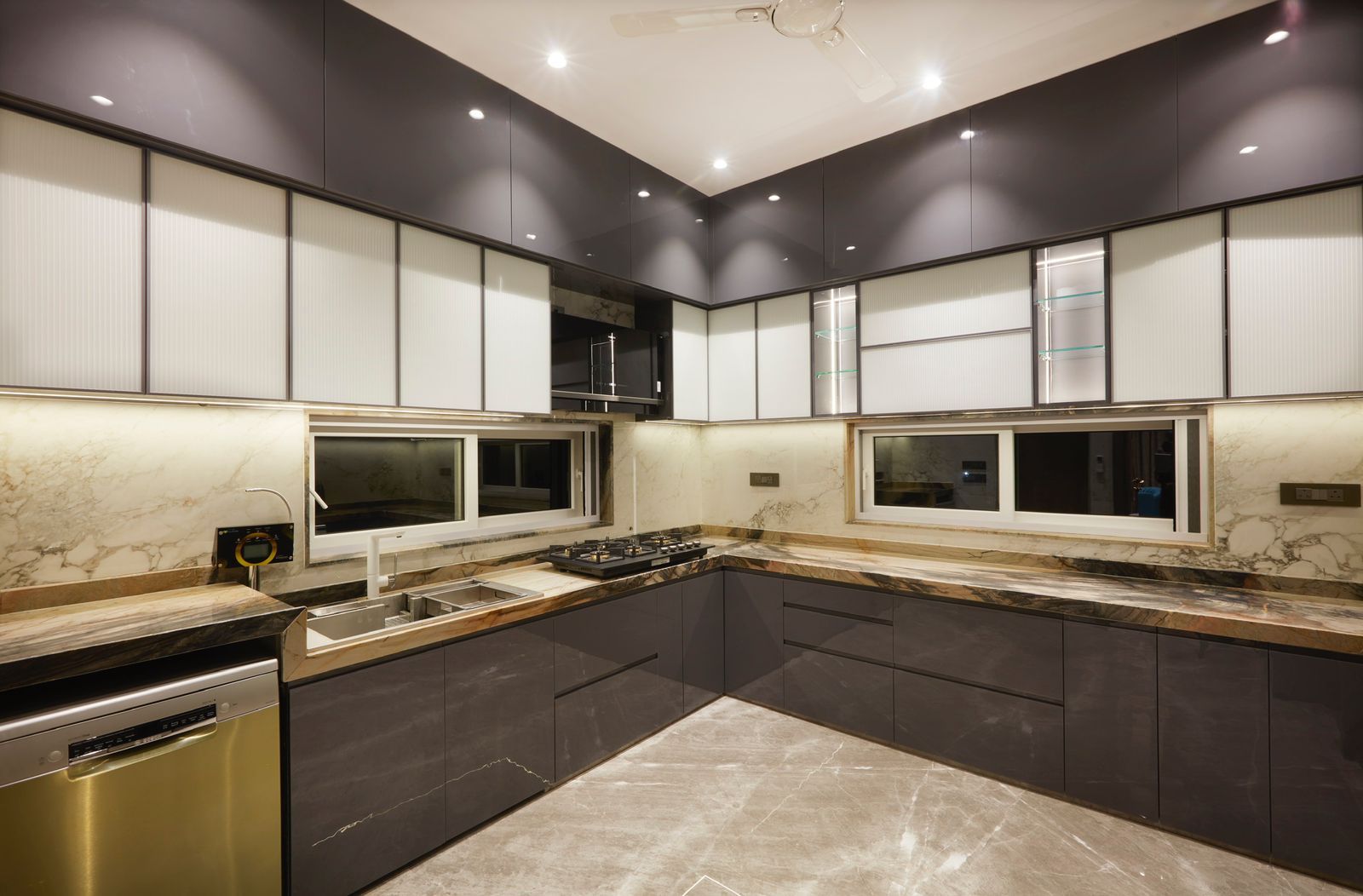
Selected work by Greenbox Design Studio. Tap any image to enlarge.
Frequently asked questions
What size rug for a 3-seater sofa?+
At least the sofa length plus a foot in width, and 5 ft deep with the front legs on the rug. For a standard 88-inch three-seater that means a 9 × 12 ft rug — an 8 × 10 misses the width by about four inches, which is exactly enough for the sofa arm to hang off the edge.
Should all the furniture legs be on the rug?+
It is the most generous arrangement and it needs the biggest rug. Front legs on is the standard compromise and it anchors the group perfectly well. A floating rug with nothing on it is the cheapest option and the one that makes a room look smallest.
What size rug goes under a dining table?+
Table dimensions plus two feet on every side, so a chair pulled out still has all four legs on the rug. For a 72 × 40 in six-seater that is at least 10 × 8 ft. A rug that catches a chair leg on its edge is more annoying than no rug at all.
How much floor should show around a rug?+
Six to eighteen inches at every wall. Less than six and it reads as badly fitted carpet; more than about two feet and the rug stops relating to the room. In a 12 ft wide room a 9 ft rug leaves 18 inches each side, which is close to ideal.
Do I need an underlay under a rug?+
On a vitrified, marble or wooden floor, yes. Without one the rug slides every time somebody walks across it, the corners lift and the edge becomes a trip hazard. A 3 mm anti-slip underlay is about ₹45 per sq ft and it also makes a thin rug feel considerably better underfoot.