
Three Mumbai gym markets
| Market | Typical area | ₹ per sq ft | What governs it |
|---|---|---|---|
| Society clubhouse gym | 500 – 1,800 sq ft | ₹1,700 – 2,400 | Committee budget, podium slab, resident noise, no staff |
| Neighbourhood commercial gym | 2,000 – 5,000 sq ft | ₹1,900 – 2,800 | Upper-floor commercial premises, shared entrance, member parking |
| Boutique studio — yoga, pilates, spin | 800 – 2,500 sq ft | ₹2,100 – 3,200 | Acoustics between studios, small high-street units, high finish expectation |
| Premium club | 6,000 – 15,000 sq ft | ₹2,800 – 3,800 | Grade-A or mall landlord rules, full wet areas, night working |
| Corporate gym in an office fit-out | 400 – 1,500 sq ft | ₹1,900 – 2,900 | Landlord fit-out manual, slab loading in a tower, no shower provision by default |
Ex-GST. Includes flooring, mirrors, ceilings, changing rooms, MEP coordination and finishes. Excludes all fitness equipment.
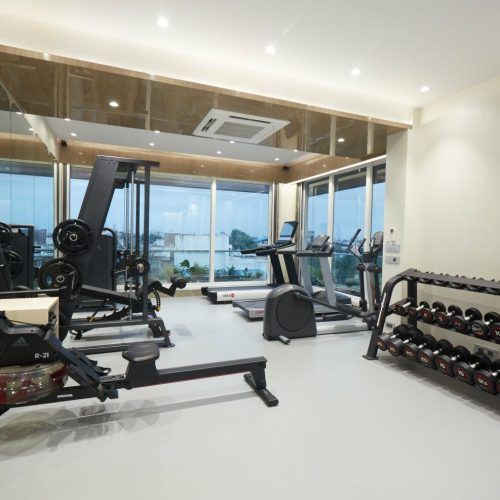
Everything here sits above something else
The slab, and the letter you need
- Get the building’s structural drawings or, where they do not exist, a structural engineer’s assessment. In pre-2000 Mumbai stock the drawings frequently do not exist and an assessment is the only route.
- Establish the permitted imposed load. A residential slab is typically designed for 2 kN/m², an office floor 3–4 and a podium car park 5. A free-weight zone needs 5–7.5, and an Olympic platform 7.5–10 plus impulse.
- Where the slab cannot take it, change the plan, not the specification. Cardio and resistance machines on the upper floor, free weights at podium or ground level. Spreading load with a thicker rubber does not increase slab capacity; it only manages impact.
- Get it in writing on the engineer’s letterhead. The society or landlord will ask for it, and so will your insurer after any incident.
- Beware the concentrated load. A loaded rack transfers most of its weight through four small feet. Spreader plates under racks and platforms are cheap and they matter more than the overall floor rating.
Impact noise, which is what actually gets gyms closed
A 100 kg deadlift dropped on a 20 mm rubber floor generates a structure-borne thud that the flat below hears as clearly as a hammer. This is not solved by carpet, and it is not solved by asking members to be considerate.
- A floating platform is the only real answer. A plywood and rubber sandwich on resilient pads, isolated from the surrounding floor and from the walls, at ₹1,200–₹2,400 per sq ft within the platform. It costs about ₹2.5–4 lakh for a two-platform zone and it is the difference between operating and not.
- Isolate the whole free-weight zone where you can. A resilient layer under the entire zone, turned up at the perimeter so nothing bridges to the wall. A single rigid contact at the edge defeats the whole build-up.
- No fixing through the isolation layer. Racks bolted through a floating floor into the slab transmit everything the isolation was meant to stop.
- Airborne noise is a separate problem. Music and class instruction travel through the slab and the walls, and need mass and a break, not absorption. A spin studio above a flat needs a full isolation build-up on floor, walls and ceiling.
- Fix the hours in writing. Most Mumbai societies will agree 6am to 10pm. Agreeing it up front, with a written noise undertaking, prevents the complaint becoming a general body resolution.
- Measure before and after. A simple before-and-after reading in the flat below, documented, has settled more disputes for our clients than any amount of assurance.
Society clubhouse gyms
A large share of our fitness work in this city is a committee-funded gym in a society clubhouse, and it is a different project from a commercial one. There are no staff, the users are residents who will complain directly, and the budget comes out of a maintenance corpus.
| Issue | Commercial gym | Society clubhouse gym |
|---|---|---|
| Budget source | Operator capital | Maintenance corpus or a one-time levy; scrutinised line by line |
| Supervision | Staffed | Unstaffed — equipment selection must be safe for unsupervised use |
| Free weights | Core of the offer | Often limited to dumbbells; barbell platforms need a committee decision |
| Hours | Commercially set | Fixed by resolution, typically 5:30am to 10pm |
| Changing rooms | Full provision | Usually none — residents come from their flats |
| Ventilation | Mechanical | Frequently a podium room with one openable wall; this is the commonest failure |
| Maintenance | Operator contract | Facility manager; specify finishes that survive with minimal attention |
A society in Powai spent eleven lakh on equipment and forty thousand on ventilation. By March nobody was using the room after seven in the evening because you could not breathe in it.
Greenbox commercial fit-out lead
Water, power and the monsoon
- Water storage for showers. Forty to fifty-five litres per shower at peak, stored, because the municipal supply is timed. A commercial gym with six showers needs meaningful storage and a booster set, and that has to be located before the lease.
- Electrical load. Treadmills, the air conditioning and the ventilation together will exceed a residential or small-commercial sanctioned load. Raising it takes weeks and occasionally a transformer.
- Humidity is the maintenance problem. Four months above 75% relative humidity corrodes plate-loaded equipment, fogs mirrors and makes rubber flooring slippery. Dehumidification, or at least well-designed air movement, is a real line item here.
- Salt air near the coast. In Juhu, Bandra West and Versova, chrome and mild-steel equipment frames pit within two years. Specify coated frames and keep equipment away from open windows on the sea side.
- Monsoon entrance detailing. A recessed mat well of at least 1,800 mm and R11 slip resistance at the entrance and in the changing rooms. A wet gym floor is the highest liability surface in the building.
The engineering fundamentals
Floor loading by zone, flooring rates, ventilation calculations, changing room provision and format rate bands are set out on gym and fitness studio interior design. For related Mumbai formats see salon interior designers in Mumbai, and for society amenity work generally, commercial interior designers in Mumbai.
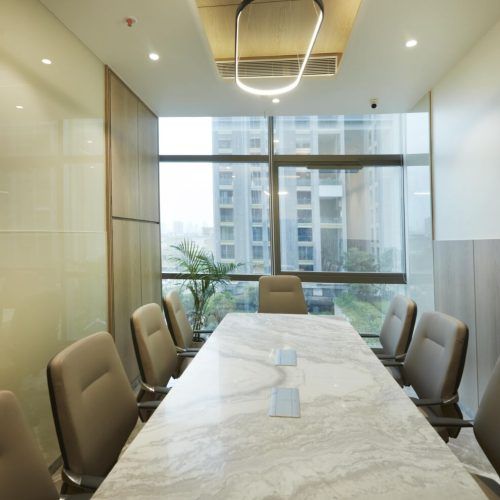
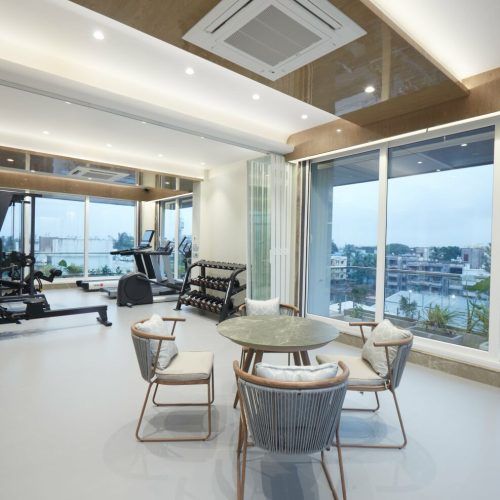
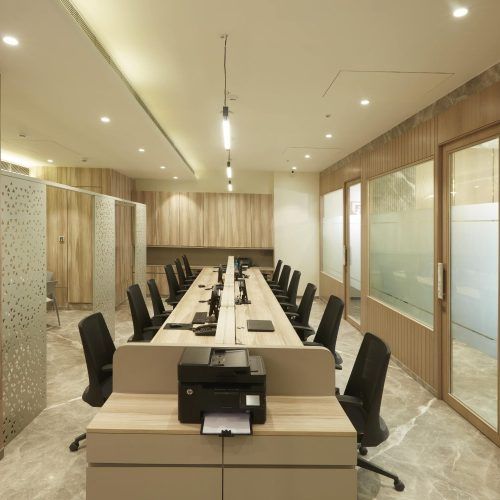
Selected commercial work by Greenbox Design Studio. Tap any image to enlarge.
Frequently asked questions
What does a gym cost to build in Mumbai?+
₹1,700–₹2,400 per sq ft for a society clubhouse gym, ₹1,900–₹2,800 for a neighbourhood commercial gym, ₹2,100–₹3,200 for a boutique studio and ₹2,800–₹3,800 for a premium club. All ex-GST and all excluding fitness equipment.
Can I put free weights on an upper floor in Mumbai?+
Only with a structural engineer's written clearance. A residential slab is typically designed for about 2 kN/m² and an office floor 3–4, while a free-weight zone needs 5–7.5 and an Olympic platform 7.5–10 plus impulse. Where the slab cannot take it, move the free weights to podium or ground level rather than trying to spread the load with thicker rubber.
How do I stop the flat below hearing dropped weights?+
A floating platform — plywood and rubber on resilient pads, isolated from the surrounding floor and the walls — at ₹1,200–₹2,400 per sq ft within the platform. Nothing may bridge the isolation, including rack bolts. A two-platform zone costs roughly ₹2.5–4 lakh and is the difference between a gym that keeps operating and one that does not.
What is different about a society clubhouse gym?+
It is unstaffed, so the equipment has to be safe for unsupervised use; the budget comes from a maintenance corpus and is scrutinised line by line; hours are fixed by resolution, usually around 5:30am to 10pm; there are generally no changing rooms; and ventilation in a podium room is the single most common failure.
Does the monsoon affect a Mumbai gym?+
Yes, in three ways. Four months above 75% relative humidity corrodes plate-loaded equipment and fogs mirrors, so dehumidification or strong air movement is a real line item. Rubber flooring becomes slippery when damp, so R11 slip resistance and a 1,800 mm recessed mat well at the entrance matter. And near the coast, chrome and mild-steel frames pit within two years.
What hours will a society allow a gym to operate?+
Typically 6am to 10pm, sometimes from 5:30am. Agree it in writing at the start along with a noise undertaking, and take a before-and-after sound reading in the flat below once the isolation is built. Documented measurements have settled far more disputes for our clients than assurances have.