
Rates by what the slab is doing
| Slab condition | Where | What the frame has to do | ₹ per sq ft |
|---|---|---|---|
| Level within 10 mm | Post-2010 towers and possessions | Standard suspension at 600 mm centres | ₹115 – 140 |
| 10 – 25 mm out | 1990s and 2000s stock | Adjusted hanger lengths; a levelling survey first | ₹135 – 160 |
| 25 – 50 mm out | 1960s–70s colony blocks | Deeper void, more hangers, levelling across the room | ₹155 – 180 |
| Uneven with exposed conduit and old fixings | Oldest colony stock | Clearing and making good before framing | ₹170 – 195 |
| Beam-heavy, low soffit | Any era, but common in the older blocks | Ceiling designed around the beam rather than under it | ₹145 – 175 |
Ex-GST, per square foot of ceiling area. Excludes light fittings. Every quotation here follows a laser-level survey.
What an out-of-level slab actually costs you
If a slab drops 40 millimetres across a living room and the ceiling is hung to a fixed drop from the slab, the finished ceiling slopes by 40 millimetres too — invisible in a photograph and painfully obvious against a straight curtain track or a door head. Hanging it level instead means the void is 40 millimetres deeper at one end, more hangers are needed, and the perimeter detail has to absorb the difference where the ceiling meets the wall. That is the work the higher rate pays for. It is also why we laser-level the room before quoting rather than after: a rate quoted from a floor plan in this stock is an estimate that will be revised, and the revision is never downward.
Level the ceiling, not the slab
Worked example: 380 sq ft of ceiling in a 720 sq ft flat
A redevelopment possession with a level slab. Ceiling in the living and dining area and the passage only; the bedrooms keep the 2.85 metre slab painted. Simple cove detail, no deep profiles.
| Scope | ₹ lakh | Note |
|---|---|---|
| Slab preparation and levelling survey | 0.06 | Laser survey; old fixings cleared; soffit made good |
| Frame and suspension | 0.14 | Galvanised sections at 600 mm centres |
| Board and finishing | 0.19 | Standard board; two-coat jointing and sanding |
| Cove detail | 0.09 | Continuous cove around the living and dining area |
| Access panels | 0.02 | At the split unit drain crossing |
| Painting | 0.07 | Two coats over primer, washable emulsion |
| Total, ex-GST | 0.57 | ₹150 per sq ft of ceiling |
Add 18% GST. Excludes light fittings. On a 1968 colony flat of the same area, the levelling and preparation line alone would be ₹18,000–₹26,000 rather than ₹6,000.
Why we avoid deep coffers on the refinery side
The fine particulate that settles across the Mahul and Vashi Naka side of Chembur settles on horizontal surfaces, and a ceiling with deep coffers, wide steps or exposed ledges collects it at precisely the height nobody can reach. Within a year those surfaces read as grey. The design response is straightforward: keep the ceiling planes shallow and the steps narrow, avoid ledges deeper than about 100 millimetres, and use cove lighting that throws upward off a plain surface rather than a stepped one with a shelf. It is not a restriction on doing something good — a clean stepped ceiling with a continuous profile light is a better room than a coffered one anyway — but the reason for the choice is practical and worth knowing.
Two other Chembur notes
- Washable paint on the ceiling too. Not just the walls. A ceiling in this suburb is wiped more often than in most, and a standard emulsion will burnish where it is cleaned, leaving a patch. A washable finish costs a few hundred rupees more on a flat and does not.
- Check the slab above before closing it. In the older colony blocks the flat above often has original plumbing, and the first sign of a failing joint is a stain on your new ceiling. We look for existing stains, tap for dampness and, where there is any doubt, suggest the ceiling waits until the neighbour's bathroom has been inspected. It is an awkward conversation and it is cheaper than the alternative.
One further point about the old stock. Where a 1960s slab is badly out of level, there is a cheaper answer than a deep-void level ceiling and it is sometimes the right one: skip the ceiling, repair and skim the slab soffit, and light the room with pendants, wall lights and a track. A properly repaired and painted slab in a 2.9 metre room looks considerably better than a low ceiling hung to hide it, and it costs ₹45 to ₹70 per square foot instead of ₹155 to ₹180. We offer that comparison on every old-stock survey.
For the suburb as a whole, see interior designers in Chembur. For board systems, materials and city-wide rates, see false ceiling designers in Mumbai.
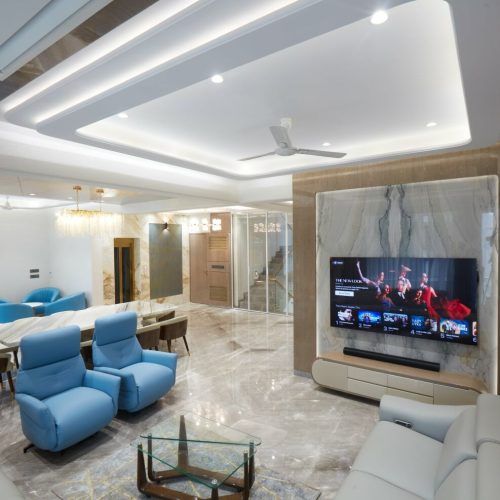
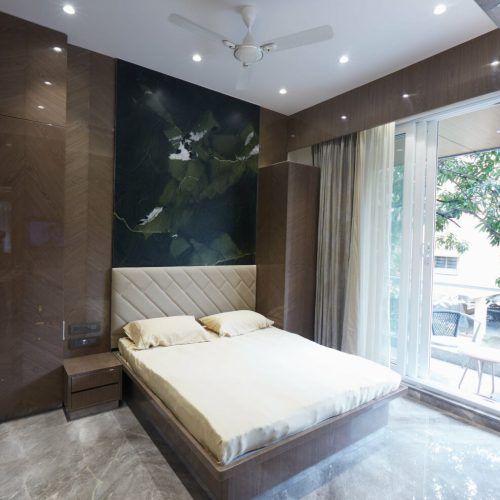
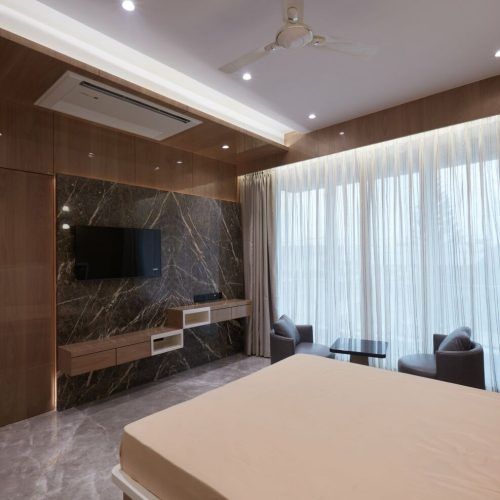
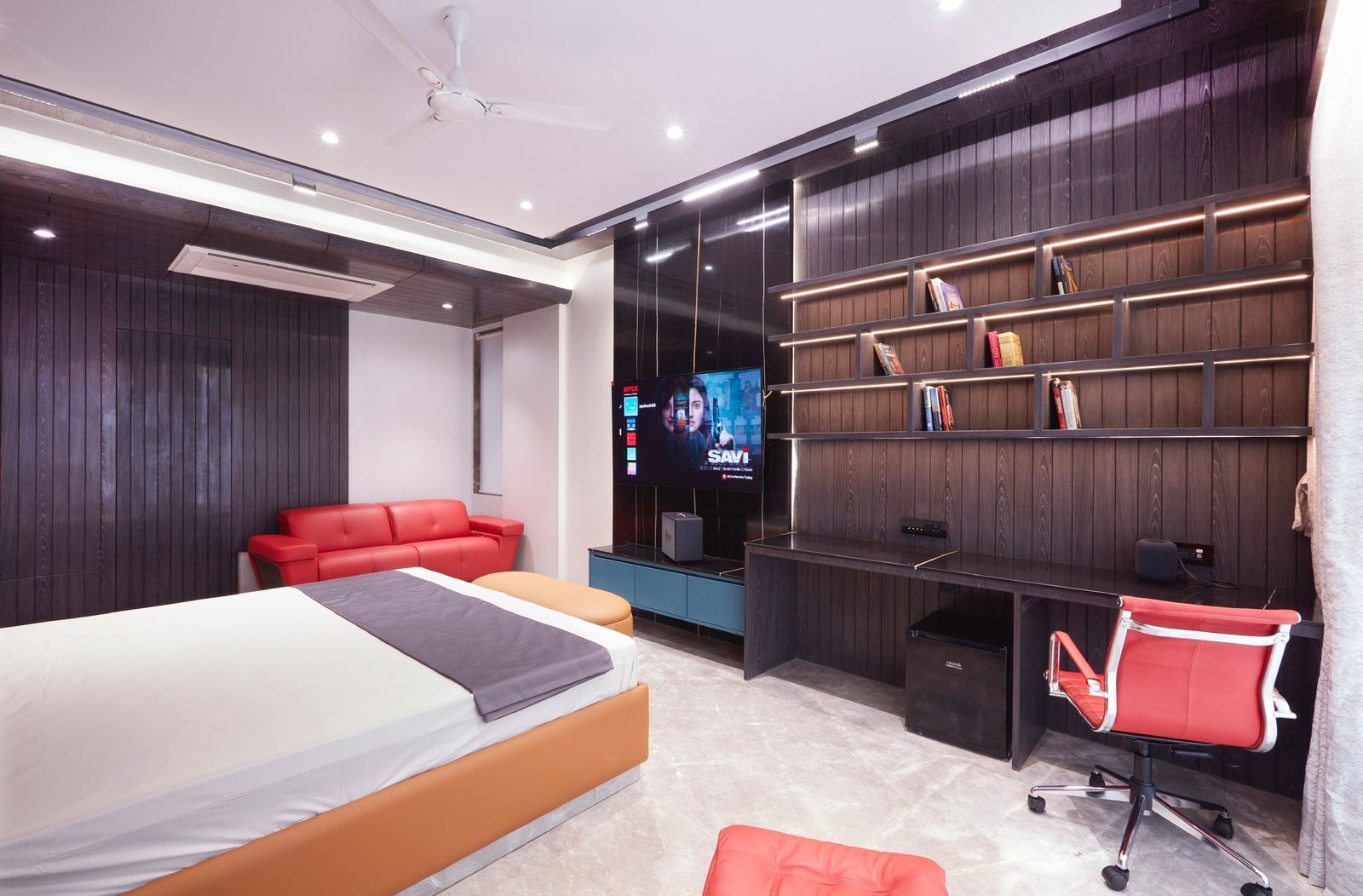
Ceiling and lighting work by Greenbox Design Studio.
Frequently asked questions
Why does an old slab cost more to ceiling?+
Because a 1960s slab can be 25–50 mm out of level across a room. Hanging the ceiling level means a deeper void at one end, more hangers and a perimeter detail that absorbs the difference. Hanging it parallel to the slab is cheaper and produces a visibly sloping ceiling against your curtain track.
Should we avoid coffered ceilings in Chembur?+
On the refinery side, yes. Deep coffers, wide steps and ledges collect the airborne deposit at a height nobody can reach, and within a year they read as grey. Shallow planes, narrow steps, no ledge deeper than about 100 mm, and cove light thrown off a plain surface. It is also, in our view, the better-looking answer.
Is a possession flat easier?+
For the ceiling itself, yes — the slab is level and the work is straightforward. What a possession flat costs you is elsewhere: stripping out the builder platform, one bathroom and any loose flooring, typically ₹45,000–₹70,000 on a 700 square foot flat, which is not a ceiling cost but does belong in the same budget.
What if the flat above has old plumbing?+
Then your new ceiling is the place their leak will appear. We look for existing stains and tap for dampness, and where there is real doubt we suggest waiting until the neighbour's bathroom has been inspected. It is an awkward conversation and it is a great deal cheaper than opening a finished ceiling.
Do you use POP or gypsum board?+
Board on a galvanised frame for anything flat or stepped, because it is dimensionally stable, dry to install and repairable in a panel. POP still has a place for curved and moulded detail where board cannot go. What we would not do is a full POP ceiling over a large area in this stock, where slab movement and humidity together produce hairline cracking.