

The discipline that makes it contemporary
The difference between an Indian contemporary interior and a themed one is arithmetic, not taste. A modern shell — plain walls, clean joinery, simple ceiling — carrying one substantial crafted element per room reads as contemporary with depth. The same shell carrying a jaali screen, a carved console, brass inlay, a Madhubani painting, block-printed curtains and a temple bell in the same room reads as a hotel lobby. Each element is beautiful; the problem is density.
So the planning rule we use is one element per room, sized large enough to be a decision rather than an accessory. A 1,200 x 2,100 mm jaali screen between the living and dining is an element. A 300 mm jaali panel set into a wardrobe door is an accessory, and three accessories do not add up to one element.
The craft vocabulary, with prices
| Element | What it is | 2026 cost | Where it belongs | Sourcing note |
|---|---|---|---|---|
| MDF / WPC CNC jaali | Machine-cut lattice | ₹1,400–₹2,400 / sq ft | Partition, shutter face, balcony screen | Fast, uniform, reads as modern |
| Carved teak jaali | Hand-carved hardwood | ₹2,800–₹4,500 / sq ft | One feature screen only | Jodhpur and Saharanpur workshops; 6–10 weeks |
| Brass inlay in timber | Strip or pattern set into wood | ₹900–₹2,600 / sq ft of panel | Headboard, console top, door | Ask whether lacquered or left to patina |
| Athangudi tile | Handmade cement tile, Tamil Nadu | ₹240–₹480 / sq ft laid | One floor: entry, pooja, balcony | 12–16 week lead; order 12% extra |
| Kota / Jaisalmer stone | Quarried Indian stone | ₹180–₹420 / sq ft laid | Floors, counters, window sills | Honed finish, not polished |
| Handloom textile | Khadi, ikat, mangalgiri, block print | ₹900–₹4,000 / m | Curtains, cushions, upholstery | The cheapest authentic entry point |
| Carved reclaimed teak door | Salvaged and restored | ₹45,000–₹2,20,000 | Main door or one internal door | Mumbai salvage yards; treat for borer |
| Terracotta and studio pottery | Handmade vessels | ₹1,500–₹25,000 each | Grouped, one cluster per room | Buy three, not eleven |
Design and build under one accountable roof
Jaali: getting it right
The jaali is the element most often used and most often misused. Its original function was environmental — filtering light and moving air while providing privacy — and it works best in a flat when it is still doing one of those jobs rather than merely decorating a surface. A jaali as a partition between living and dining, filtering light from one to the other, is doing its work. A jaali panel glued to a flat wall is a pattern.
- Use it where light passes through it. A screen with a window or a lit space behind it casts the pattern into the room, which is the entire point.
- Scale the aperture to the distance. Openings of 40–70 mm read well at 2–3 m; a fine 15 mm lattice becomes a grey blur from across a room and costs far more to cut.
- Choose the material honestly. CNC-cut MDF is a modern material making a traditional pattern, and that is a legitimate choice. Do not finish it to imitate carved teak; it will not convince anyone.
- Consider the cleaning. A jaali has an enormous surface area and collects Mumbai dust in every aperture. Specify one that can be vacuumed with a brush head, and avoid deep undercut carving in a high-dust position.
- Backlight it or do not. Uplighting or grazing a jaali from 100 mm away transforms it. Flat frontal light flattens it to wallpaper.
Brass, and what humidity does to it
Brass is the signature metal of the style and it behaves in a way clients are rarely warned about. Unlacquered brass in Mumbai's humidity develops a patina within weeks — first a deepening of tone, then darker areas where hands touch it. Many people love this; others are dismayed by it. The decision has to be made at specification, because lacquering after the fact requires stripping the piece.
Lacquered brass keeps its bright finish for three to six years indoors, then the lacquer begins to fail unevenly, which looks worse than an honest patina. PVD-coated brass-finish hardware holds for ten years or more but never develops the depth of real metal. For handles and taps that are touched daily we usually recommend either PVD for permanence or unlacquered for character, and advise against lacquered brass in high-touch positions.
A costed room
| Element | Specification | Cost |
|---|---|---|
| Base joinery, living room | Plain, flush, matte laminate, 110 sq ft shutter | ₹1,98,000 |
| Jaali partition | 1,200 x 2,100 mm CNC in solid ash | ₹58,000 |
| Handloom curtains | Two windows, mangalgiri cotton | ₹42,000 |
| Kota stone console top | 1,500 x 450 mm honed | ₹18,000 |
| Studio pottery cluster | Three pieces | ₹16,000 |
| Lighting including jaali grazer | Layered, 2700 K | ₹62,000 |
| Total, living room | — | ₹3,94,000 |
The craft content is ₹1,34,000 of ₹3,94,000 — about a third. Above roughly 40%, the room starts to read as themed.
Lead times and sourcing
Craft elements do not behave like catalogue products, and the commonest way an Indian contemporary scheme gets diluted is that the hand-made pieces were ordered too late and were substituted with machine equivalents to hold the handover date. Athangudi tiles take twelve to sixteen weeks and arrive with dimensional variation that the tiler must be warned about. Carved teak from Saharanpur takes six to ten weeks and needs a sample panel approved first. Handloom fabric is woven in runs and a repeat order months later will not match the first.
Order the craft elements in the first two weeks of the project, before the joinery drawings are even finalised, and design the built work around what arrives. That is the reverse of the normal sequence and it is the only way the elements that define the style actually make it into the finished flat.
Sourcing directly from a craft cluster is cheaper than buying through a Mumbai retailer and considerably harder. You are dealing with a workshop rather than a shop: there is no catalogue, dimensions are agreed by drawing and photograph, payment is usually substantially in advance, and freight to Mumbai is your problem. For a single significant piece the saving of 30–45% is worth the effort. For a scheme with several elements, working through a studio that already has those relationships removes a category of risk that clients consistently underestimate — the carved screen that arrives 40 mm narrow, six weeks before handover, with no time to remake it.
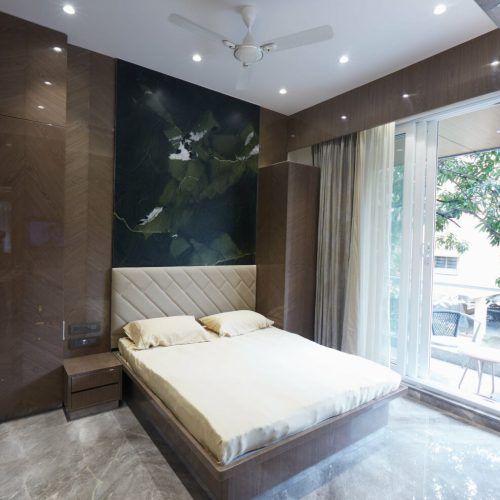
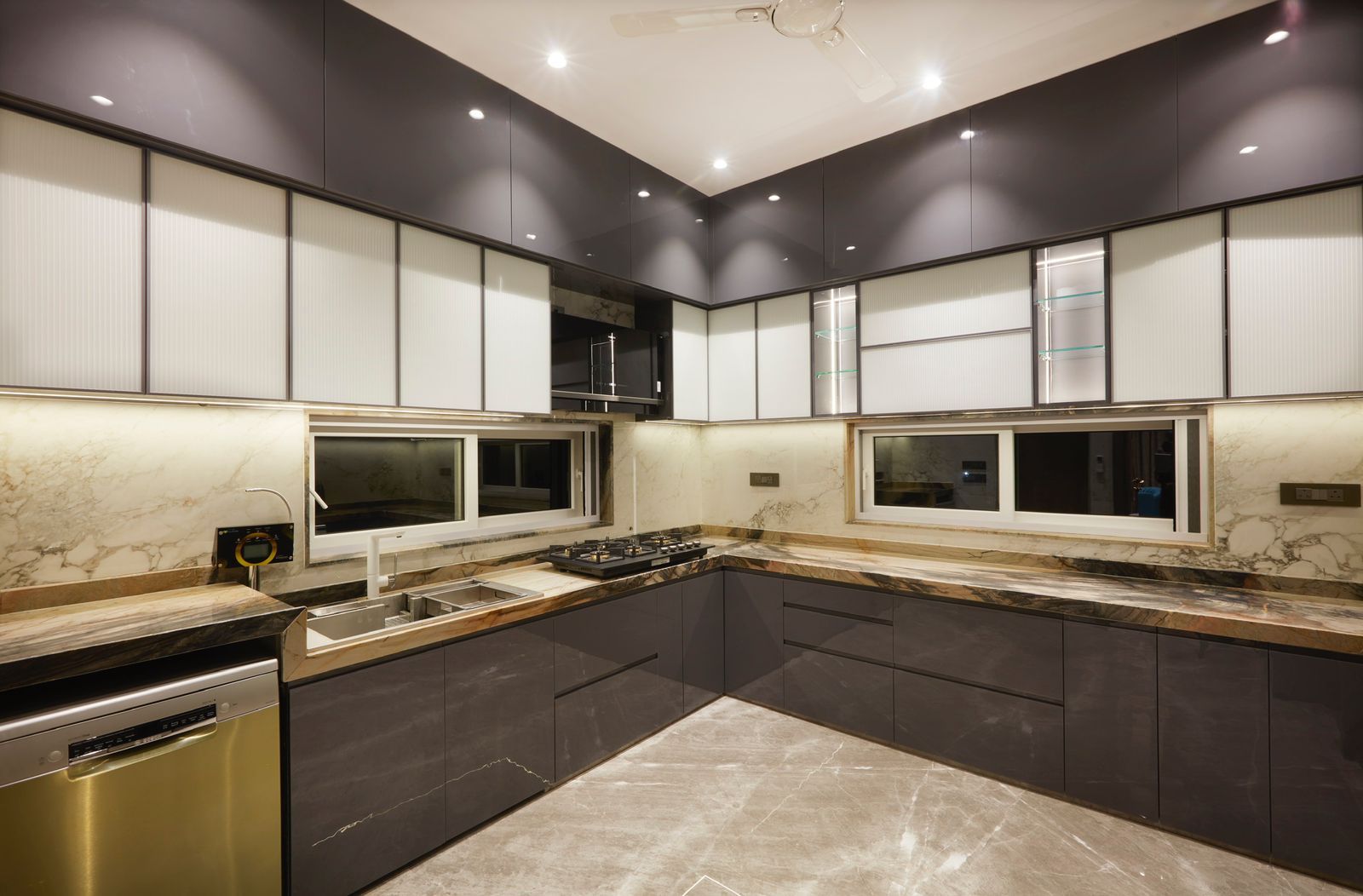
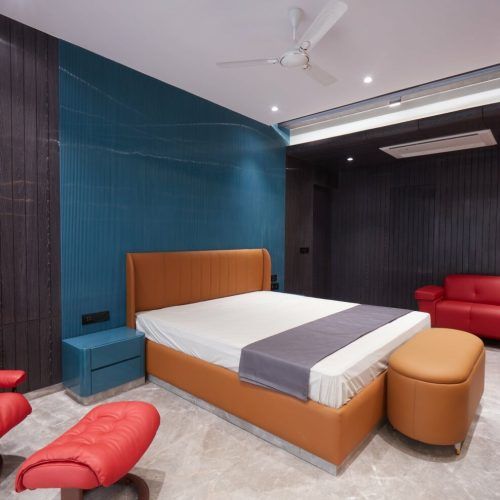

Selected work by Greenbox Design Studio. Tap any image to enlarge.
Frequently asked questions
What is Indian contemporary style?+
A restrained modern interior — plain walls, clean joinery, simple ceilings — carrying a small number of genuinely crafted Indian elements at a meaningful scale: a jaali screen, brass inlay, handloom textiles, Athangudi or Kota stone. The restraint is what keeps it contemporary rather than traditional or themed.
How much does a jaali screen cost?+
₹1,400–₹2,400 per sq ft for CNC-cut MDF or WPC, and ₹2,800–₹4,500 per sq ft for hand-carved hardwood. A 1,200 x 2,100 mm partition therefore runs ₹35,000–₹60,000 machine-cut, or ₹70,000–₹1,15,000 hand-carved, ex-GST, with a six to ten week lead time on the carved version.
Will brass tarnish in Mumbai?+
Unlacquered brass develops a patina within weeks in Mumbai humidity, deepening in tone and darkening where it is handled. Lacquered brass stays bright for three to six years and then fails unevenly. PVD-coated brass-finish hardware holds for a decade. Decide which you want at specification stage — it cannot be changed later without stripping.
How do I avoid it looking like a theme restaurant?+
One substantial craft element per room, and keep the craft content under about 40% of the room's budget. The shell stays plain and modern. Two or three crafted elements in one room, each competing for attention, is precisely the failure mode, and it is more common in expensive projects than in modest ones.
Where can I source authentic craft elements?+
Jodhpur and Saharanpur for carved teak, Karaikudi in Tamil Nadu for Athangudi tiles, Kota and Jaisalmer for stone, and handloom clusters across Andhra Pradesh, Telangana and Gujarat for textiles. Lead times run six to sixteen weeks, so these must be ordered at the start of a project rather than during finishing.
What does an Indian contemporary flat cost?+
₹12–₹22 lakh ex-GST for a 720 sq ft 2BHK in Mumbai in 2026. The base interior is priced like any mid-to-upper scheme; the craft elements add roughly ₹2.5–₹6 lakh depending on whether you use machine-cut or hand-made work and how many rooms carry an element.